By submitting, you consent to our use of your data. Privacy Policy.
Category
The AI World
Share the article
The enterprise AI landscape just experienced its most dramatic shift yet. New research from Menlo Ventures reveals that 76% of enterprise AI use cases are now purchased rather than built internally, a complete reversal from 2024, when the split was 47% built vs 53% purchased. This seismic shift represents more than changing preferences; it signals the maturation of the enterprise AI market and the hard-learned lessons from hundreds of failed internal AI projects.
As companies collectively spent $37 billion on generative AI in 2025 (up 3.2x from 2024), the data tells a clear story: the era of custom AI development is ending, and the platform era has begun.
The numbers don't lie: Enterprise AI's strategic reversal
From build-first to buy-first in 12 months
The transformation happened faster than anyone predicted. According to the latest enterprise spending analysis, the build vs buy ratio for AI solutions has completely flipped:
2024: 47% built internally, 53% purchased
2025: 24% built internally, 76% purchased
The $37 billion reality check
Enterprise generative AI spending reached $37 billion in 2025, representing more than 6% of the entire software market achieved within just three years of ChatGPT's launch. But here's the crucial insight: most of this spending went to applications and platforms, not custom development.
The message from enterprise buyers is clear: speed to value trumps perfect customization.
Why custom AI development lost its enterprise appeal
The hidden costs that killed custom development
What started as "we'll build it ourselves" enthusiasm quickly turned into budget nightmares. Enterprise teams discovered that custom AI development carries costs far beyond the initial build:
Development Costs: $100,000 to $500,000+ for enterprise-grade solutions
Ongoing Maintenance: $5,000-$20,000 monthly for enterprise AI systems
Compliance & Security: $10,000-$100,000 annually in regulated industries
Technical Debt: 65% of total costs materialize after deployment
But the real killer wasn't financial; it was time

The time-to-value problem
McKinsey's latest research shows that while 23% of organizations are scaling agentic AI systems and 39% are experimenting with AI agents, most custom-built solutions never make it past the pilot stage. Internal builds that promised 6-month delivery timelines stretched into multi-year projects, while off-the-shelf solutions delivered value in weeks.
Consider this: 50% of developers now use AI coding tools daily, but these are predominantly platforms like GitHub Copilot and Claude Code, not custom-built internal tools.
The integration complexity wall
Perhaps the most underestimated challenge was integration complexity. Enterprises discovered that 60% of AI development time was consumed by connecting systems, managing APIs, and ensuring data flow, work that modern AI platforms handle automatically.
As one Fortune 500 CTO put it:
"We thought we were building AI. We were actually building plumbing."
The platform advantage: Why buying became winning
Speed to market transformed decision-making
The competitive advantages of AI platforms became undeniable:
Deployment Speed: Days vs months for implementation
Pre-built Integrations: 1500+ connectors vs custom API development
Automatic Updates: Continuous improvement vs manual maintenance
Proven Reliability: Battle-tested at scale vs untested custom code
The security and compliance game-changer
With 59.9% of AI/ML transactions being blocked due to security concerns, enterprises needed solutions with built-in governance. Leading AI platforms now include:
Enterprise-grade security by default
Compliance frameworks for GDPR, HIPAA, and SOX
Audit trails and monitoring capabilities
Role-based access controls
Building these capabilities internally requires specialized security expertise that most enterprises lack.
Multi-agent systems: The complexity breaking point
The rise of multi-agent AI systems, where multiple specialized agents collaborate on complex workflows, proved to be the final nail in the coffin for custom development.
Google's recent launch of Gemini 2.0 "for the agentic era" demonstrates the sophistication required for modern AI systems. These aren't simple chatbots; they're orchestrated intelligence networks that require:
Advanced reasoning capabilities
Native tool integration
Multi-modal processing (text, voice, image, video)
Real-time learning and adaptation
The barrier to entry for building these systems is now so high that even tech giants struggle with implementation complexity.
When building AI still makes sense (Spoiler: rarely)
The 24% exception: Where custom development survives
While the vast majority of enterprises have moved to purchased solutions, custom development still makes sense in specific scenarios:
Unique Competitive Advantage: Proprietary algorithms that define your business model
Extreme Compliance Requirements: Highly regulated industries with unique constraints
Legacy System Dependencies: Deep integration with irreplaceable legacy infrastructure
Unlimited Budgets: Organizations with significant AI research divisions
The hybrid approach: Best of both worlds
Smart enterprises aren't choosing between build or buy, they're choosing build WITH buy. Modern AI platforms offer:
White-label deployment options
API-first architecture for customization
Open-source compatibility
This hybrid approach delivers the speed of platforms with the flexibility of custom solutions.
The neterprise AI procurement revolution
From IT projects to strategic initiatives
AI procurement has evolved from technical decisions to strategic imperatives. 64% of procurement executives expect generative AI to fundamentally change their operations within five years.
The new evaluation criteria prioritize:
Time to Value: Weeks, not months
Total Cost of Ownership: Including hidden costs
Scalability: From pilot to enterprise-wide deployment
Integration Ecosystem: Pre-built connectors and APIs
Governance Capabilities: Security, compliance, and auditability
The platform selection framework
Leading enterprises now use structured frameworks for AI platform evaluation:
Technical Requirements:
Multi-agent workflow support
Enterprise integration capabilities
Real-time monitoring and analytics
Scalable infrastructure
Business Requirements:
Rapid deployment timelines
Predictable pricing models
Training and support programs
Compliance certifications
The future: Platform-first AI strategy
Why this trend will accelerate
Several factors ensure the build-to-buy shift will continue:
Model Complexity: Frontier AI models require massive infrastructure investments
Integration Demands: Modern workflows require 10+ system connections
Regulatory Pressure: Compliance requirements favor proven platforms
Talent Scarcity: AI expertise is too expensive and rare to scale internally
The winner's playbook
Enterprises winning with AI share common strategies:
Start with Platforms: Evaluate proven solutions before considering custom development
Focus on Integration: Prioritize solutions that connect existing systems
Plan for Scale: Choose platforms that grow with your organization
Invest in Training: Success depends on user adoption, not just technology
Taking action: Your AI platform strategy
Step 1: Audit your current AI initiatives
Before making new decisions, evaluate existing projects:
Which custom builds are stalled or over budget?
What integration challenges are blocking progress?
How much development time is spent on non-AI tasks?
Step 2: Define your platform requirements
Create a structured evaluation framework:
Must-have capabilities for your industry
Integration requirements for existing systems
Compliance standards for your organization
Scalability needs for future growth
Step 3: Evaluate leading platforms
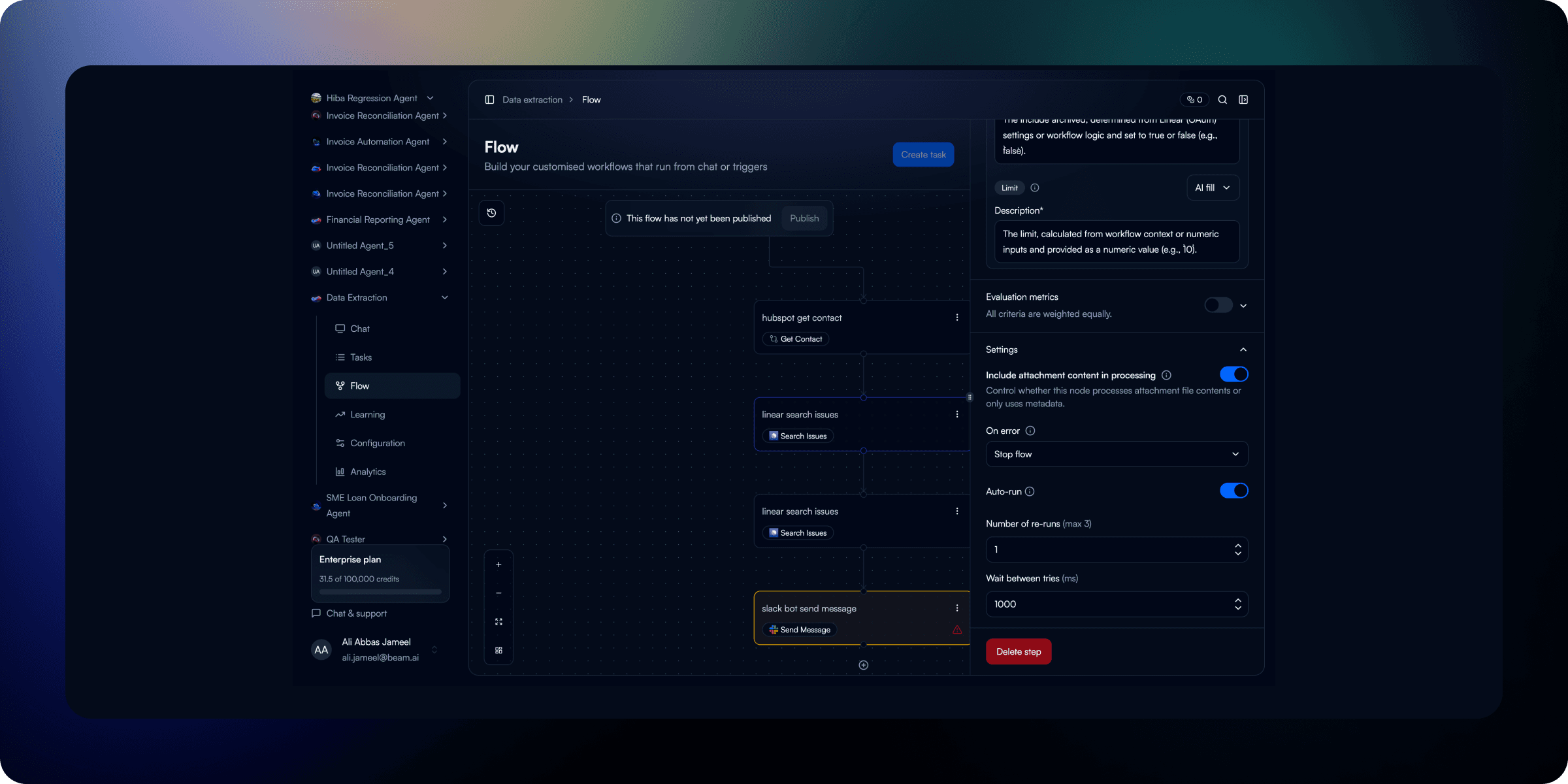
Don't build what you can buy. Leading AI agent platforms like Beam AI offer:
Visual workflow builders for non-technical users
Conclusion: Embrace the platform era
The enterprise AI build vs buy decision is no longer a debate, the data has decided. With 76% of organizations now purchasing AI solutions and $37 billion in enterprise AI spending flowing to platforms and applications, the message is clear: the future belongs to those who can implement AI fastest, not those who build it from scratch.
The organizations winning with AI aren't the ones with the biggest development teams. They're the ones with the best platform strategies.
Ready to join the 76%? Explore Beam AI's enterprise platform and see how leading companies are deploying AI agents in days, not months. Start with our template gallery and pre-built integrations to accelerate your AI transformation.