AI agents
AI Agents: A Human-Like Workforce for Your Organization
AI agents are versatile problem solvers that learn and improve over time. Their goal oriented approach allows them to tackle even the most complex and dynamic workflows.

Agentic automation
Intelligently automate anything you can imagine
Agents fuse powerful tools, integrations, databases, external triggers, in addition to an assigned character, to execute complex workflows for you.


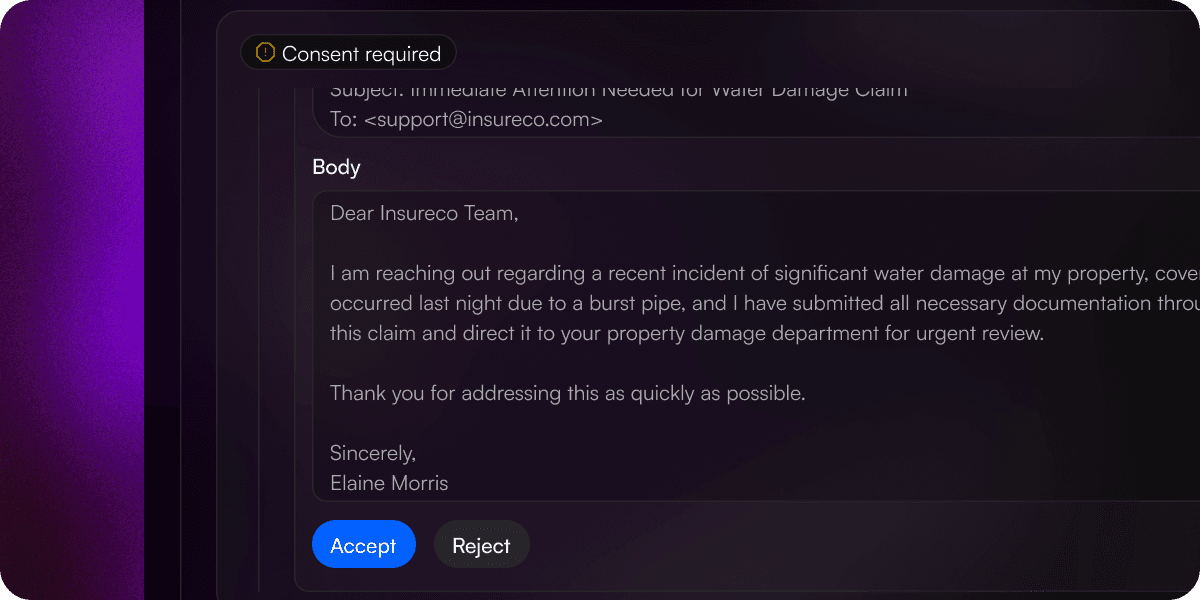
General problem solver
AI Agents are intelligent, not because they're fine tuned to respond perfectly, but because of the human-like logic they apply to task-execution. They are capable of offering solutions to even the most complex challenges swiftly. Their ability to process information rapidly allows them to find solutions to these issues within seconds, demonstrating a remarkable proficiency in critical thinking and problem-solving.
Goal oriented
Highly adaptable
Improves over time
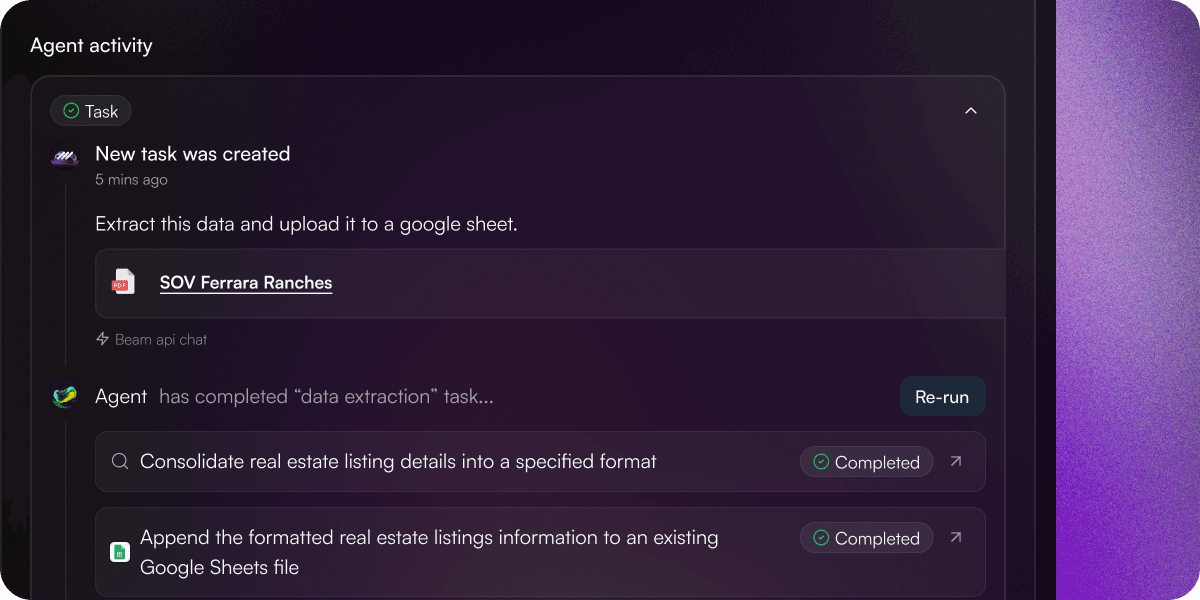
Intelligent task planning
Our agents excel in managing the automation of any workflow that comes in, all the way to planning and executing the task, ensuring you have comprehensive support across the board. Their expertise spans a wide array of tasks, allowing them to adeptly navigate everything from streamlining incoming orders to meticulously addressing insurance claims.
Break Down Complexity
End-to-End Automation
Versatile Expertise

Agentic workflow execution
Get things done the 'Agentic' way and experience unmatched speed that leaves traditional methods in the dust, thanks to our powerful autonomous agents. These agents use the latest technology to handle tasks with incredible agility and precision, making your workflow smoother and more efficient than ever.
Reduce Errors
Increase Quality
Lower Costs
Integrations, tools & triggers
Agents leverage a dynamic combination of Tools, Integrations, and external Triggers, all underpinned by an Agent Memory, to flawlessly execute workflows. This approach integrates the use of cutting-edge software tools with seamless system integrations and responsiveness to external triggers, ensuring adaptability in task management.
Use Existing Tools
Intelligent Triggers
Fully Customizable
See all integrations

Agent character
Tailor the agent's persona to align with your organization's specific communication practices for every scenario. Whether you aim for a tone that's friendly, professional, or empathetic, you can customize the agent's character to seamlessly integrate with your team's approach. This personalization allows the agent to engage with your audience in a manner that's most appropriate.
Customizable Persona
Library of Styles
Audience Dependant

Use templates or create in seconds
Jump right in with our ready-made templates or let your imagination run wild by creating something new in just seconds. Whether you’re in a hurry and need a quick solution or want to build something from scratch to fit your exact needs, you have the freedom to choose. Our easy-to-use tools make it simple to get things done the way you want.
Start in Minutes
Pre-made Selection
Use-case Specific
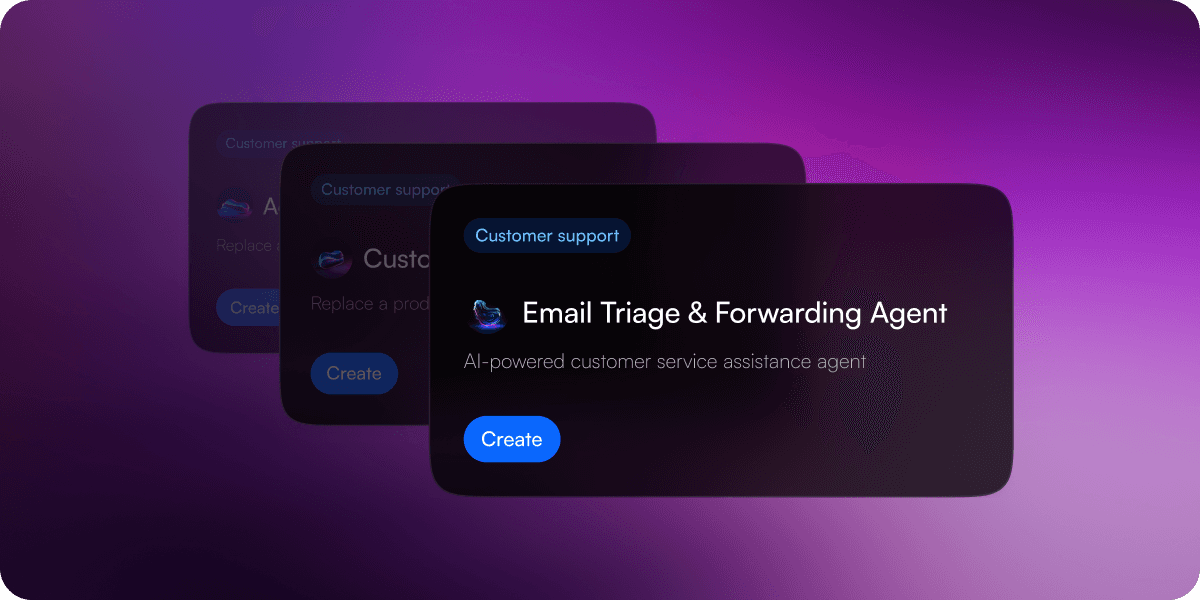
Learning agent
Agents continuously improve in both understanding and executing tasks the more they interact with you. With every task they complete, they take a step further in augmenting their intelligence. This process of incremental learning allows agents to refine their capabilities over time, adapting to your specific preferences with increasing accuracy.
Instant Feedback
Improves Over Time
Learns at Scale

Human in the loop
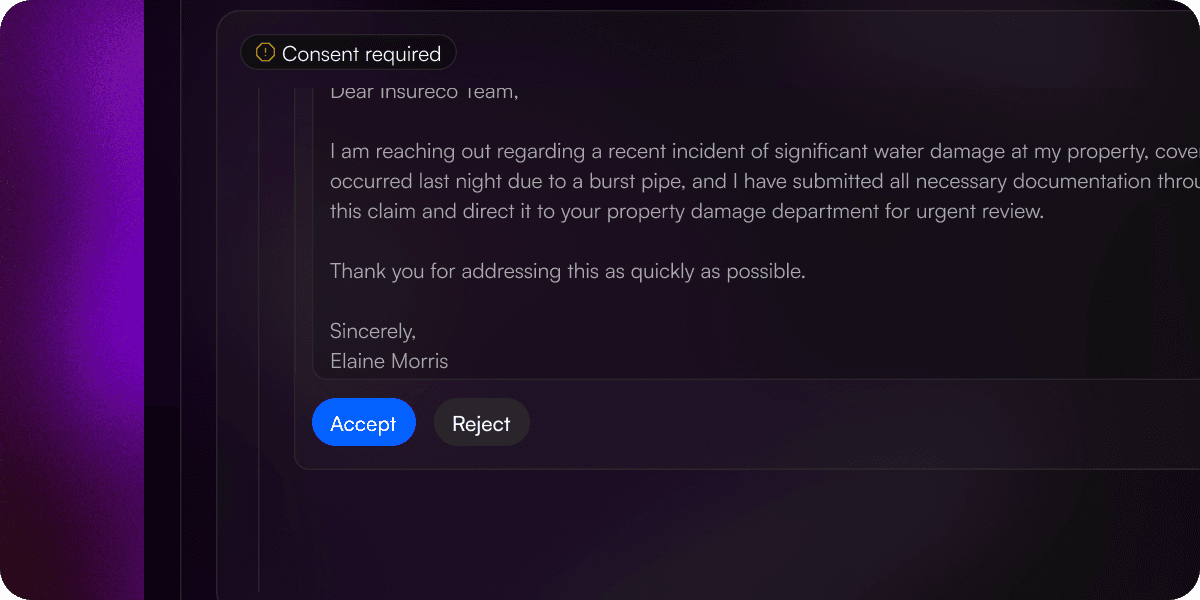
Work together with AI and human expertise to boost both speed and quality. This collaboration combines the creativity and insight of human minds with the fast, efficient execution of AI, making your projects more effective and dynamic.
AI Companion
Human in Control
Transparent Execution
Customizable deployment
Deploy your solutions either on-premises or in the cloud; our platform is designed to support your organization in smoothly integrating agents into your ecosystem, regardless of your preferred infrastructure. We offer flexible deployment options to ensure that our agents can adapt to your specific technological environment.
Custom solutions
Cloud
On premise

Security & privacy
We place paramount importance on your privacy and security. With a commitment to ensuring your data remains localized, we implement stringent measures to safeguard your information. Our agents are built to ensure that your data is protected against unauthorized access at all times.
Enterprise Grade
EU-hosted
SOC 2

FAQ
Frequently asked questions
Learn the answers to common questions about our AI solutions, tools, and services, helping you understand how they can benefit your business and streamline operations.
How can one platform unify all AI tools for business optimization?
Beam AI offers a comprehensive platform to create, deploy, and manage Autonomous AI agents tailored to specific business objectives, whether for marketing, software development, or healthcare. Our Agents are custom and adapt to every field!
Learn more about what else Beam AI offers!
What’s the practical definition of AI agents?
A working AI agent definition is: a goal-driven software entity that perceives context, reasons about options, and acts through tools to achieve outcomes autonomously. Key characteristics include:
Autonomy: Operates without constant supervision to meet targets
Reasoning & planning: Analyze context, decompose tasks, and choose the best path
Learning & adaptation: Improve from data, feedback, and outcomes over time
Multimodal input: Understands text, audio, images, and structured data
Goal orientation: Align actions with business outcomes and measurable SLAs
How do AI agents work?
AI agents are intelligent software programs that perform tasks autonomously based on predefined rules and machine learning algorithms. They can handle repetitive tasks, process large volumes of data, and provide actionable insights to support business process automation. With the right setup, AI agents learn and adapt over time, becoming more effective and delivering greater value.
In practice, agents run a continuous perceive–decide–act–learn loop: they take in text, audio, or images, plan the next step, execute through connected tools, and fold the outcome back into their model. By tapping APIs, databases, and enterprise apps, this closed loop enables dependable AI agent orchestration across an end-to-end workflow, steadily improving accuracy, speed, and auditability.
Which examples deliver value today?
Across industries, these AI agent examples consistently drive measurable gains across teams:
Chatbots: Handle FAQs, intent routing, and secure lookups, increasing first-contact resolution while passing complex cases to humans with full context
Personal assistants: Manage calendars, draft emails, book travel, and summarize meetings, removing administrative drag from knowledge work
RPA agents: Capture invoices, post orders, reconcile payments, and validate forms, shrinking error rates and cycle times
Code-generation agents: Propose boilerplate, write tests, suggest refactors, and assist migrations, accelerating delivery without weakening review gates
Data-analysis agents: Explore datasets, detect anomalies, generate narratives, and create decision-ready visuals, turning telemetry into action
Custom AI agents: Combine tools, memory, and guardrails to fit your stack and KPIs, adapting as processes evolve.
How exactly does Beam AI work in different industries?
Here are a few insights on AI agents work in specific businesses:
⇒ Discover our case studies for even more insights!
AI agents for healthcare: Improving patient care
In healthcare, AI agents are invaluable for automating administrative tasks, managing patient data, and providing predictive insights to enhance patient care. From appointment scheduling to monitoring treatment plans, AI-driven automation can significantly improve operational efficiency.
Healthcare providers can use AI agents to analyze patient data, predict potential health risks, and offer personalized treatment suggestions. This leads to better healthcare outcomes and a more proactive approach to patient management.
Example: For this field, you could use our Patient Intake Scheduler AI Agent!
AI agents for marketing: Driving campaign success
In marketing, AI agents can automate lead segmentation, personalize customer interactions, and analyze consumer behavior. They help marketing teams optimize campaigns by providing insights into customer preferences and predicting trends.
By integrating AI agents into a CRM system, businesses can automatically score leads based on interaction data and predict conversion probabilities. This allows sales teams to focus on high-potential prospects, increasing efficiency and improving sales outcomes.
Example: In marketing, we recommend using our Social Media Content AI Agent!
AI agents for software development: Enhancing user experience
For software developers, AI agents can streamline development processes by providing predictive analytics. These agents can also assist in managing development workflows and ensuring timely project deliveries. In the end, this especially serves customer satisfaction
Example: If you need help with status checks in delivery, maybe the Order Tracking AI Agent could be helpful!
Our AI agents adapt to every field by leveraging advanced machine learning models and domain-specific data, ensuring tailored and precise performance. They learn from what you want to work on.
⇒ Find out more about specific AI agents here!
How do you turn business processes into reliable AI agents?
Beam AI is not just another tool—it's a full ecosystem of AI-driven solutions. The platform offers an “All-in-One AI”, ensuring businesses have access to the right templates for every process without the need of different websites and a list of passwords for them.
How to build an AI agent?
Building AI agents with Beam AI involves a streamlined process that ensures robust performance and alignment with business goals.
Step-by-Step Guide to Building AI Agents:
Identify business needs: Determine specific tasks or processes that can benefit from automation.
Choose the right AI tools: Leverage Beam AI's platform, which offers all necessary tools in one place.
Develop and customize: Use pre-built templates or develop custom AI Agents for your unique requirements.
Deploy and monitor: Implement AI agents across relevant business systems and track their performance.
Refine and optimize: Continuously analyze performance data to fine-tune AI behaviors and maximize efficiency.
Want to learn about artificial intelligence in a work environment?
⇒ Visit our Webinars to gain expert knowledge!
Should I buy AI agents or build them?
If your process is standard, starting from a template is fastest. If it’s differentiating, build with an AI agent builder and keep the logic in-house. Many customers blend both: buy the basics, build the edge.
What is the layer in my architecture?
Think of the AI agent layer as the reasoning and execution tier above your systems (CRM, ERP, ticketing). It plans tasks, calls tools, writes back to systems, and documents decisions, turning messy, multistep work into reliable AI automation.
Which Frameworks and Stacks Can I Bring?
Bring the stack you know. Teams commonly pair Beam with OpenAI, DeepSeek, or other LLMs, and orchestrate via iPaaS tools such as n8n. The platform is model-agnostic and API-first, so you can evolve your agentic workflows without lock-in.
Do you support voice AI agent use cases?
Yes. Many teams expose agents over voice by pairing speech-to-text / text-to-speech engines and a telephony or web-calling layer. You keep transcripts, rationales, and outcomes inside the same AI agent workflow for compliance and coaching.
Can I hire an AI agent agency, or should my team own this?
If speed is critical, partner with an AI agent agency for initial deployment, then upskill your team to own iteration, data quality, and controls. Beam AI supports both paths so you don’t trade velocity for maintainability.
What’s the deal with coins and AI agent crypto?
AI agent coins are crypto tokens tied to agent projects; they’re speculative and unrelated to enterprise-grade AI automation. Beam AI does not issue tokens. If your use case genuinely needs blockchain, agents can interact with wallets or smart contracts through audited APIs and strict policies.
Can Beam AI interoperate with AI agent manus?
Yes. Beam AI is vendor-agnostic: if AI agent manus exposes stable APIs/webhooks, you can register it as an external tool in our AI agent platform, route tasks via agentic workflows, and keep governance (RBAC, approvals, audit logs) in Beam. Run a quick security and quality check before production.
What is agent memory?
Agent memory is the context layer that lets ai agents carry state across steps and, when needed, across sessions. Instead of treating every task as a one off chat, memory helps an agent remember what it has already done, what data it saw, and what preferences or constraints it should follow, so decisions stay consistent across an end to end workflow. In Beam’s framing, memory sits alongside tools, integrations, and triggers as a core building block, and it is also described as short and long term context that should respect retention and privacy controls.
What is agentic RAG?
Agentic RAG, Retrieval Augmented Generation in an agent context, means the agent does not rely on the model’s internal knowledge alone. It retrieves the most relevant information from your databases or knowledge sources, injects that context into the reasoning step, and then uses tools to execute actions based on grounded data. Beam explicitly positions this as connecting ai agents to existing databases to produce more accurate, context rich outputs, and as “agentic” because retrieval becomes part of the perceive decide act learn loop, not a standalone search step.
What does human in the loop mean in practice?
Human in the loop means you design checkpoints where a person can approve, correct, or override an agent’s work before it becomes final or before sensitive actions happen. In practice, you gate risky steps like sending external emails, updating customer records, or approving financial actions, while letting low risk steps run autonomously to keep speed high. Beam also frames this as tuning autonomy levels and human handoffs to match your risk profile, so you get both execution speed and quality assurance.
Cloud vs. on premises deployment?
Cloud deployment optimizes for fast rollout, elasticity, and simpler operations, especially when your stack is already SaaS heavy. On premises deployment optimizes for tighter data residency requirements, internal network access, and stricter governance for regulated environments. Beam explicitly supports both on premises and cloud deployment, and it highlights privacy and security signals like data localization, EU hosted options, and SOC 2 alongside that flexibility.
How do integrations and triggers work together?
Triggers define when an agent should start and what input data is passed into the workflow, in Beam’s docs this becomes the task query that all nodes can access. Integrations, via integration connectors, are the tools the agent uses inside workflow steps to take action in external systems, for example sending an email, creating a record, or fetching data from apps like Gmail, Salesforce, Airtable, or Slack. Put simply, triggers start the run, integrations do the work, and the agent can combine both with memory to keep execution consistent across multi step workflows.
Why you should try Beam AI today?
Beam AI stands out by offering a fully integrated platform for AI agents that simplifies the development process while delivering powerful automation capabilities. Whether for business, marketing, software development, or healthcare, Beam AI provides the flexibility, scalability, and innovation needed to stay ahead in today's competitive market.