Agent OS

The first self-evolving execution engine for AI agents

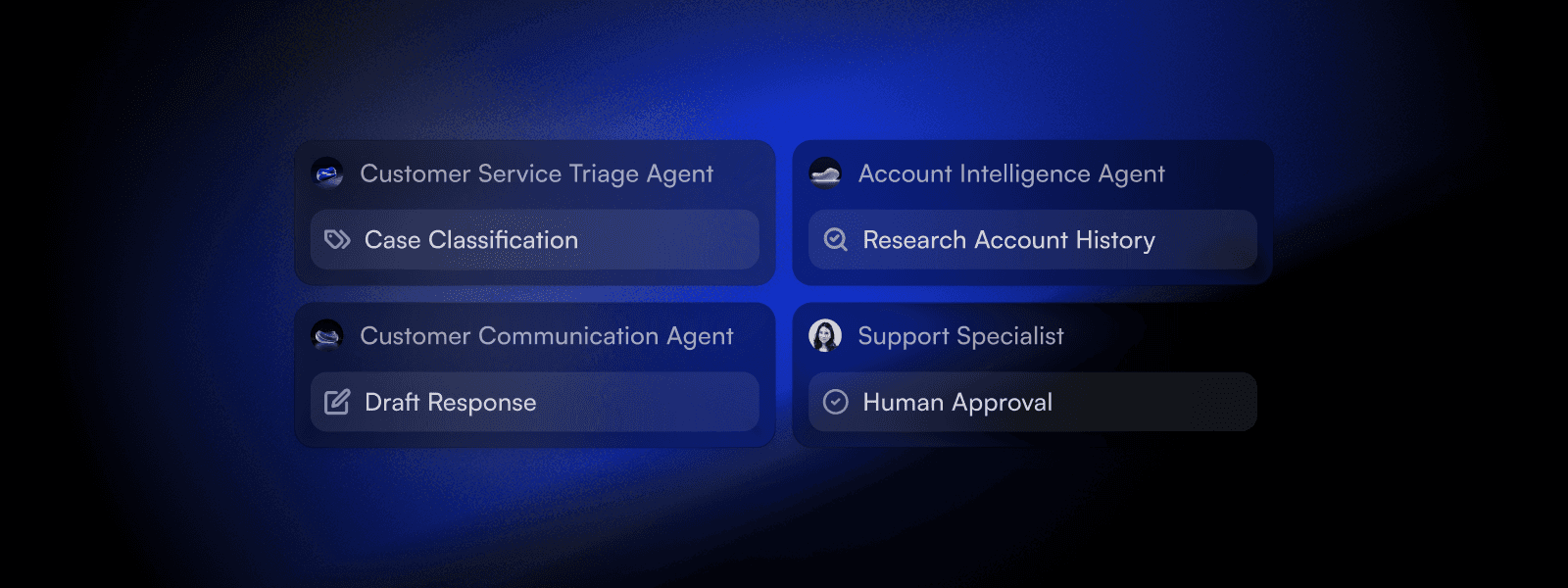
Agent OS is Beam's proprietary framework for production AI agents. Unlike static automation, Beam agents learn from every interaction. Improving accuracy automatically without manual maintenance. Graph-based execution combines workflow reliability with AI flexibility. Multi-agent orchestration scales to enterprise complexity. The result is agents that get better every day, not agents that stay broken for weeks.
Agent OS

The first self-evolving execution engine for AI agents

Agent OS is Beam's proprietary framework for production AI agents. Unlike static automation, Beam agents learn from every interaction. Improving accuracy automatically without manual maintenance. Graph-based execution combines workflow reliability with AI flexibility. Multi-agent orchestration scales to enterprise complexity. The result is agents that get better every day, not agents that stay broken for weeks.

Agent OS

The first self-evolving execution engine for AI agents

Agent OS is Beam's proprietary framework for production AI agents. Unlike static automation, Beam agents learn from every interaction. Improving accuracy automatically without manual maintenance. Graph-based execution combines workflow reliability with AI flexibility. Multi-agent orchestration scales to enterprise complexity. The result is agents that get better every day, not agents that stay broken for weeks.

Gradient
Gradient
Gradient

Agent OS

Core capabilities for production AI agents

Everything you need to build, deploy, and improve AI agents at enterprise scale. From graph-based execution to self-learning, these capabilities make Beam agents production-ready.

Agent OS

Core capabilities for production AI agents

Everything you need to build, deploy, and improve AI agents at enterprise scale. From graph-based execution to self-learning, these capabilities make Beam agents production-ready.
Graph-based execution for reliability and flexibility

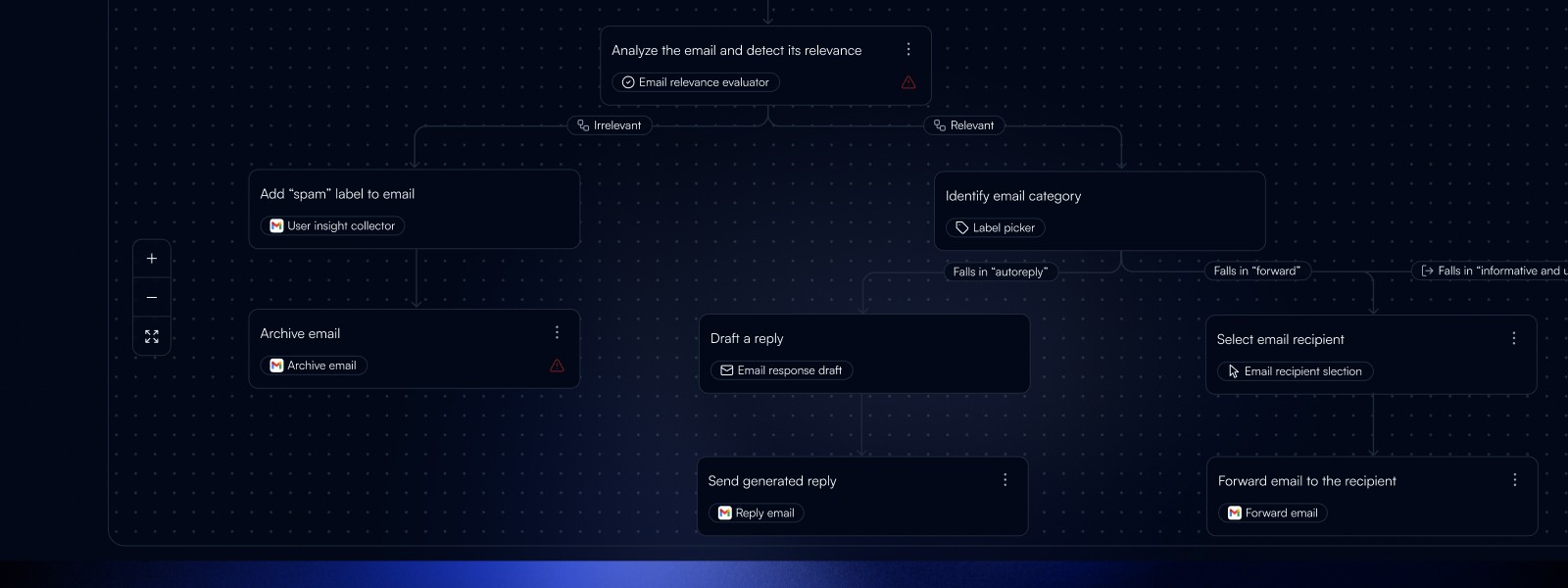
A flow is a graph-based structure that defines agent execution. Nodes perform actions. AI processing, API calls, data operations. Branches create conditional paths. Merging points converge multiple branches. The result is you get the reliability of fixed workflows for predictable steps, and the flexibility of AI reasoning for complex decisions. In the same agent, in the same workflow.

Graph-based execution for reliability and flexibility

A flow is a graph-based structure that defines agent execution. Nodes perform actions. AI processing, API calls, data operations. Branches create conditional paths. Merging points converge multiple branches. The result is you get the reliability of fixed workflows for predictable steps, and the flexibility of AI reasoning for complex decisions. In the same agent, in the same workflow.

Graph-based execution for reliability and flexibility

A flow is a graph-based structure that defines agent execution. Nodes perform actions. AI processing, API calls, data operations. Branches create conditional paths. Merging points converge multiple branches. The result is you get the reliability of fixed workflows for predictable steps, and the flexibility of AI reasoning for complex decisions. In the same agent, in the same workflow.

Nodes: AI processing, integrations, data operations

Branches: Conditional paths with edge selection criteria

Merging: Multiple branches converge into single execution path

Unified building blocks for every agent

Agent OS brings skills, integrations, tools, triggers, and graphs together in one system. Triggers start work from events like webhooks, schedules, emails, or app actions. Skills encapsulate repeatable logic you can reuse across agents. Tools wrap LLM capabilities and custom logic. Integrations connect to SAP, Salesforce, Oracle, Workday, and your internal systems. Graphs orchestrate everything into end-to-end workflows instead of scattered scripts.

Unified building blocks for every agent

Agent OS brings skills, integrations, tools, triggers, and graphs together in one system. Triggers start work from events like webhooks, schedules, emails, or app actions. Skills encapsulate repeatable logic you can reuse across agents. Tools wrap LLM capabilities and custom logic. Integrations connect to SAP, Salesforce, Oracle, Workday, and your internal systems. Graphs orchestrate everything into end-to-end workflows instead of scattered scripts.

Unified building blocks for every agent

Agent OS brings skills, integrations, tools, triggers, and graphs together in one system. Triggers start work from events like webhooks, schedules, emails, or app actions. Skills encapsulate repeatable logic you can reuse across agents. Tools wrap LLM capabilities and custom logic. Integrations connect to SAP, Salesforce, Oracle, Workday, and your internal systems. Graphs orchestrate everything into end-to-end workflows instead of scattered scripts.

Triggers: Webhook, schedule, email, and app events to start agents

Skills: Reusable bundles of logic and prompts shared across agents

Integrations & tools: 1500+ connectors plus custom tools in one catalog

Multi-agent orchestration to scale without chaos

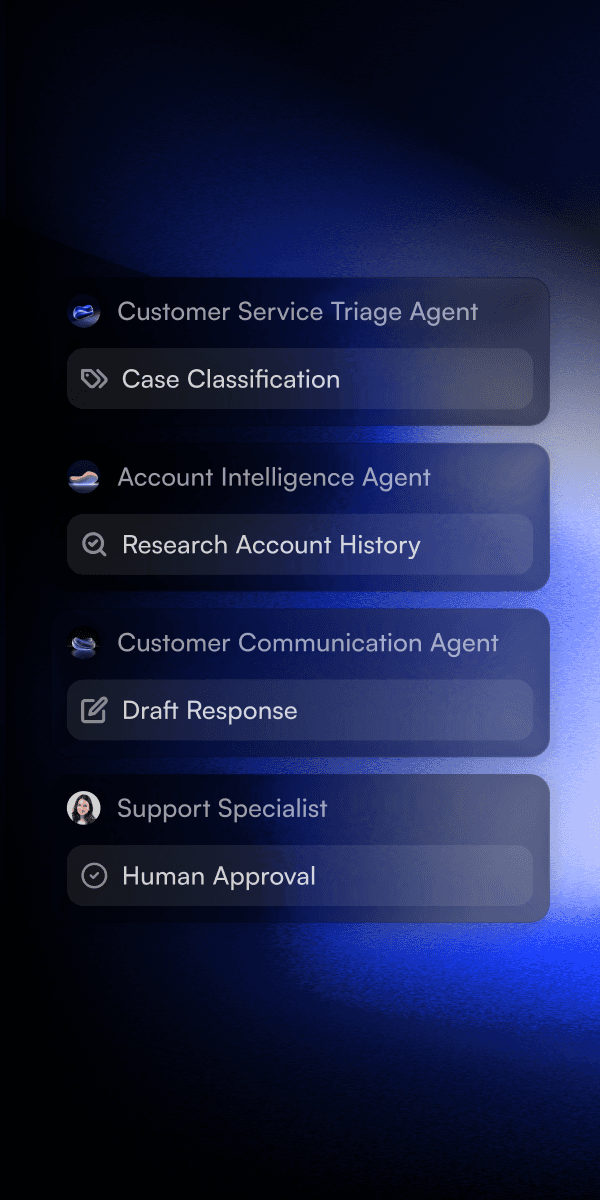
Multi-agent collaboration allows one agent to trigger another within a workflow. Build specialized agents that excel at specific tasks. Invoice processing, candidate screening, compliance checking. Coordinate them through a central orchestrator. MCP (Model Context Protocol) enables communication with external agent platforms (deployed with IBM and Cisco). A2A protocol support for flexible integration patterns.

Multi-agent orchestration to scale without chaos

Multi-agent collaboration allows one agent to trigger another within a workflow. Build specialized agents that excel at specific tasks. Invoice processing, candidate screening, compliance checking. Coordinate them through a central orchestrator. MCP (Model Context Protocol) enables communication with external agent platforms (deployed with IBM and Cisco). A2A protocol support for flexible integration patterns.

Multi-agent orchestration to scale without chaos

Multi-agent collaboration allows one agent to trigger another within a workflow. Build specialized agents that excel at specific tasks. Invoice processing, candidate screening, compliance checking. Coordinate them through a central orchestrator. MCP (Model Context Protocol) enables communication with external agent platforms (deployed with IBM and Cisco). A2A protocol support for flexible integration patterns.

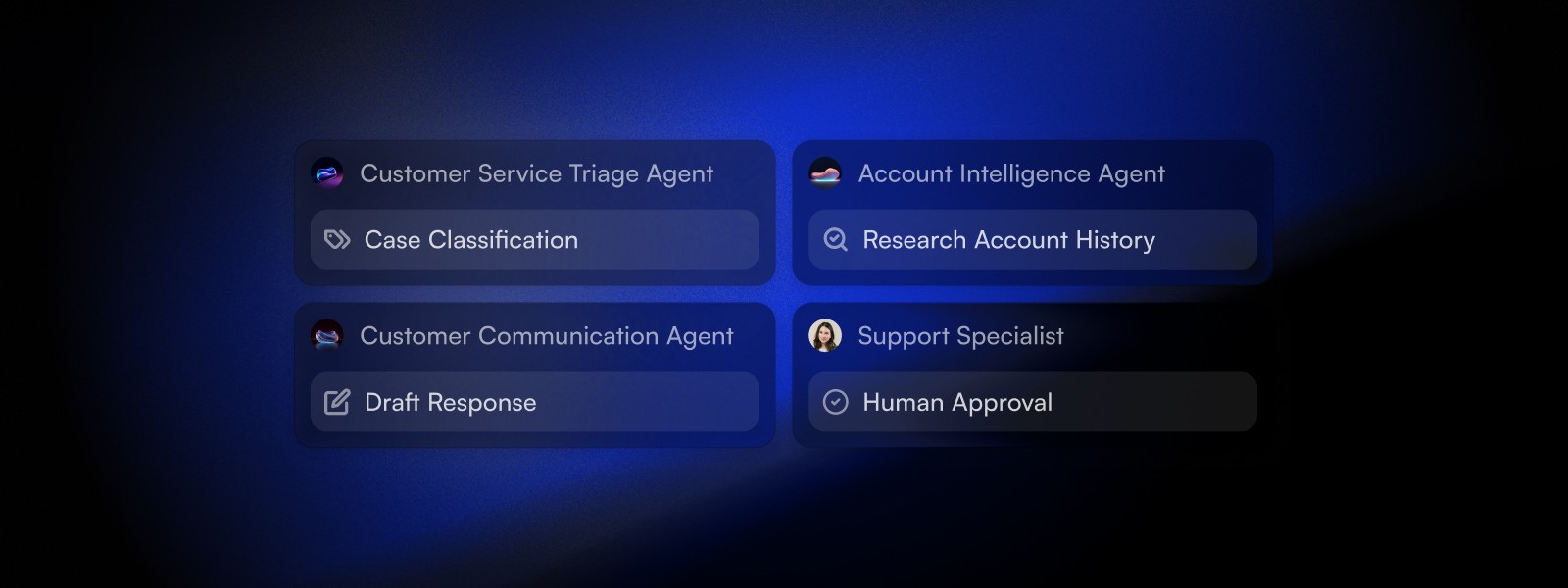
Specialized agents for specific domains

Reusability across multiple workflows

MCP and A2A protocol for external systems
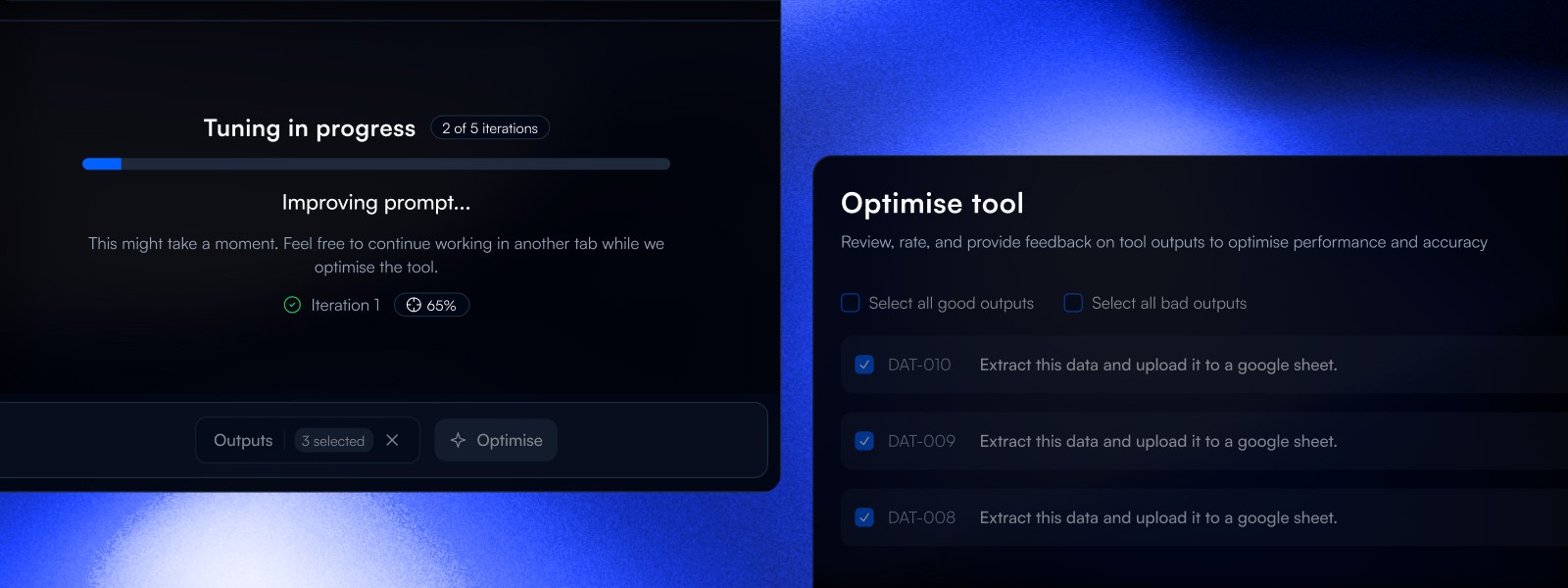
Self-learning for agents that improve automatically

The Learning Hub tracks tool performance across all workflow nodes, identifying underperforming tools below accuracy thresholds. When outputs fail, mark what went wrong. AI analyzes failures, identifies patterns, and rewrites prompts with clearer instructions. Validation testing automatically retests against failed cases before deployment. Transform 5% accuracy to 100% in about 30 seconds.

Self-learning for agents that improve automatically

The Learning Hub tracks tool performance across all workflow nodes, identifying underperforming tools below accuracy thresholds. When outputs fail, mark what went wrong. AI analyzes failures, identifies patterns, and rewrites prompts with clearer instructions. Validation testing automatically retests against failed cases before deployment. Transform 5% accuracy to 100% in about 30 seconds.

Self-learning for agents that improve automatically

The Learning Hub tracks tool performance across all workflow nodes, identifying underperforming tools below accuracy thresholds. When outputs fail, mark what went wrong. AI analyzes failures, identifies patterns, and rewrites prompts with clearer instructions. Validation testing automatically retests against failed cases before deployment. Transform 5% accuracy to 100% in about 30 seconds.

Automatic prompt rewriting from failure patterns

Learns domain expertise automatically (libraries, formulas, industry conventions)

Self-corrects when it learns wrong behaviors
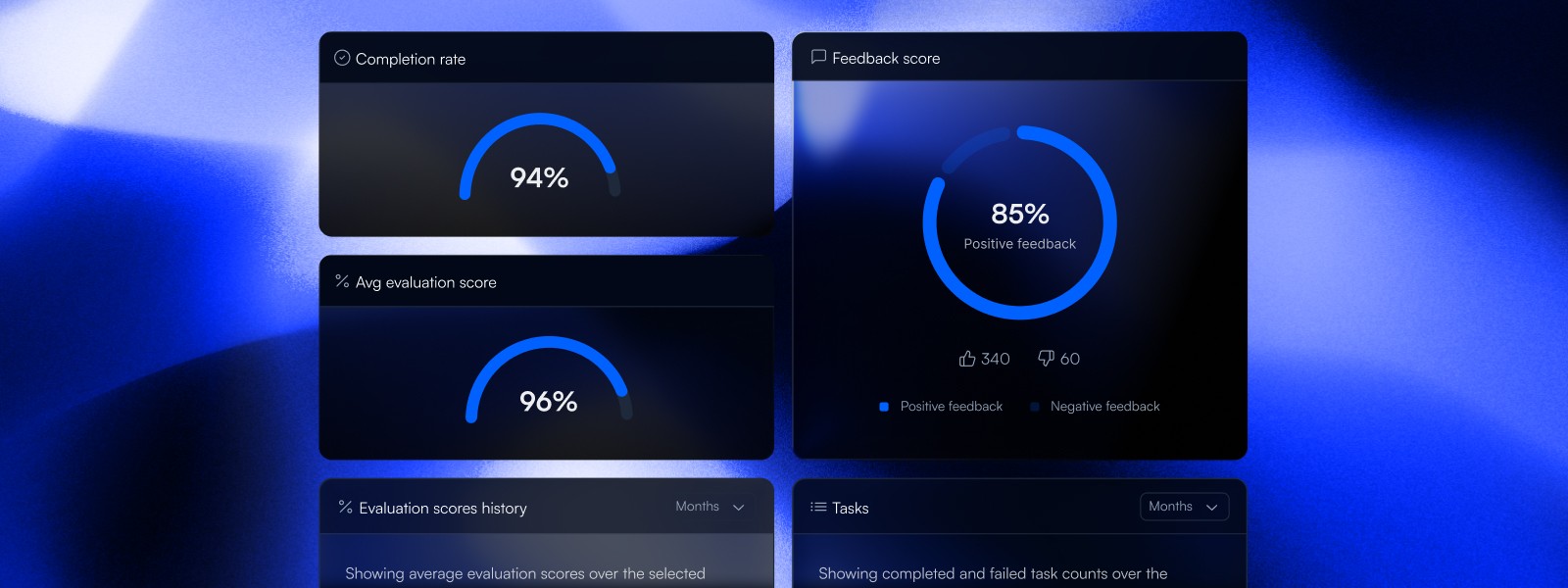
Evaluation framework to know exactly how good you are

Configure evaluation criteria per node. The system validates format, required fields, and data correctness automatically. Every execution gets an accuracy score. Track completion rate (95%+ target), evaluation score, and feedback score. Auto-retry triggers when scores drop, with self-healing prompts. You always know exactly how your agents are performing. And you can prove it.

Evaluation framework to know exactly how good you are

Configure evaluation criteria per node. The system validates format, required fields, and data correctness automatically. Every execution gets an accuracy score. Track completion rate (95%+ target), evaluation score, and feedback score. Auto-retry triggers when scores drop, with self-healing prompts. You always know exactly how your agents are performing. And you can prove it.

Evaluation framework to know exactly how good you are

Configure evaluation criteria per node. The system validates format, required fields, and data correctness automatically. Every execution gets an accuracy score. Track completion rate (95%+ target), evaluation score, and feedback score. Auto-retry triggers when scores drop, with self-healing prompts. You always know exactly how your agents are performing. And you can prove it.

Automatic output validation against criteria

Node-level accuracy scoring

Auto-run self-healing on low scores
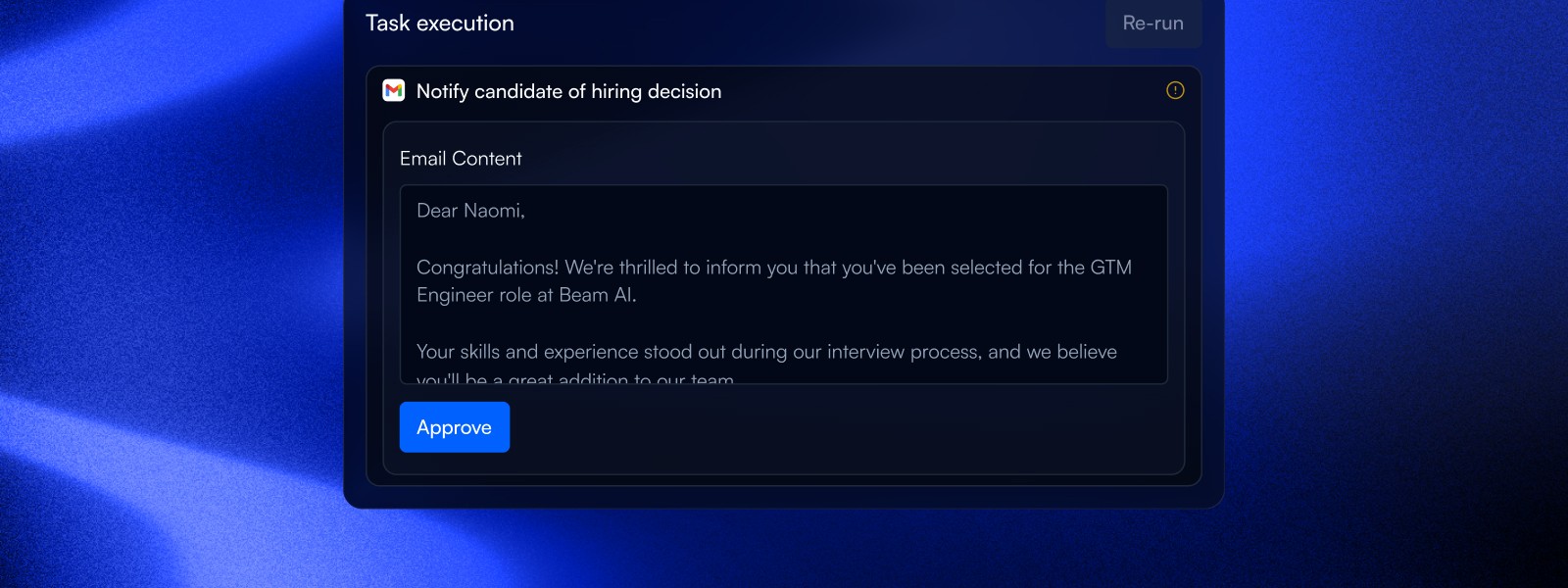
Human-in-the-loop for control without bottlenecks

Three automation modes control agent autonomy. Fully autonomous means end-to-end without human intervention. Human-in-the-loop pauses at designated checkpoints for review. Consent nodes show execution context and proposed action, humans approve or reject. Hybrid means autonomous execution with selective oversight at critical steps. All pending tasks route to a centralized Inbox.

Human-in-the-loop for control without bottlenecks

Three automation modes control agent autonomy. Fully autonomous means end-to-end without human intervention. Human-in-the-loop pauses at designated checkpoints for review. Consent nodes show execution context and proposed action, humans approve or reject. Hybrid means autonomous execution with selective oversight at critical steps. All pending tasks route to a centralized Inbox.

Human-in-the-loop for control without bottlenecks

Three automation modes control agent autonomy. Fully autonomous means end-to-end without human intervention. Human-in-the-loop pauses at designated checkpoints for review. Consent nodes show execution context and proposed action, humans approve or reject. Hybrid means autonomous execution with selective oversight at critical steps. All pending tasks route to a centralized Inbox.

Consent nodes pause for approval

Centralized Inbox for all pending approvals

Gradual autonomy as trust builds
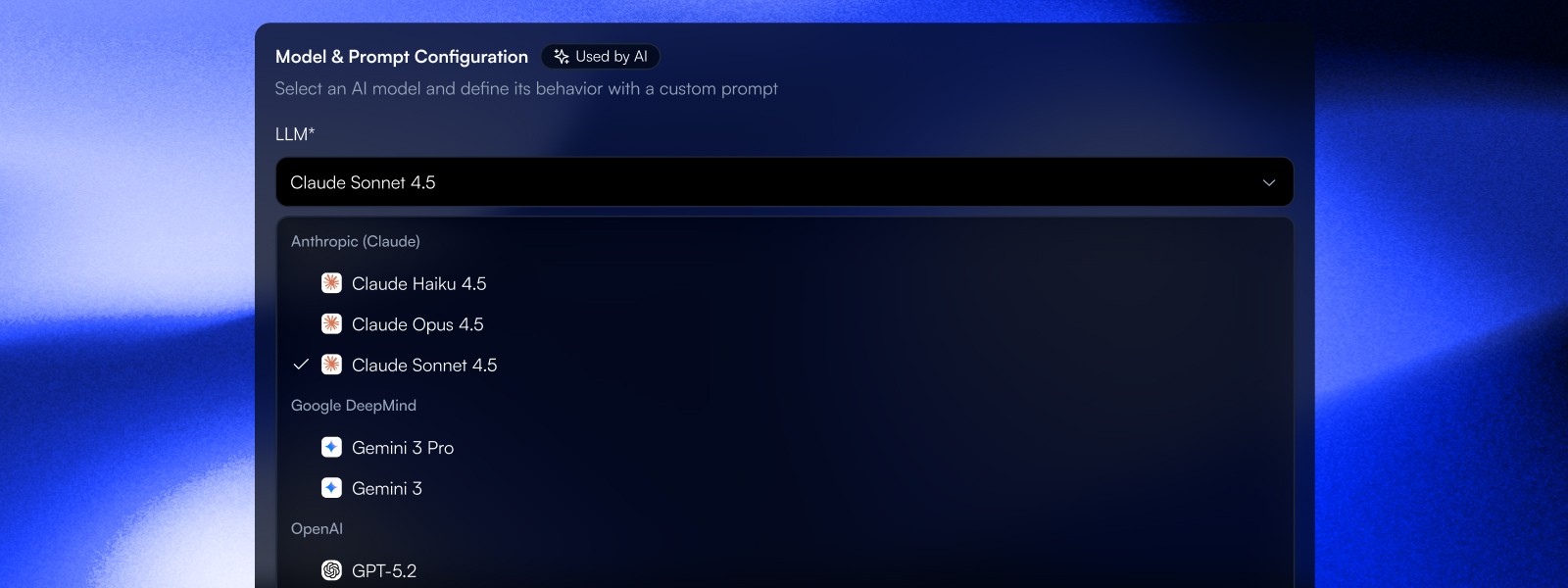
Model flexibility to use any LLM and switch anytime

Agent OS is model-agnostic. Use OpenAI (GPT-4, GPT-4o), Anthropic (Claude), Google (Gemini), Meta (Llama), or your custom fine-tuned models. Specify endpoint, API key, and model version. Beam routes requests. Benchmark different LLMs for your specific use case. Some tasks need GPT-4, others work fine with Llama. For on-premise, bring your own models. Data sent to LLMs is not used for training.

Model flexibility to use any LLM and switch anytime

Agent OS is model-agnostic. Use OpenAI (GPT-4, GPT-4o), Anthropic (Claude), Google (Gemini), Meta (Llama), or your custom fine-tuned models. Specify endpoint, API key, and model version. Beam routes requests. Benchmark different LLMs for your specific use case. Some tasks need GPT-4, others work fine with Llama. For on-premise, bring your own models. Data sent to LLMs is not used for training.

Model flexibility to use any LLM and switch anytime

Agent OS is model-agnostic. Use OpenAI (GPT-4, GPT-4o), Anthropic (Claude), Google (Gemini), Meta (Llama), or your custom fine-tuned models. Specify endpoint, API key, and model version. Beam routes requests. Benchmark different LLMs for your specific use case. Some tasks need GPT-4, others work fine with Llama. For on-premise, bring your own models. Data sent to LLMs is not used for training.

GPT, Claude, Gemini, Llama, custom models

Benchmarking to select optimal model per use case

On-premise deployment with your own models
Memory system so agents remember what matters

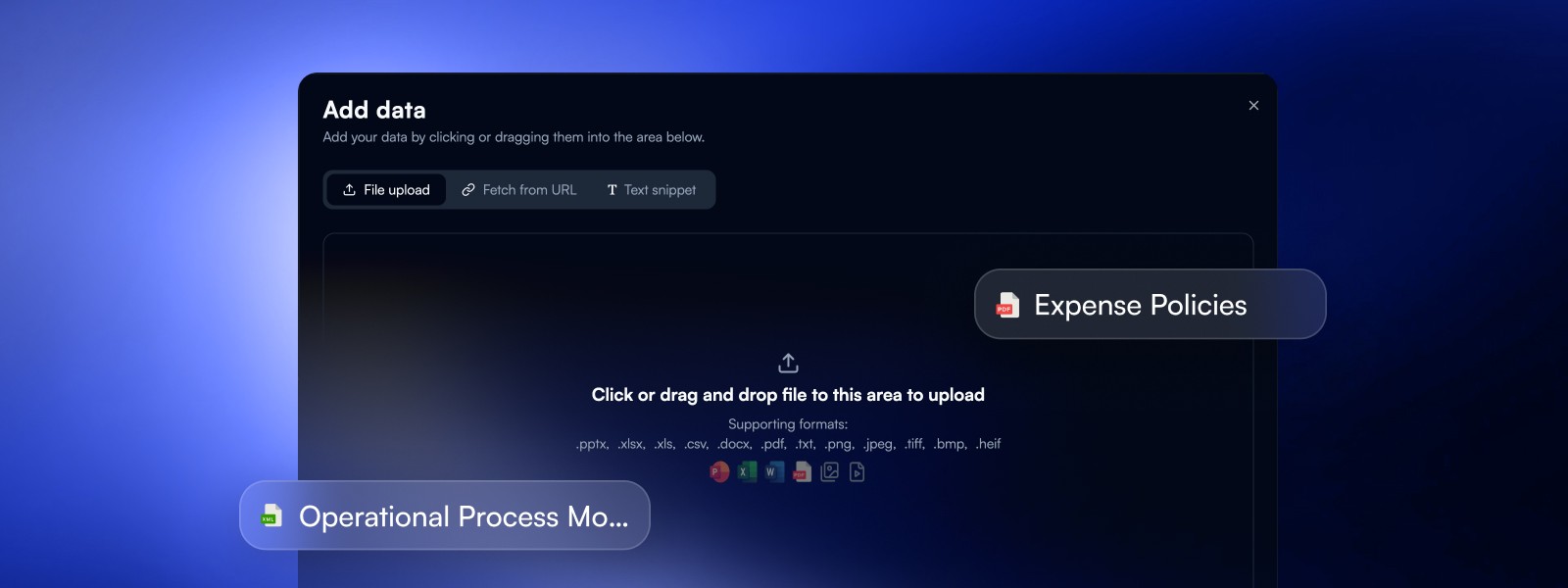
Four memory types serve different needs. Short-term stores current task context. Long-term stores persistent knowledge accumulated over time. Working handles active processing and temporary data. Episodic stores sequences of events and past interactions. Memory uses vector embeddings for semantic search. Upload files (PDF, CSV, TXT, JSON) to agent memory. Content becomes accessible to all nodes automatically.

Memory system so agents remember what matters

Four memory types serve different needs. Short-term stores current task context. Long-term stores persistent knowledge accumulated over time. Working handles active processing and temporary data. Episodic stores sequences of events and past interactions. Memory uses vector embeddings for semantic search. Upload files (PDF, CSV, TXT, JSON) to agent memory. Content becomes accessible to all nodes automatically.

Memory system so agents remember what matters

Four memory types serve different needs. Short-term stores current task context. Long-term stores persistent knowledge accumulated over time. Working handles active processing and temporary data. Episodic stores sequences of events and past interactions. Memory uses vector embeddings for semantic search. Upload files (PDF, CSV, TXT, JSON) to agent memory. Content becomes accessible to all nodes automatically.

Four memory types with different retention

Vector embeddings for semantic retrieval

File upload (PDF, CSV, TXT, JSON)
Start Today

Start building custom AI agents to automate processes

Join our platform and start building AI agents for various types of automations.

Start Today

Start building custom AI agents to automate processes

Join our platform and start building AI agents for various types of automations.