By submitting, you consent to our use of your data. Privacy Policy.
Category
AI Agents
Share the article
The cheapest capable model for an AI agent keeps changing, and this week Google moved it again. Gemini 3.8 Flash launched on 2 September 2026 as its "most intelligent workhorse model," the third Flash release in about six weeks, and the early benchmarks put it close to the frontier on agent tasks at a fraction of the cost.
The numbers so far are strong across the board, not in one domain. It runs at about 305 tokens a second, the fastest any independent lab has clocked, at $0.75 and $3.75 per million input and output tokens, against Claude Opus 5's $5 and $25 and GPT-5.6 Sol's $4 and $20. On several agent benchmarks it now edges frontier models that cost six to seven times more.
One caveat belongs up front: these are launch-day benchmarks, not production results. Benchmarks tell you where a model might fit; only your own workflow tells you whether it actually does, and real tests will confirm or deflate the early numbers. With that caution, here is what the benchmarks say so far, where Gemini 3.8 Flash looks like it belongs in an agent stack, and where it still trails.
What is Gemini 3.8 Flash?
Gemini 3.8 Flash is Google's latest fast, low-cost model, built for coding and agentic workloads rather than the hardest frontier reasoning. It ships with a 1-million-token context window and runs at about 305 tokens per second, the fastest output speed Artificial Analysis has measured.
The pricing is the pitch. At $0.75 and $3.75 per million tokens through the end of 2026 (rising to $1.50 and $7.50 in January), it is six to seven times cheaper than Opus 5 and meaningfully cheaper than GPT-5.6 Sol. For an agent that runs thousands of times a day, that gap is the whole business case.
How good is it for agents, really?
Strong on the early evidence, and honestly weaker on the hardest coding. On these launch benchmarks its wins cluster in domain-specific professional agents and mid-difficulty terminal work, which is most of what production agents actually do, though how it holds up on your workflows is the test that counts.
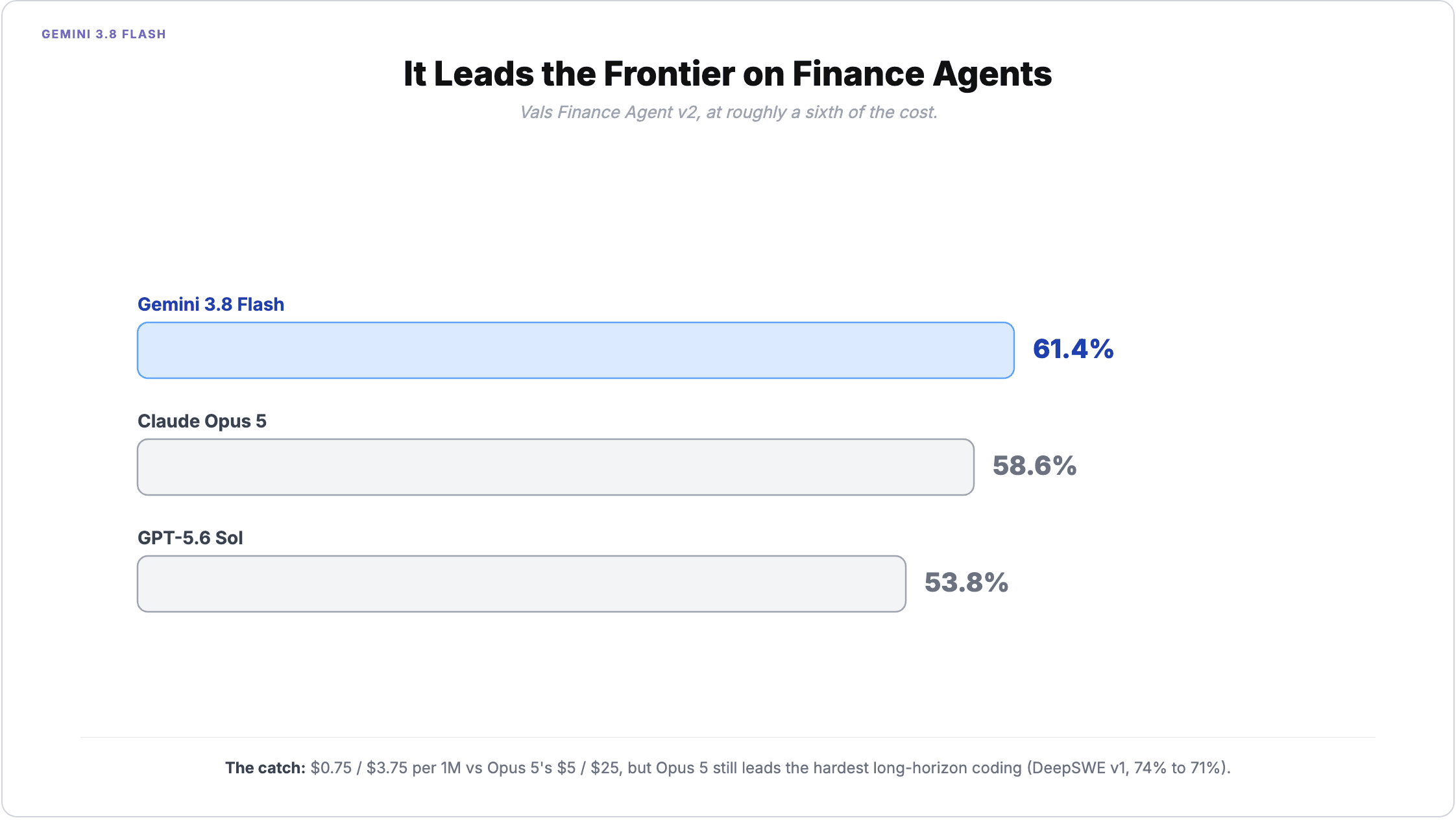
Take finance and legal as two examples where it leads the frontier so far: 61.4% on Vals Finance Agent v2 and 10.0% on Harvey's Legal Agent Benchmark, against 6.7% for Opus 5 and 2.5% for GPT-5.6 Sol. On agentic terminal coding it edges ahead too, 89.4% on Terminal-bench 2.1 versus Opus 5's 89.1%. The catch is long-horizon software engineering: on DeepSWE v1 it scores 71.0%, behind Opus 5's 74.0% and GPT-5.6 Sol's 72.7%.
That profile is precise about where it belongs. It is a finance-and-operations workhorse that approaches frontier quality on the domain work, not a replacement for the frontier on the hardest multi-step engineering.
For agent work | Gemini 3.8 Flash | Claude Opus 5 | GPT-5.6 Sol |
|---|---|---|---|
Price per 1M (in / out) | $0.75 / $3.75 | $5 / $25 | $4 / $20 |
Vals Finance Agent v2 | 61.4% | 58.6% | 53.8% |
Harvey Legal Agent | 10.0% | 6.7% | 2.5% |
Terminal-bench 2.1 (agentic coding) | 89.4% | 89.1% | — |
DeepSWE v1 (hardest long-horizon SWE) | 71.0% | 74.0% | 72.7% |
Output speed | ~305 tok/s (fastest) | — | — |
Where Gemini 3.8 Flash fits in an agent stack
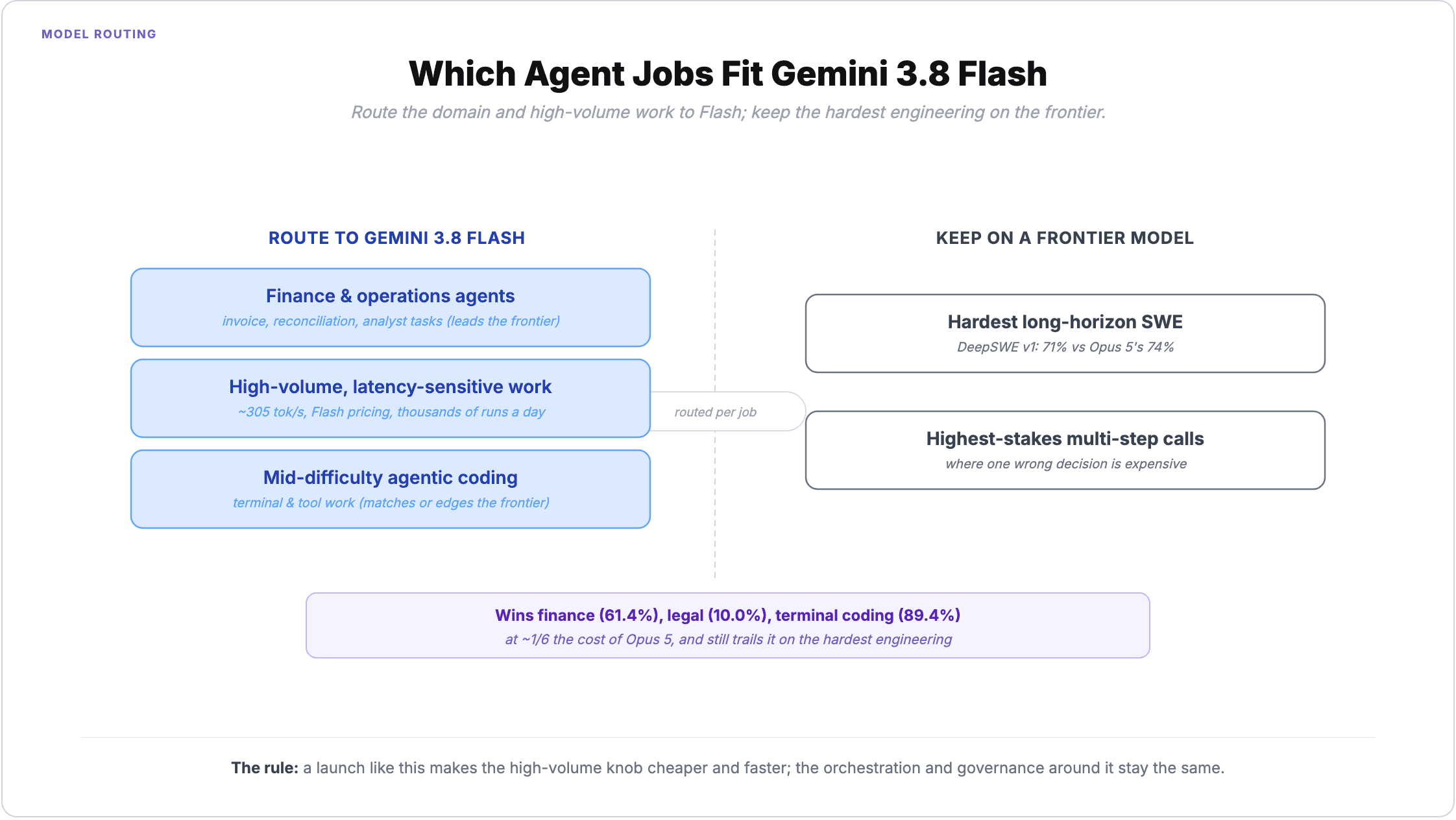
The result does not mean "switch everything to Gemini." It means route the right work to it. At Beam we run production agents on the model best befitting the job, and 3.8 Flash earns a specific and large set.
Finance and operations agents — invoice, reconciliation, and analyst-style tasks, where it now leads the frontier at a fraction of the cost.
High-volume, latency-sensitive work — at 305 tokens a second and Flash pricing, it is built for the agents that run thousands of times a day.
Mid-difficulty agentic coding and terminal work — where it matches or edges the frontier.
Keep the hardest long-horizon engineering, and the highest-stakes multi-step decisions, on a frontier model, because that is exactly where DeepSWE shows Flash still trails. The point is a model-agnostic stack that routes per job, not a single model for everything.
Why cheap and fast isn't the whole story
A better, cheaper model is a real advantage, and it is still not what decides whether an agent ships. Most enterprise agent pilots that fail do so on evaluation, governance, and reliability, not on the model underneath.
A Flash model with no evaluation, no audit trail, and no exception handling is a cheaper demo, not a cheaper deployment. The orchestration layer is what turns a strong model into a production agent, and it is model-independent by design, which is the entire reason a result like this is good news rather than a migration project. You route Gemini 3.8 Flash to the work it wins, and the layer around it stays the same.
How to put it to work
The pattern is the same one that survives every model release. Route each workflow to the model that fits it, keep the evaluation, audit trail, and human-in-the-loop in your control, and swap models as new ones ship without rewriting the agent.
That is how we run it at Beam: for finance and operations AI agents, the model is one knob, and a launch like Gemini 3.8 Flash just makes the high-volume knob cheaper and faster. The orchestration, integration, and audit trail are what make any of them hold up in production.
Which model runs which job
Gemini 3.8 Flash is the clearest example yet of why the model question is a routing question. On the early benchmarks it matches or beats the frontier on a lot of the domain-specific agent work that fills a back office, at a fraction of the cost, and still trails on the hardest engineering, and production testing will show how much of that holds.
Point it at the high-volume, domain-specific, latency-sensitive agents and it looks ready to earn its place. Keep the hardest long-horizon work on the frontier. The teams that win the next model release are the ones whose stack lets them try it in a day, not rebuild for a quarter.
Common questions about Gemini 3.8 Flash for agents
Is Gemini 3.8 Flash good enough for production AI agents?
On the early benchmarks it looks capable of most of them: it leads the frontier on finance and legal agent tasks and matches it on mid-difficulty agentic coding, at six to seven times lower cost. These are launch-day numbers, so production testing is what will confirm it, and the hardest long-horizon engineering should stay on a frontier model, where it still trails.
Gemini 3.8 Flash vs Opus 5: which is better for agents?
It depends on the job. Gemini 3.8 Flash wins finance-agent tasks (61.4% vs 58.6%) and legal (10.0% vs 6.7%) at a fraction of Opus 5's price, while Opus 5 leads the hardest long-horizon software engineering. Most production stacks route across both.
How much does Gemini 3.8 Flash cost?
$0.75 per million input tokens and $3.75 per million output through the end of 2026, rising to $1.50 and $7.50 on 1 January 2027, roughly six to seven times cheaper than Claude Opus 5.