
By submitting, you consent to our use of your data. Privacy Policy.
Category
Professional Services
Built by
Beam.ai
Datev is a people or recruiting platform for accounting and tax teams, organized around clients, documents, accounting data, and permissions. The vendor documentation defines the resource model and required permissions. Keep the record useful to the recruiter or people-operations owner; leave judgment-heavy decisions with a person. Use the Beam catalogue entry as a starting point, then confirm connector actions and event coverage before rollout

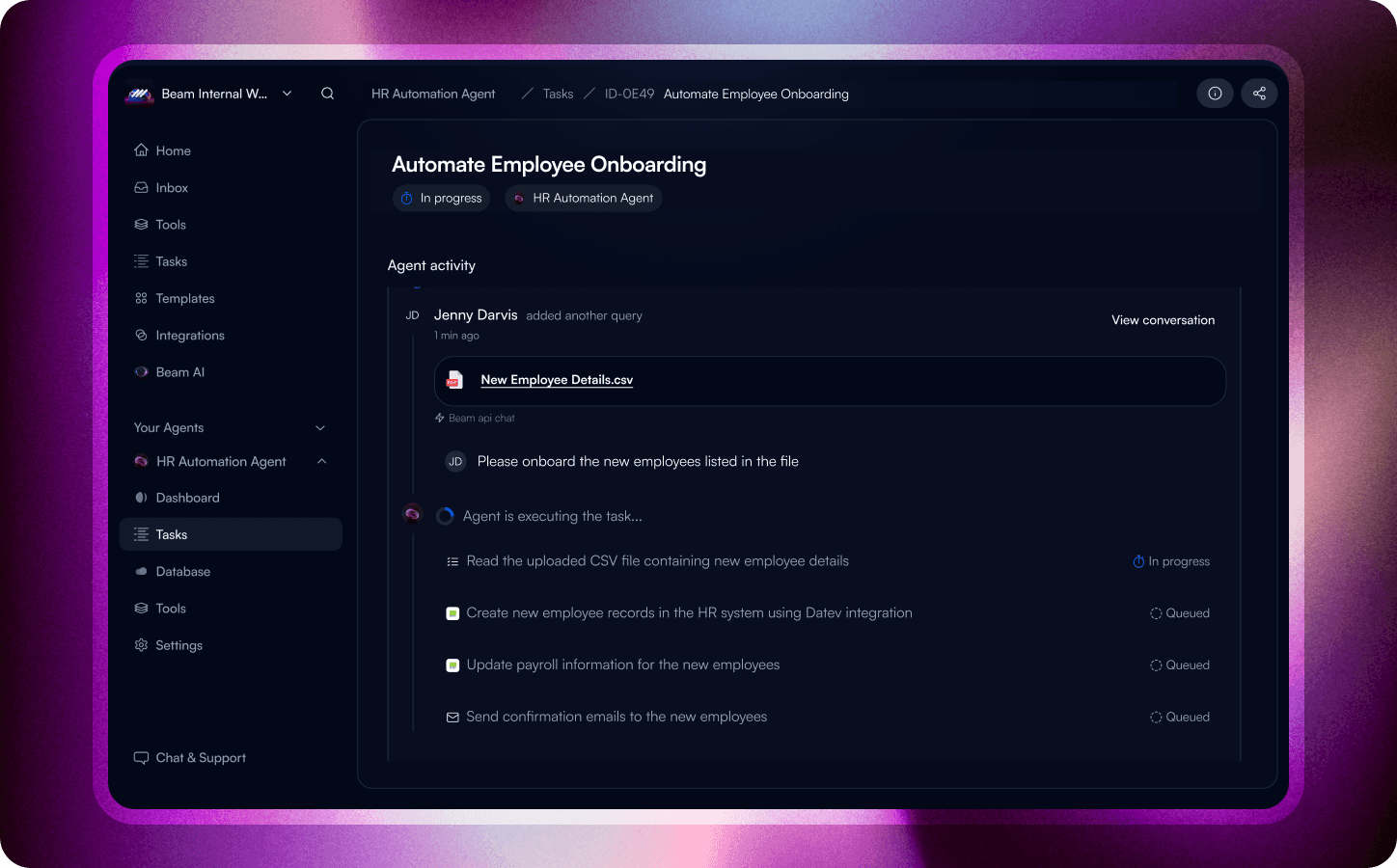
What to connect: Datev
The useful question is not whether Datev can be automated in the abstract. It is which clients, documents, accounting data, and permissions matter to accounting and tax teams, which fields are authoritative, and where a person should review the result. For Datev, keep client context attached to the owner of the next decision
Where Beam fits
Start by writing the handoff in plain language: what changes in Datev, what Beam is allowed to prepare, and who signs off. Verify the event, fields, and return path before treating the workflow as available
A narrow pilot to validate
If a client record is created, updated, or ready for review, first establish which client fields are authoritative. Let Beam prepare the next step for review, then test whether the connector can record the approved result.
For handoffs involving clients and documents, define what counts as complete and what should stop the workflow. Do not infer either rule from a category label.
Operational value
A workflow boundary that is small enough to test.
Clearer separation between source data, Beam reasoning, and the final action.
An explicit exception path for cases outside the documented rule.
Before you build
Check the connector's available read, write, search, notification, and event operations for your Beam workspace. Confirm the vendor authentication method, required scopes, plan limits, and any approval requirements. Treat the two workflow patterns above as designs to validate, not promises of universal coverage.