4 Min. Lesezeit
AI Agents for Order Management: Cutting Order Entry From 11 Minutes to 3


By submitting, you consent to our use of your data. Privacy Policy.
Kategorie
KI-Agenten
Artikel teilen
Order management breaks in the same place every time: a person reads an order off an email, a PDF, or a portal, and keys it into the system. That manual entry takes a median of about 11 minutes per order and carries roughly a 9% error rate, which is where the wrong quantity, the wrong SKU, and the delayed shipment come from.
An AI agent does the same work in about 3 minutes at under 1% error, and processes the routine orders without a person touching them at all. Here is what an order management agent automates, the numbers, and where a rep still steps in.
What is an order management AI agent?
An order management AI agent handles an incoming order as a multi-step task: it reads the order from whatever channel it arrived on, validates the products, quantities, pricing, and stock, enters it into the system, and confirms it, escalating only what it cannot resolve.
The difference from EDI or a portal form is the unstructured front door. Most B2B orders still arrive as email, PDF, or a phone follow-up; an agent reads those directly, resolves a product from a partial description, and catches the pricing mismatch before the order ships wrong.
What AI agents automate in order management
The wins are the high-volume steps between an order arriving and it being confirmed.
Order capture — reading orders from email, PDF, portal, or EDI, whatever the format.
Validation — checking products, quantities, pricing, and stock against your systems.
Order entry — creating the order in the ERP or OMS directly.
Confirmation and status — acknowledging the order and answering status questions.
Exception handling — flagging the out-of-stock, the pricing conflict, the credit hold.
The pattern is consistent: the agent owns the routine capture-to-confirmation, and a rep handles the exceptions.
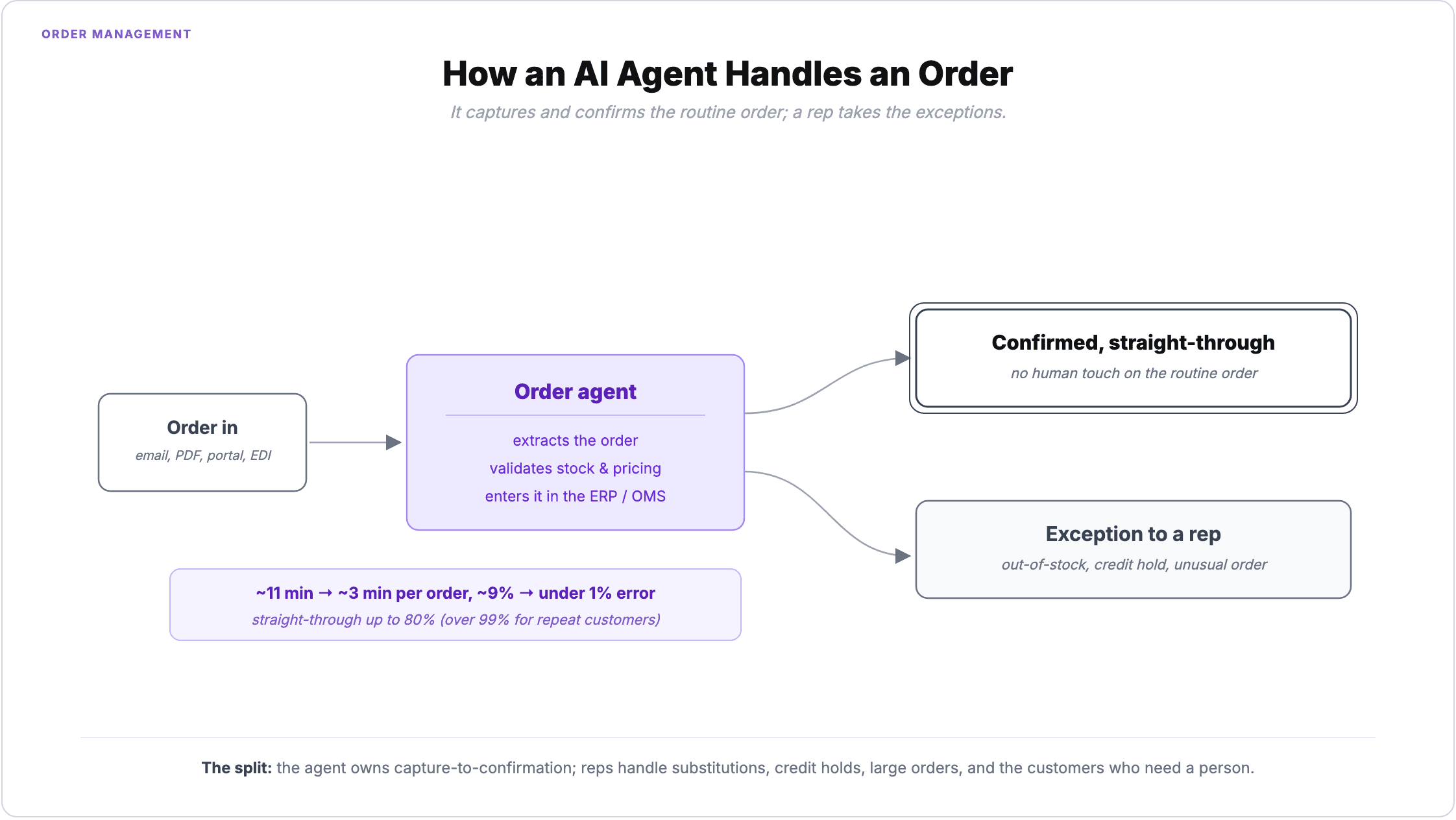
What it actually saves
The numbers are stark against the manual baseline. Automated order processing cuts entry time from about 11 minutes to 3, drops the error rate from roughly 9% to under 1%, and reduces processing cost meaningfully against a $14 to $54 cost per order, with industry leaders reporting 40% cost reductions.
The bigger shift is straight-through processing, orders handled with no human at all. Straight-through rates have climbed from around 32.6% to 80% on first contact and past 99% for repeat customers. In our own BPO and operations deployments, Beam agents run this order work at high accuracy with a person on the exceptions, and the point is that the routine order stops being a task at all.
Per order | Manual entry | AI agent |
|---|---|---|
Entry time | ~11 minutes | ~3 minutes |
Error rate | ~9% | under 1% |
Straight-through | ~32.6% | up to 80% (>99% repeat) |
Channels | one at a time, re-keyed | email, PDF, portal, EDI |
Cost per order | $14-54 | up to 40% lower |
Where a rep still steps in
The limit keeps the automation trustworthy. Agents own the routine order, not the judgment call.
An out-of-stock that needs a substitution offered, a large or unusual order, a credit hold, an angry customer chasing a delivery: those go to a person, with the agent handing over the full context. The rep is no longer keying clean orders; they are handling the ones that need a human.
How to deploy AI agents in order management
The pattern is the same across operations. Agents sit on top of the ERP or OMS you already run, read from the channels orders already arrive on, and keep a human on the exceptions.
Governance is what makes it production-grade: permissions scoped to the task, an audit trail on every order action, and control over thresholds like order value and credit, which is why a governed agent platform matters more than the model. Most teams start with one channel or one product line, prove the accuracy, then expand.
Common questions about AI agents in order management
What does an order management AI agent do?
It captures orders from email, PDF, portal, or EDI, validates products, pricing, and stock, enters the order into the ERP or OMS, confirms it, and escalates exceptions like out-of-stock or credit holds to a rep.
How much faster is automated order processing?
Order entry drops from about 11 minutes to 3, the error rate falls from roughly 9% to under 1%, and straight-through processing reaches up to 80% on first contact and over 99% for repeat customers.
Does it replace the customer service team?
No. It handles routine capture-to-confirmation, while reps manage substitutions, large or unusual orders, credit holds, and the customers who need a person.