By submitting, you consent to our use of your data. Privacy Policy.
Category
AI Agents
Share the article
End-to-end candidate screening automation means handing an AI agent the whole pipeline, not one step: parse the CV, match it to the role, score and rank, verify the basics, draft the outreach, and book the call, with a recruiter reviewing exceptions. Done right, it takes screening from the 6 to 7 minutes a recruiter spends per CV down to under 2, and it frees recruiters for the part that actually needs a human. The mistake most teams make is automating one step, usually resume parsing, and stopping. The leverage is in owning the whole chain. Here's the full pipeline, what to automate first, and where it breaks.
What "end-to-end" actually means
Most "screening automation" is a single tool bolted onto a manual process. A resume parser that extracts fields. A keyword filter on an ATS. Each removes a few minutes, then hands the work back to a human, who still does the ranking, the outreach, and the scheduling by hand. The time saved is marginal because the bottleneck moved one step down the line, it didn't disappear.
End-to-end means an agent owns the connected chain of decisions from application to booked conversation, and a recruiter supervises the exceptions instead of running every step. That's the difference between shaving minutes and removing the manual work.
The candidate-screening pipeline, stage by stage
Stage | What the agent does | Human role |
|---|---|---|
1. Intake & parse | Read every CV, extract structured data from any format | None (spot-check) |
2. Match & score | Compare candidate to the role's real requirements, score fit | Set the criteria |
3. Rank & shortlist | Order candidates, surface the top set with reasoning | Review the shortlist |
4. Verify basics | Check must-haves (right to work, location, certifications) | Handle flags |
5. Draft outreach | Write personalized outreach per shortlisted candidate | Approve / edit tone |
6. Schedule | Offer times, book the call, handle reschedules | None |
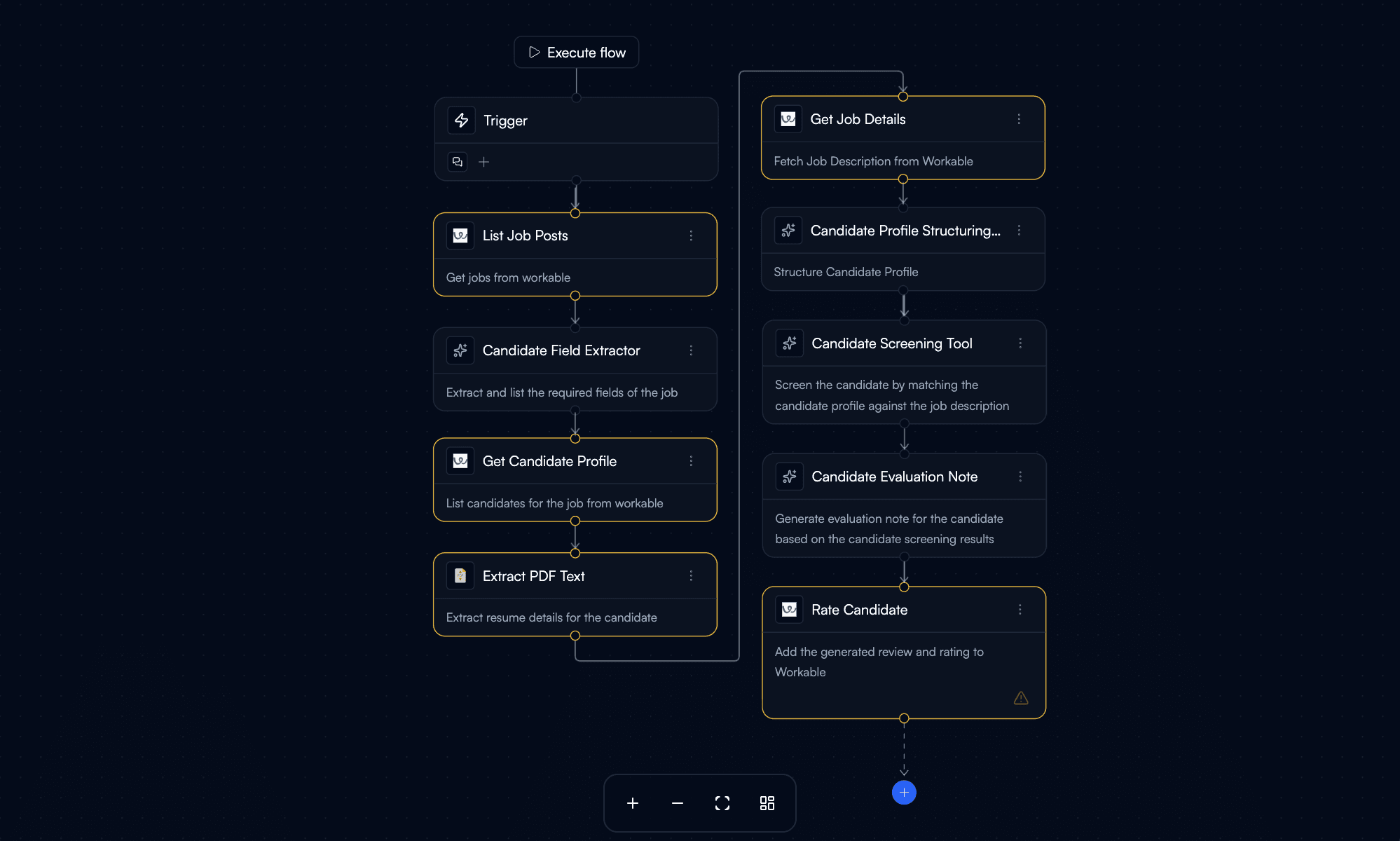
A Beam candidate-screening agent in the builder: from resume extraction to a scored, rated candidate written back to the ATS.
Stage 1: Intake and parse
The agent reads every incoming CV, in any format, and turns it into structured data. Not just keyword extraction, actually reading the document the way a recruiter would. This is the stage most teams already automate, and the one with the least leverage on its own.
Stage 2: Match and score against the real role
Here's where an agent separates from a keyword filter. Instead of matching on exact terms, the agent evaluates a candidate against what the role actually needs, adjacent skills, relevant experience phrased differently, the context a keyword misses. At Booth & Partners, a Beam screening agent reviews 9,500+ CVs at a 97.8% completion rate, spending 1.5 to 2 minutes per CV against a recruiter's 6 to 7, and it grew screening capacity by 14x without adding recruiters.
Stage 3: Rank and shortlist with reasons
The agent orders candidates and surfaces the top set with the reasoning attached, so a recruiter can see why someone ranked where they did rather than trusting a black-box score. The recruiter reviews the shortlist, not the whole pile.
Stage 4: Verify the basics
Before a human spends time, the agent checks the hard must-haves: right to work, location, required certifications, availability. This is where speed compounds. A US healthcare staffing agency cut time-to-contact from 90 hours to 14, a 42% faster path from application to a real conversation, largely by removing the manual lag between "applied" and "verified and contacted." That is what end-to-end recruiting automation buys you: not a faster step, a shorter path.
Stage 5: Draft the outreach
The agent writes personalized outreach for each shortlisted candidate, referencing their actual background, not a mail-merge template. The recruiter approves or adjusts the tone. This is the stage teams most often leave manual, and it's a big share of the wasted hours.
Stage 6: Schedule and book
The agent offers times, books the call, and handles reschedules. The recruiter's calendar fills with conversations instead of coordination. Removing this "ghost work" of manual scheduling is one of the quieter time sinks in recruiting.
What to automate first
If you can only start one place, do not start with parsing. Everyone starts with parsing because it's the easiest, and it's why so much "automation" saves so little.
Start with stage 2, matching and scoring, because that's where recruiter hours actually go and where consistency matters most. A human screening 500 CVs is fast on the first fifty and tired by the last. An agent scores the five-hundredth exactly like the first. Automate the judgment-heavy, volume-heavy middle of the pipeline first, then extend outward to outreach and scheduling. The payback follows the hours, and the hours are in the middle, not the edges.
Where candidate-screening automation breaks
Three failure modes, all avoidable:
Over-automation with no human on exceptions. An agent should own the routine and hand edge cases to a recruiter. Teams that try to remove the human entirely lose the judgment that catches the non-obvious great candidate. Keep people on exceptions, always.
Optimizing for speed over fairness. Screening automation touches hiring decisions, which means bias and compliance are not optional. Automated employment-decision tools face real scrutiny, from NYC's Local Law 144 bias-audit requirement to the EU AI Act's high-risk category. Build auditability in from day one, not after a complaint.
Automating steps instead of the chain. The recurring mistake. Point tools at single stages and the bottleneck just moves. The leverage is an agent that owns the connected pipeline, with the recruiter supervising, not operating.
What good looks like
Done end-to-end, the numbers move together, not one metric at the expense of another. Screening drops from 6 to 7 minutes a CV to under 2. Capacity scales without headcount, 14x at Booth & Partners. Time-to-contact collapses from days to hours. And recruiters spend their week on candidates and clients instead of coordination. Hudson RPO, a global recruitment outsourcer, put a Beam screening agent into production and reported 2.1x ROI with a 5.6-month payback.
None of this requires ripping out your ATS. Agents run on top of the stack you already have, and most teams reach a live agent in 4 to 6 weeks. The gap between "we automated parsing" and "we automated screening" is the difference between saving minutes and giving recruiters their week back.