By submitting, you consent to our use of your data. Privacy Policy.
Category
AI Agents
Share the article
Reconciliation is where the month-end close gets stuck. Someone matches thousands of transactions across systems by hand, chases the ones that do not tie out, and does it under a deadline, which is exactly the condition that produces mistakes. A Gartner survey found 18% of accountants make financial errors daily and 59% make several a month, largely a byproduct of repetitive manual work.
AI agents take that matching off the critical path. Teams that automate reconciliation typically cut the time it takes by 60 to 80% and pull the close from around 10 days to 3, while lifting matching accuracy well above what a tired human hits at 2am. Here is what a reconciliation agent actually does, the numbers, and where a controller still has to sign.
What is a reconciliation AI agent?
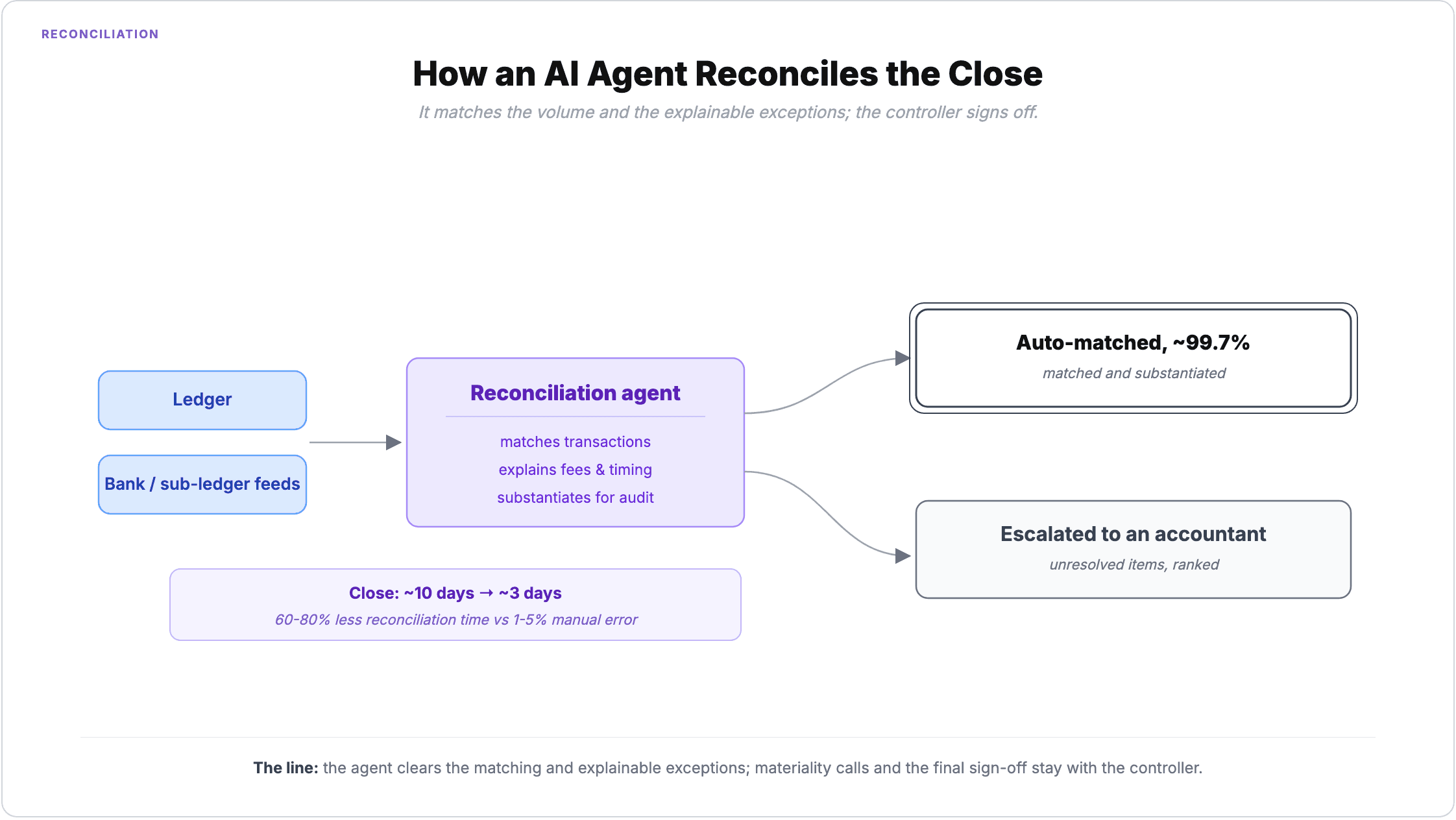
A reconciliation AI agent matches records across sources and resolves the differences as a multi-step task. It pulls the ledger and the bank or sub-ledger feed, matches transactions, applies the rules for timing and fees, and routes what it cannot match to a person with the context attached.
The difference from a macro or a rules engine is the long tail. A rule matches the clean transactions; an agent handles the messy ones, a payment that arrived net of a fee, a batch that settled a day late, a description that does not quite line up, without kicking every one of them to a human.
What AI agents automate in reconciliation
The value is in the volume of matching and the exception work around it.
Transaction matching — tying the ledger to bank, card, and sub-ledger feeds across thousands of lines.
Exception resolution — explaining timing differences, fees, and partial payments instead of just flagging them.
Intercompany reconciliation — matching across entities and currencies at close.
Substantiation — attaching the supporting detail an auditor will ask for.
Prioritized escalation — sending the genuinely unresolved items to an accountant, ranked.
The pattern holds: the agent clears the routine matches and the explainable exceptions, and the accountant keeps the judgment calls.
What it actually saves
The numbers are consistent across finance teams that have done it. Automation cuts reconciliation time by 60 to 80% and takes close cycles from roughly 10 days to 3, with matching accuracy reported around 99.7%, against a manual error rate of 1 to 5% per task (Journal of Computer Information Systems).
The baseline that makes this land: best-in-class teams still reconcile a single account in about 2.6 hours, per APQC. Multiply that by hundreds of accounts a month and the manual cost of the close is enormous before a single error is counted. At Beam, reconciliation is one of the finance workflows we run as agents, at high accuracy with a human on the exceptions, and the point is not that the model matches faster; it is that the close stops depending on one person's overtime.
At month-end close | Manual reconciliation | With an AI agent |
|---|---|---|
Time to reconcile | 2.6 hours per account (best-in-class, APQC) | 60-80% less |
Close cycle | ~10 days | ~3 days |
Matching accuracy | 1-5% error rate per task | ~99.7% |
Exceptions | every mismatch to a human | agent resolves the explainable ones |
Audit trail | rebuilt from notes | captured on every match |
Where a controller still signs off
The limit is the point of trust. Agents own the matching, not the sign-off.
Judgment calls on materiality, unusual write-offs, disputed balances, and the final attestation on the close stay with the controller and the accounting team. An agent gives them a close that is already matched and substantiated, so their time goes to the items that actually need a decision rather than the thousands that do not.
How to deploy AI agents in reconciliation
The pattern is the same one that works across finance operations. Agents sit on top of the ERP and the feeds you already run, follow your existing matching rules and materiality thresholds, and keep a human on the exceptions.
Governance is what makes it auditable: permissions scoped to the task, an audit trail on every match, and explainable reasoning for each exception, which is why a governed agent platform matters more than the model. Most teams start with one high-volume reconciliation, bank or a busy sub-ledger, prove the accuracy against a known-good close, then expand.
Common questions about AI agents in reconciliation
What does a reconciliation AI agent do?
It matches transactions across the ledger and bank or sub-ledger feeds, resolves explainable exceptions like fees and timing differences, substantiates the results for audit, and escalates only the genuinely unresolved items to an accountant.
How much faster is automated reconciliation?
Teams typically cut reconciliation time 60 to 80% and pull the close from around 10 days to 3, with matching accuracy near 99.7%, versus a 1 to 5% manual error rate per task.
Is AI reconciliation accurate enough for audit?
Yes, when it runs on a governed platform. Every match and exception is logged with explainable reasoning, which is easier to evidence for an auditor than a manual team's working notes, while the controller keeps the final sign-off.