
By submitting, you consent to our use of your data. Privacy Policy.
Kategorie
KI-Agenten
Artikel teilen
The honest answer to "what does an AI agent cost" is that the model is the small part, and the number swings more on how you deploy it than on which vendor you pick. The same agent, doing the same work, can run 26 times cheaper on one model than another, and still fail if the orchestration around it is wrong.
So the useful question is not the sticker price of a model. It is what the whole running agent costs against the manual work it replaces, and what drives that number up or down. Here is how AI agent cost actually breaks down, with real figures, and how to model it before you build.
What you actually pay for
An AI agent has two cost layers, and teams usually price only the first.
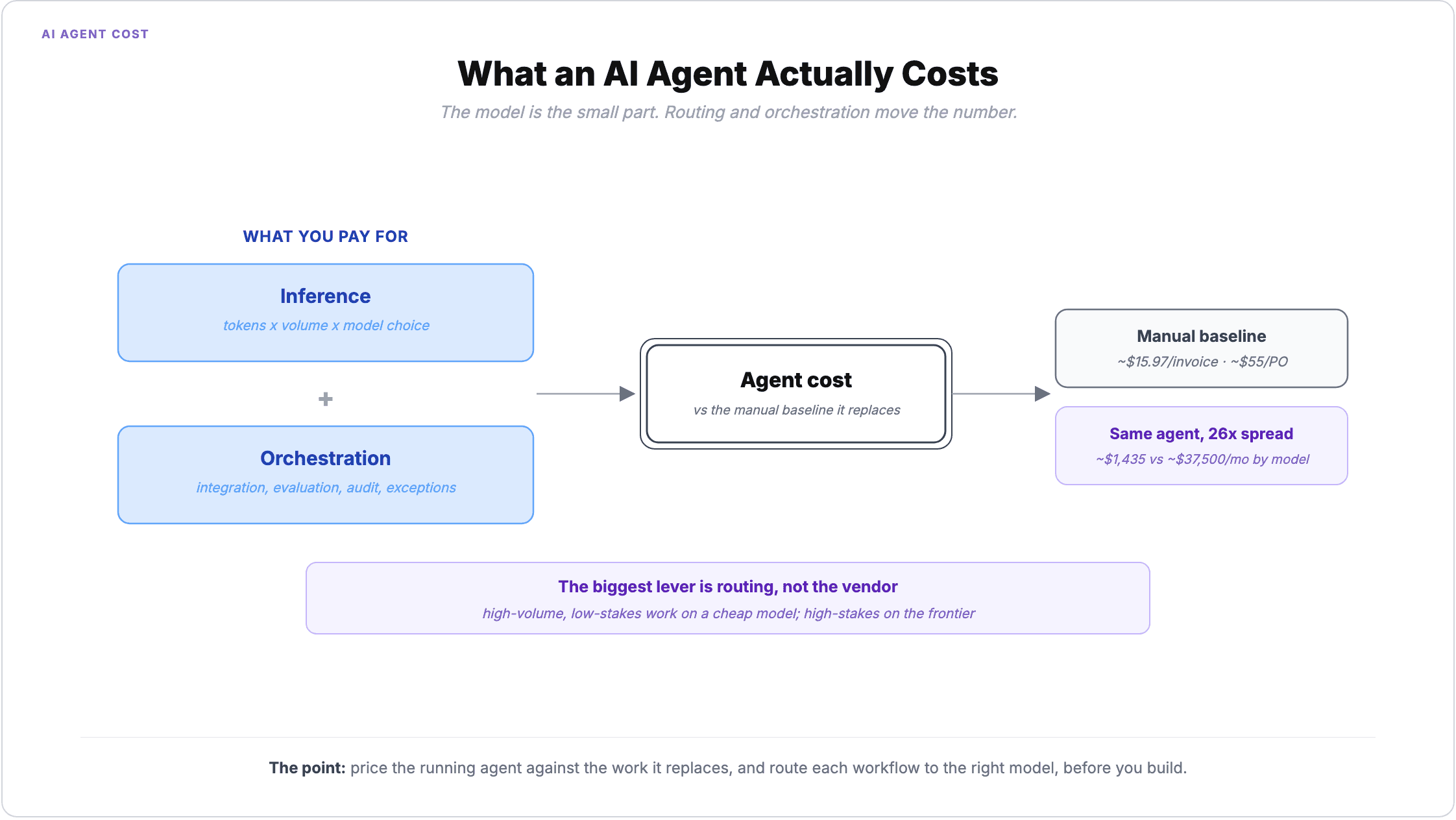
The visible cost is inference: the tokens the model reads and writes on every run. The hidden cost is orchestration: the integration, evaluation, audit trail, and exception handling, the governed platform that decides whether the agent survives contact with production. A cheap model with no orchestration is not a cheap agent; it is a demo that never ships.
Against those costs sits the baseline the agent replaces, which is where the value is. Manual invoice processing runs about $15.97 a document, a purchase order about $55, and both carry error rates and cycle times that cost more than the processing itself.
Why the model choice swings the bill 26x
Inference cost is real, and it is not uniform. In our own model-by-model workload analysis, we priced a typical enterprise agent, 100,000 tokens of context and 5,000 of output per run, about 1,000 runs a day. On a frontier model that agent costs roughly $37,500 a month. On a cheaper open-weight model, about $1,435. Same agent shape, a 26x spread.
That gap is why the cost conversation has to start with routing, not procurement. A high-volume, lower-stakes agent belongs on the cheap model; a high-stakes one that has to finish the job belongs on the frontier. Paying frontier prices for work a cheaper model handles is the most common way agent budgets balloon.
Cost layer | What it is | What moves it |
|---|---|---|
Inference | tokens in and out per run | model choice (up to 26x), context size, run volume |
Orchestration | integration, evaluation, audit, exceptions | build vs platform, governance requirements |
Baseline replaced | manual cost of the task | ~$15.97/invoice, ~$55/PO, plus error and delay |
What drives an agent's cost up or down
Three levers set the number, and none of them is the vendor's logo.
Volume — cost scales with runs, so the highest-volume workflow is where the math is best.
Context size — every token in the prompt is paid on every run; tighter context is cheaper.
Model routing — the right model per job, not one model for everything, is the single biggest lever.
Get those right and the agent runs at a fraction of the manual baseline. Get them wrong and you can spend frontier money on a task that never needed it.
How to model it before you build
The way to avoid an over-priced agent is to model the payback on a specific workflow first, using inputs you already have: the task volume, the manual time per item, and your fully-loaded cost. That gives you the operating benefit, and netting it against the build gives ROI and payback.
Our AI ROI calculator runs exactly this across finance, recruiting, and BPO workflows as a planning estimate, so you can see the number on your own volumes before committing. The point is to pick the workflow where the payback is clearest, prove it, then scale, rather than pricing a model in the abstract.
Common questions about AI agent cost
How much does an AI agent cost to run?
It depends on volume and model choice more than the vendor. A typical enterprise agent (100k tokens in, 5k out, ~1,000 runs a day) can cost about $37,500 a month on a frontier model or about $1,435 on a cheaper open-weight one, plus the orchestration around it.
Why is the same AI agent so much cheaper on one model than another?
Inference is priced per token, and model prices span nearly two orders of magnitude. The same agent shape can run 26x cheaper on a cheaper model, which is why routing each workflow to the right model matters more than the sticker price.
What is the biggest driver of AI agent cost?
Model routing. Running every workflow on a frontier model, including the high-volume low-stakes ones that a cheaper model handles fine, is the most common reason agent budgets balloon.