By submitting, you consent to our use of your data. Privacy Policy.
Kategorie
KI-Agenten
Artikel teilen
Procurement runs on documents and approvals, which is exactly the work an AI agent is built for. It does not set your sourcing strategy or negotiate the contract. It clears the requisition-to-PO grind that sits between a request and a delivery, and that grind is more expensive than most teams realize.
The median company spends about $55 to process a single purchase order, and top performers issue one in roughly five hours while laggards take up to 48, according to APQC benchmark data across thousands of organizations. Across thousands of POs a year, that gap is real money and real cycle time. Here is what AI agents automate in procurement, the numbers behind it, and where a buyer still has to decide.
What is a procurement AI agent?
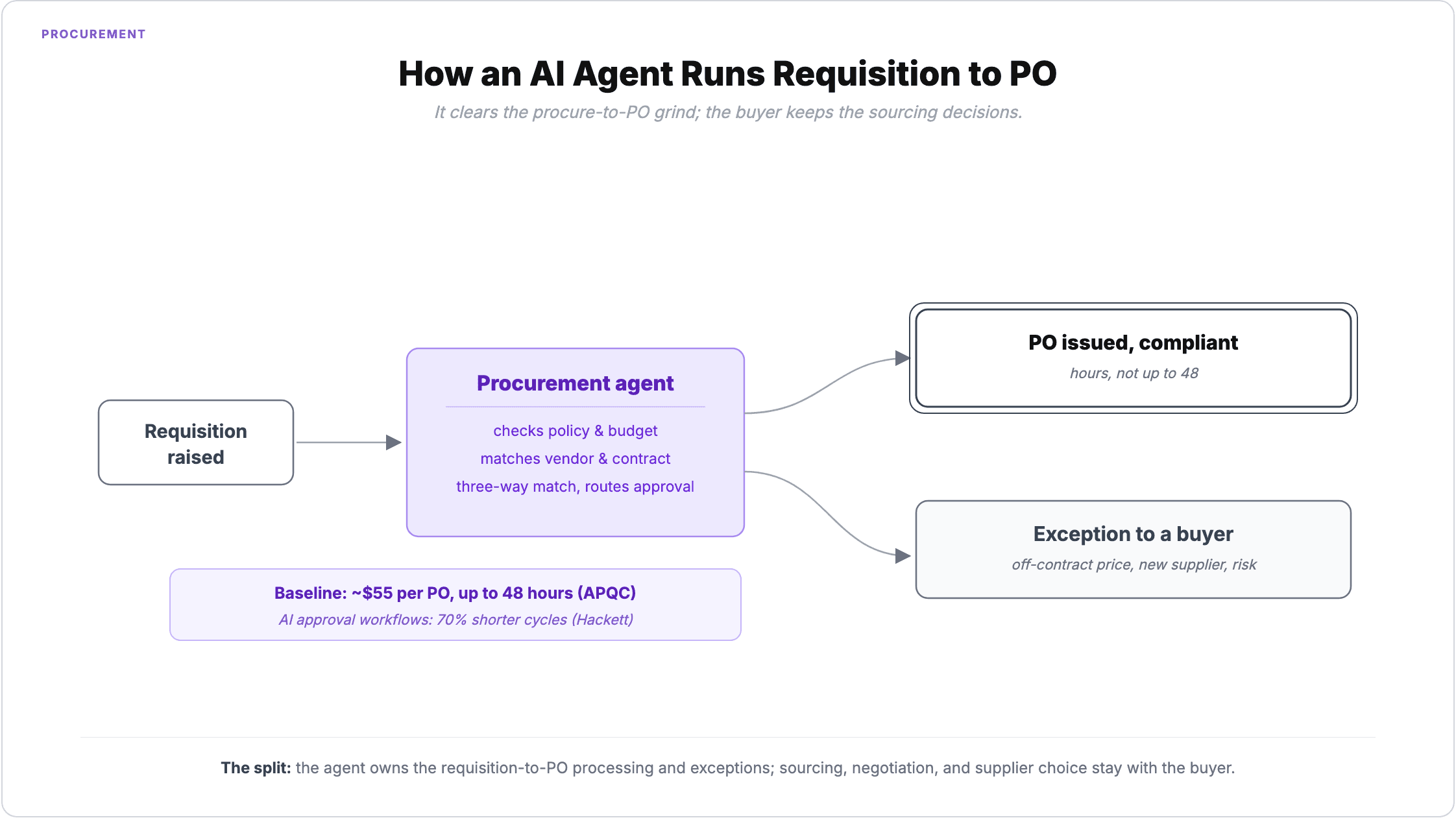
A procurement AI agent handles the operational steps of buying as a multi-step task, not a single reply. It reads the requisition, checks it against policy and budget, matches it to the right vendor and contract, routes the approval, and issues the PO, with a person reviewing the exceptions.
The distinction from a workflow tool matters. A rules engine routes a form; an agent reads a messy requisition, resolves the vendor from a half-complete name, flags that the price is above the contracted rate, and drafts the PO ready to send. It handles the judgment-shaped parts that used to stop and wait for a human.
What AI agents automate in procurement
The wins are the high-volume, rule-heavy steps of procure-to-pay that eat a buyer's day.
Requisition intake and validation — reading the request, checking policy, budget, and completeness.
Vendor and contract matching — resolving the supplier and pulling the contracted terms.
Three-way matching — reconciling the PO, the goods receipt, and the invoice, and flagging the mismatch.
Approval routing — sending each request to the right approver with the context attached.
Supplier onboarding — collecting and verifying the documents a new vendor needs to be set up.
The pattern is consistent: the agent owns the repetitive processing and the exception handling, and the sourcing decisions stay with the category manager.
What it actually saves
The savings come from speed and consistency at volume. Hackett Group found that top-performing procurement teams run requisition-to-PO cycles 58% faster than their peers, and that AI-driven approval workflows cut approval time by 70%.
Put that against the APQC baseline of $55 per PO and a cycle time that stretches to 48 hours at the bottom, and the math is straightforward. An agent that issues a compliant PO in hours instead of days, at a fraction of the touch cost, compounds across every transaction the business runs.
In our own deployments, procurement is one of the workflows Beam agents run for finance and operations teams, alongside AP and reconciliation, at high task accuracy with a human on the exceptions. The model matters less than the orchestration: the agent has to act inside your ERP and P2P systems, not beside them.
Procure-to-PO step | Manual baseline | With an AI agent |
|---|---|---|
Cost per PO | ~$55 (APQC median) | A fraction of the touch cost |
Requisition-to-PO cycle | up to 48 hours (bottom quartile) | hours, not days |
Approval routing | manual chase | 70% shorter (Hackett, AI workflows) |
Three-way match | line-by-line by hand | agent matches, flags the exception |
Consistency | policy applied unevenly | same rules on every request |
Where a buyer still decides
Being clear about the limit is what makes the automation safe to run. Agents own the process, not the strategy.
Sourcing decisions, supplier negotiations, contract terms, and any spend that carries real risk or ambiguity stay with a category manager. An agent can prepare the analysis and surface the outliers; it should not pick the supplier or sign the deal. The right design keeps buyers on exactly that work and takes the PO grind off their plate.
How to deploy AI agents in procurement
The pattern that works is the same across finance operations. Agents sit on top of the ERP and procurement systems you already run, follow your existing policy and approval matrix, and keep a human on the exceptions.
What makes it production-grade is the governance around it: permissions scoped to the task, an audit trail on every action, and control over spend thresholds, which is why a governed agent platform matters more than the model underneath. Most teams start with one high-volume step, three-way matching or requisition intake, prove the accuracy, then expand across procure-to-pay.
Common questions about AI agents in procurement
What can a procurement AI agent actually do?
It reads requisitions, checks them against policy and budget, matches vendors and contracts, runs three-way matching, routes approvals, and issues purchase orders, handling the routine volume end to end and escalating exceptions to a buyer.
How much do AI agents save in procurement?
The baseline is about $55 per PO and cycle times up to 48 hours (APQC). Hackett found AI-driven approval workflows cut approval time 70% and top teams run requisition-to-PO 58% faster, so the savings are in touch cost and cycle time at volume.
Do AI agents replace procurement teams?
No. They automate the requisition-to-PO processing and exceptions, while sourcing strategy, negotiation, and supplier decisions stay with category managers.