
By submitting, you consent to our use of your data. Privacy Policy.
Category
AI Agents
Share the article
Onboarding is where a signed customer or a hired employee waits, and waiting is expensive. Between 30 and 50% of customer churn happens in the first 90 days, average onboarding completion sits around 35%, and every new employee takes about 26 weeks to reach full productivity. The bottleneck is rarely the welcome; it is the operational setup underneath it.
That setup, collecting documents, verifying identity, provisioning accounts, is exactly what an AI agent handles. Here is what onboarding agents automate, on both the customer and the employee side, and where a person still belongs.
What is an onboarding AI agent?
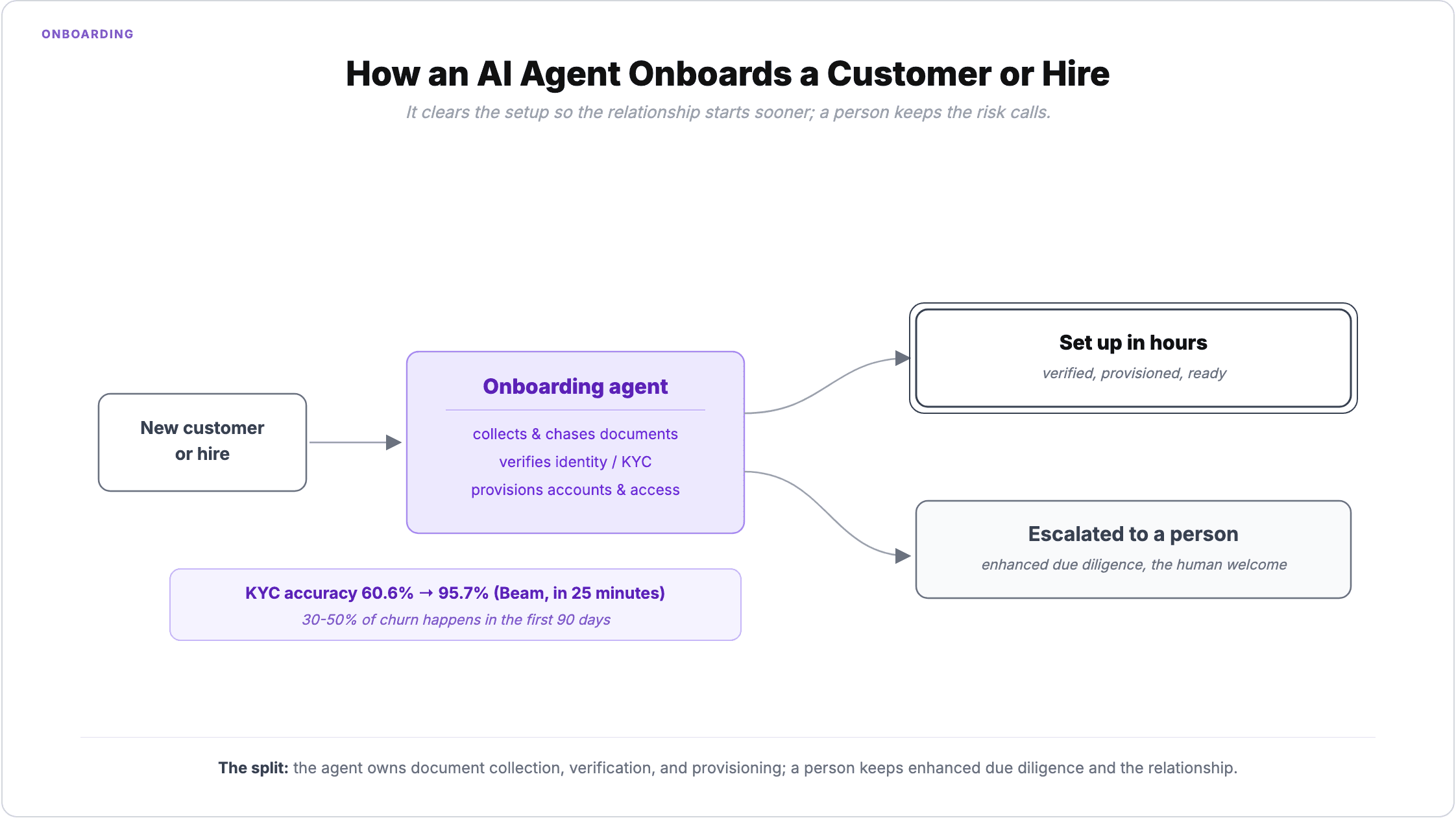
An onboarding AI agent runs the operational steps of getting someone set up as a multi-step task. It requests and reads the required documents, verifies them, creates and configures the accounts, and chases what is missing, with a person handling the judgment calls.
The difference from a checklist tool is that the agent does the work, not just track it. A checklist reminds someone to verify an ID; an agent reads the ID, checks it against the record and the sanctions list, flags the mismatch, and moves the file forward, so onboarding stops stalling on manual steps.
What AI agents automate in onboarding
The wins are the document-and-provisioning steps that make onboarding slow.
Document collection and chasing — requesting, receiving, and following up on what is missing.
Identity verification and KYC — reading IDs and proofs, checking them against records and watchlists.
Account and access provisioning — creating and configuring the systems a customer or employee needs.
Data entry into core systems — posting the verified details into the CRM, core banking, or HRIS.
Status and reminders — keeping the person informed and the process moving.
The pattern holds across customer and employee onboarding: the agent owns the operational setup, and a person handles the exceptions and the relationship.
What it actually saves
On the customer side, speed protects revenue. With 30 to 50% of churn landing in the first 90 days and completion averaging 35% against a best-in-class 67%, taking days out of setup directly protects retention.
The accuracy is real where it is hardest. At a European neo-bank, Beam agents took KYC document verification from 60.6% to 95.7% accuracy within 25 minutes of learning the country-specific formats, which is the exact step that stalls account onboarding. On the employee side, onboarding a hire costs $4,100 or more (running to $7,500-28,000 all in), and an agent takes the paperwork and provisioning off a manager's plate so the 26-week ramp starts sooner.
Onboarding step | Manual | AI agent |
|---|---|---|
Document collection | manual chase | requested, read, followed up automatically |
Identity / KYC | 60.6% accuracy (neo-bank baseline) | 95.7% (Beam, in 25 minutes) |
Account provisioning | ticket queue | created and configured directly |
Time to set up | days | hours |
Where value shows | churn in first 90 days | faster time-to-value, retention |
Where a person still belongs
The limit keeps it trustworthy. Agents own the setup, not the relationship or the risk call.
A high-risk customer that needs enhanced due diligence, a document that genuinely does not reconcile, the human welcome and the first real conversation: those stay with a person. The agent clears the operational path so the customer success manager or the hiring manager spends their time on the relationship, not the paperwork.
How to deploy AI agents for onboarding
The pattern is the same across functions. Agents sit on top of the CRM, core system, or HRIS you already run, follow your existing verification and provisioning rules, and keep a human on the exceptions.
Governance is what makes it safe, especially for identity data: permissions scoped to the task, an audit trail on every verification, and control over where personal data lives, which is why a governed agent platform matters more than the model. Most teams start with the single most-stalling step, document collection or KYC, prove it, then extend across the flow.
Common questions about AI agents for onboarding
What does an onboarding AI agent do?
It collects and reads the required documents, verifies identity (including KYC), provisions accounts and access, posts the details into your core systems, and keeps the process moving, escalating exceptions to a person.
How does AI onboarding reduce churn?
Between 30 and 50% of churn happens in the first 90 days, and completion averages just 35%. By taking days out of document collection, verification, and setup, an agent gets a customer to value faster, which is what protects retention.
Does it work for employee onboarding too?
Yes. The same agent handles the paperwork, verification, and account provisioning for new hires, taking those tasks off a manager so the 26-week ramp to full productivity starts sooner.