5 min leer
Grok Bot for Enterprise AI Agents: What the $120 Teammate Can and Can't Do in 2026


By submitting, you consent to our use of your data. Privacy Policy.
Categoría
Agentes de IA
Compartir artículo
The newest way an AI agent enters your company is not through procurement. It signs in with someone's personal subscription, on their own laptop, and starts doing real work before IT knows it exists.
That is the shift Grok Bot represents. xAI (now SpaceXAI) launched it in August 2026 as a team of persistent AI agents, each running on its own cloud computer, that sign into your existing tools and complete multi-step work on their own. It is bundled into consumer plans from $120 per seat a month, which means it reaches employees through subscriptions, not a security review.
Grok Bot is a genuinely capable product. It is also a self-serve teammate, not a governed enterprise deployment, and for anyone putting agents near production systems that difference is the whole story.
What is Grok Bot?
Grok Bot is a system of persistent, named AI agents from xAI. Each one operates through its own cloud computer, keeps working after you close your laptop, and signs into applications and websites the way a person does, without needing an API.
It is built for real work, not chat. xAI positions it around sales outbound, marketing campaigns, expense management, bug fixes, vendor negotiations, and CRM updates, with agents that return to you when a decision or approval is needed. Bots can also delegate to other Bots in shared threads, so a "Chief of Staff" agent can coordinate specialist ones.
Pricing puts it in individual hands: roughly $120 per seat a month on Cursor Premium Teams, $200 a month via Cursor Ultra, and included in SuperGrok Heavy at $300 a month (per VentureBeat). It runs on macOS, Windows, Linux, and iOS.
What it's genuinely good at
The design solves a real problem: agents that act in the messy tools you already run. Because Grok Bot signs in like a human, it works against legacy systems that have no clean API or MCP integration, which is where a lot of enterprise work actually lives.
Persistent, unattended work. Each Bot has its own computer and keeps going 24/7, so long tasks do not stall when you step away.
No-API reach. It operates websites and apps directly, so it covers legacy tools that never exposed an integration.
Multi-agent delegation. A coordinating Bot can split work across specialist Bots in a shared thread, which is a clean pattern for multi-agent orchestration.
For an individual power user or a small team, that is a strong offer. The friction starts when the same agent touches systems the whole business depends on.
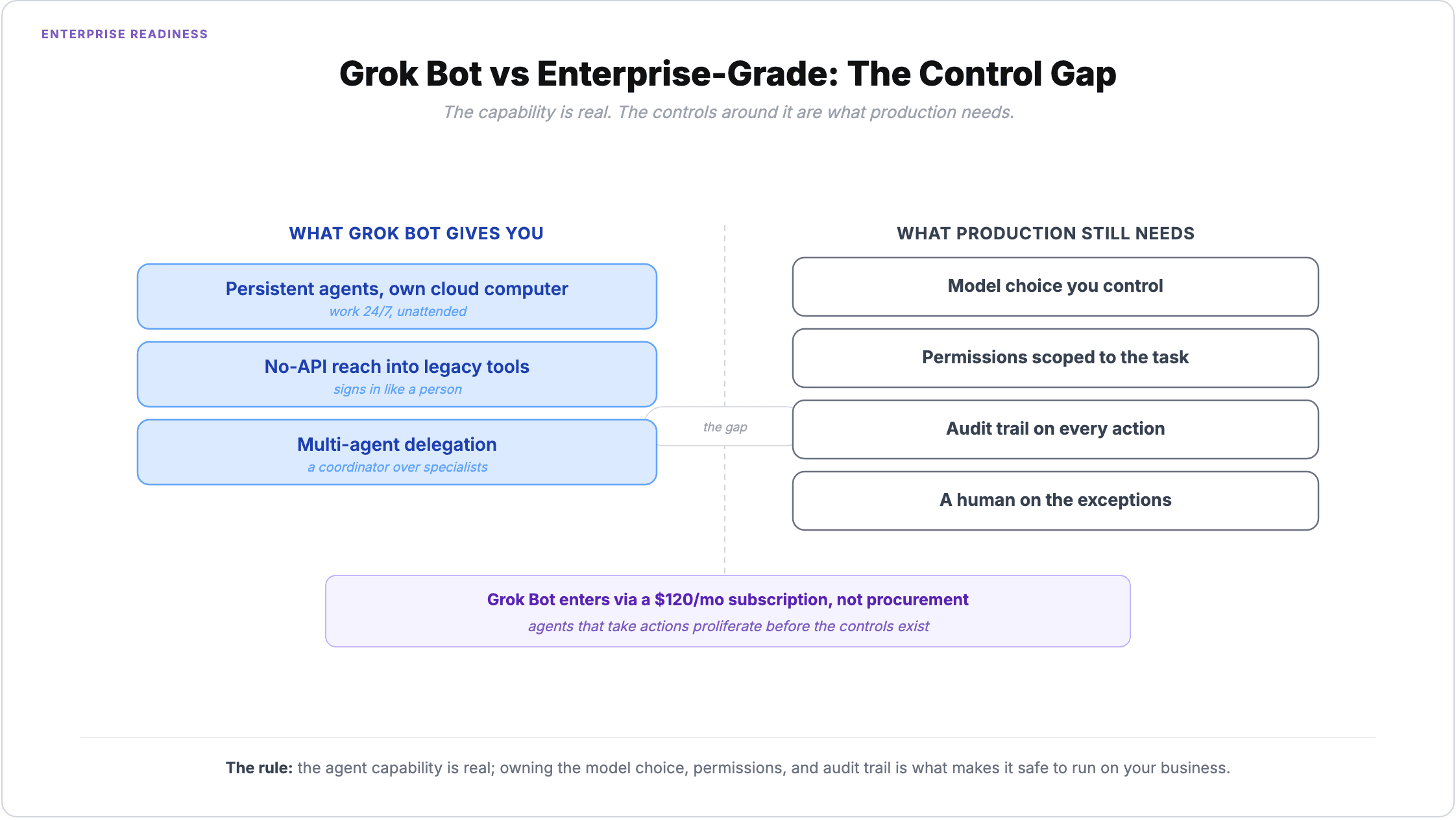
Where it falls short for enterprise
The gaps are not capability gaps. They are control gaps, and VentureBeat's own review names them.
You do not choose the model. Grok Bot routes to models automatically on the backend, and the reviewers noted the router "wasn't great" in testing, with no way for the user to override it. For a production workflow, an opaque model choice you cannot pin is a reliability and compliance problem.
There is no enterprise control layer in the box. Running agents against CRM records, support queues, and financial systems needs scoped permissions, clear escalation rules, and an audit trail on every action. A consumer subscription ships none of that, which is why "capable" and "safe to run on your business" are different questions.
And the entry path is the risk. When agents arrive through individual subscriptions, they proliferate inside the company before any governance framework exists, alongside Claude's agents, Microsoft Copilot's, and OpenAI's. That is shadow IT with the ability to take actions, not just read data.
For running business workflows | Grok Bot | Governed agent platform |
|---|---|---|
How it enters the company | Individual subscription | Procurement and security review |
Model choice | Auto-routed, not user-controlled | Routed per task, you choose |
Permissions | Consumer-grade | Scoped to the task |
Audit trail on every action | Not built in | Required, standard |
Best fit | Individual and small-team productivity | Production business processes |
How to bring agents like this into an enterprise safely
The answer is not to ban them. It is to give the capability a control layer, so the parts that decide whether an agent belongs near production are handled outside the model.
Model choice per task, not an opaque backend router you cannot see.
Permissions scoped to the job, so an agent can do one thing, not everything the logged-in user can.
An audit trail on every action, because "who approved this and why" is a question every regulated business will be asked.
A human on the exceptions, with clear escalation when the agent should stop and ask.
This is the layer we run at Beam. For enterprise finance and operations AI agents, we route across models per workload and keep the audit trail and permissions in our control, not the model vendor's. The agent capability Grok Bot demonstrates is real. Owning the governance around it is what makes it deployable.
Who is accountable when the agent acts
Grok Bot proves that always-on, tool-using agents are ready for real work. It does not answer the enterprise question, which was never whether the agent works. It is who is accountable when it does the wrong thing, and whether you can prove what it did.
Answer that with model choice, scoped permissions, and an audit trail, and an agent like this earns a place in production. Skip it, and you have deployed a capable coworker no one can govern.
Common questions about Grok Bot for enterprise
Is Grok Bot enterprise-ready?
For individual and small-team productivity, yes. For production business workflows, not on its own: it lacks user-controlled model selection, scoped permissions, and a built-in audit trail, which regulated and enterprise buyers require before an agent touches core systems.
How much does Grok Bot cost?
Access starts at about $120 per seat a month on Cursor Premium Teams, $200 a month via Cursor Ultra, and is included in xAI's SuperGrok Heavy plan at $300 a month. It runs on macOS, Windows, Linux, and iOS.
Grok Bot vs Microsoft Copilot and Claude agents: what's the difference?
All three put always-on agents inside your tools, so the differentiator is governance, not capability. The enterprise question for any of them is whether you control the model, the permissions, and the audit trail, or the vendor does.