7 min leer
Muse Spark 1.3 for AI Agents: Frontier-Level Intelligence at the Lowest Cost per Task


By submitting, you consent to our use of your data. Privacy Policy.
Categoría
Agentes de IA
Compartir artículo
The interesting number in a model launch is rarely the top-line score. It is the score next to the price, and on that measure Meta just moved the market: Muse Spark 1.3 ties the frontier on general intelligence while costing the least per task of anything in its tier.
Meta launched Muse Spark 1.3 on 2 September 2026, its fourth Muse Spark release in five months, in Muse Code and the Meta Model API. The available version scores 61 on the Artificial Analysis Intelligence Index, level with GPT-5.6 Sol and Grok 4.6, and it gets there while remaining the cheapest strong model per task. That combination is what should change which model runs your high-volume agents, with the usual caveat that these are launch-day benchmarks.
What is Muse Spark 1.3?
Muse Spark 1.3 is Meta's latest model for coding and agentic work, available now in Muse Code and via the Meta Model API. It is a fast model, generating around 235 tokens per second, second only to Google's Gemini 3.8 Flash among the current releases.
The pace is the context. Muse Spark has gone from an Intelligence Index of 53 in July to 57 in August to 61 now, a four-point jump per release, so the line Meta is pushing is accessible high performance that keeps getting cheaper to run. A higher "max" variant scores 62 in limited partner preview, sitting behind only Claude Fable 5.1 and Opus 5.
How good is it for agents, really?
Strong on the launch evidence, and strongest exactly where agents live: coding and tool use. It scores 75.4 on DeepSWE v1.1, 88.8 on Terminal-Bench 2.1, and 59.4 on SWEAtlas CodeBase QnA, leading the coding-related benchmarks at its tier.
The standout is efficiency, not a single headline score. Muse Spark reaches a top-tier intelligence level at roughly $0.40 per task on the Intelligence Index, against about $0.86 for Kimi K3 and $1.18 for GPT-5.5 at a similar level. Meta also reports the model sustains longer workflows and asks clarifying questions, using about 20% fewer tool calls and 25% fewer tokens to finish the job, vendor figures worth testing, but pointed in the direction that matters for cost at scale.
For agent work | Muse Spark 1.3 | GPT-5.6 Sol | Claude Opus 5 |
|---|---|---|---|
Intelligence Index | 61 | 61 | higher tier |
Terminal-Bench 2.1 (agentic coding) | 88.8 | strong | 89.1 |
DeepSWE v1.1 (long-horizon SWE) | 75.4 | 72.7 | 74.0 |
Output speed | ~235 tok/s | slower | slower |
Cost per task at tier | lowest of the group | mid | highest |

Where Muse Spark 1.3 fits in an agent stack
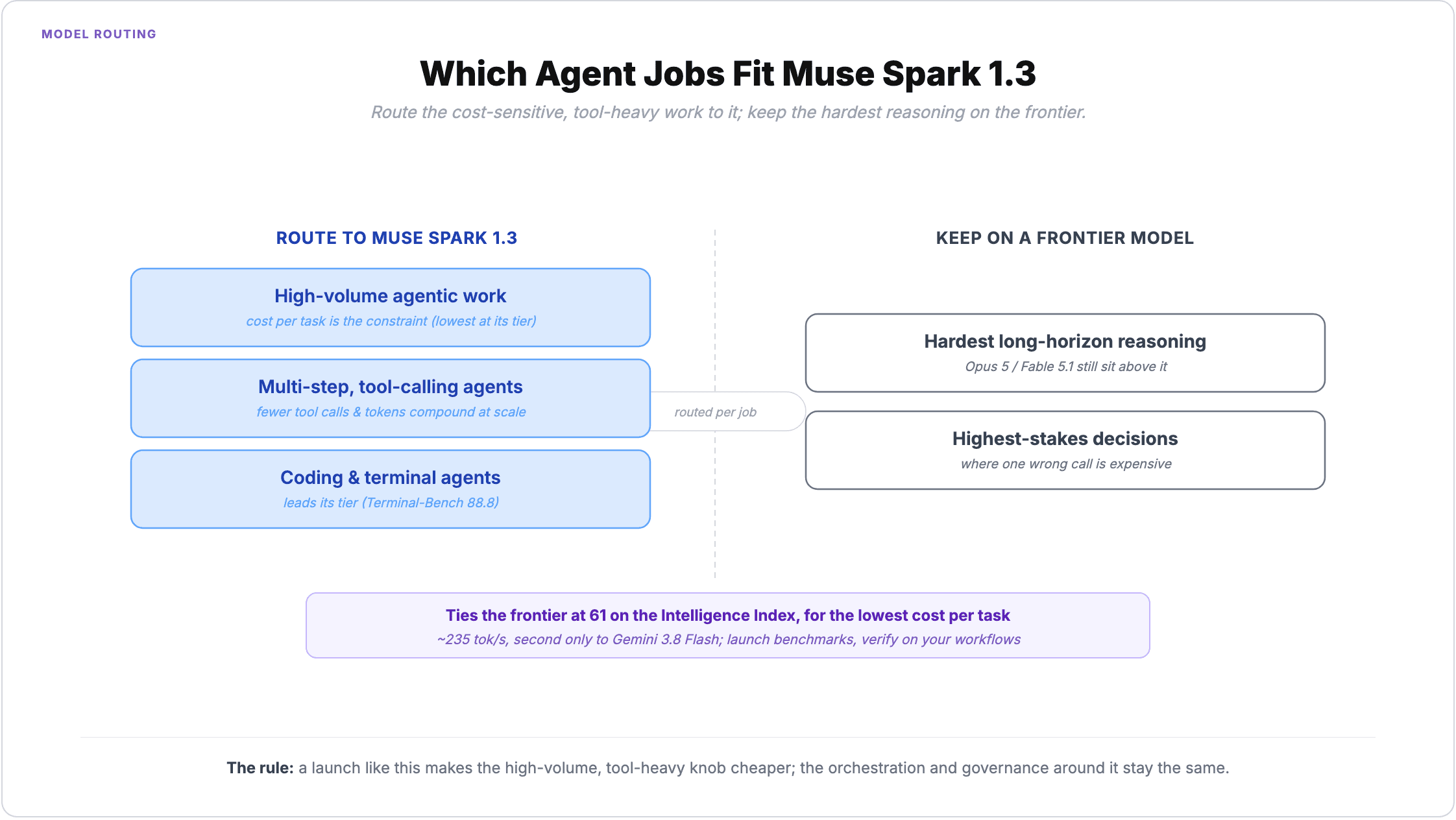
The result does not mean standardize on Muse Spark. It means route the cost-sensitive, tool-heavy work to it. At Beam we run production agents on whichever model fits the job, and 1.3 earns a specific and large set.
High-volume agentic work where cost per task is the constraint, which is most of a back office.
Multi-step, tool-calling agents where its efficiency (fewer tool calls and tokens) compounds across thousands of runs.
Coding and terminal agents, where it leads its tier on the benchmarks.
Keep the hardest long-horizon reasoning on a frontier model like Claude Opus 5 or Fable 5.1, which still sit above it on the Index. The point is a model-agnostic stack that routes per job, not one model for everything.
Where is the early consensus heading on Muse Spark 1.3?
In the first days after launch, the online consensus among agent developers is forming in two directions at once. The praise is consistent: it is fast, cheap, and genuinely good at calling tools, which matches the launch data. The doubts are about reliability under real work, and they are worth reading before you route production traffic to it.
The recurring early observations:
The benchmark-to-repo gap. The loudest theme is that the scores read better than the day-to-day experience, the familiar warning that a model can be tuned to the leaderboard. Treat the Intelligence Index as a signal, not a guarantee, and test on your own tasks.
Looping and wasted context. Several reports describe agents re-reading or rewriting the same file moments after creating it, editing and then undoing their own work, which burns context and stalls a run.
Confident but unfinished. A common complaint is a model that announces each step as done or fixed while parts of the task are still missing, so progress has to be checked rather than trusted.
Uneven by domain. Reports are strong on frontend work and noticeably weaker on some languages, with Rust called out as a low point. Capability is not uniform across the jobs you might hand it.
There is also a data-governance point worth pinning down, and it is a documented one rather than a rumor. Meta's low-cost Contributor tier trades a large discount for the right to train on your inputs and outputs, while the standard tier does not. Match the tier to the sensitivity of the work, and confirm the exact training and retention terms before you send anything regulated through it.
The caveat that matters most is that this is early. These are first impressions on a model that is only days old, drawn from public benchmarks and individual developer runs rather than months of production use. Early consensus tends to overweight the loudest experiences in both directions, and the full picture, how 1.3 holds up at scale, across languages, and inside a governed workflow, will take weeks to settle. Treat the current signal as a reason to pilot, not a verdict.
None of this cancels the value, it sharpens where it is. A cheap, fast, strong-tool-use model is exactly what you want for high-volume agent work, provided the layer around it catches the failure modes above: a check that each step actually finished before the run moves on, retries and guardrails that stop the looping, and evaluation on your own repository and harness rather than a public benchmark.
Two launches in one day, and the real lesson
Muse Spark 1.3 shipped the same day as Gemini 3.8 Flash, and both tell the same story: near-frontier intelligence is getting cheaper and faster on a monthly cadence. When the model layer improves this quickly, standardizing on any single one is a bet you will keep re-making.
That is why the durable advantage is not the model, it is the layer around it. The teams that benefit from a launch like this are the ones whose orchestration, evaluation, and governance let them route to a new model in a day instead of rebuilding for a quarter. The model keeps getting cheaper; the ability to adopt it safely is the moat.
How to put it to work
The pattern survives every release. Route each workflow to the model that fits it, keep the evaluation, audit trail, and human-in-the-loop in your control, and swap models as new ones ship without rewriting the agent.
That is how we run it at Beam: for finance and operations AI agents, the model is one knob, and Muse Spark 1.3 makes the high-volume, tool-heavy knob cheaper. The orchestration, integration, and audit trail are what make any of them hold up in production.
Common questions about Muse Spark 1.3 for agents
Is Muse Spark 1.3 good enough for production AI agents?
On the launch benchmarks, for most of them: it ties the frontier on general intelligence (61), leads its tier on coding and terminal tasks, and does it at the lowest cost per task. Early hands-on reports are more mixed, with looped file edits, over-confident "done" claims, and uneven results by language (Rust a weak spot), so keep the hardest long-horizon reasoning on a frontier model and pilot it on your own repository and harness before you commit.
Muse Spark 1.3 vs GPT-5.6 Sol: which is better for agents?
They tie on the Intelligence Index at 61, and Muse Spark 1.3 edges ahead on long-horizon coding (DeepSWE v1.1 75.4 vs 72.7) while costing less per task. GPT-5.6 Sol remains a strong, widely-integrated option; most production stacks route across both.
Is Muse Spark cheap to run?
It is the cost-efficiency leader among top scorers, reaching a top-tier intelligence level at roughly $0.40 per task, well under comparable models, which is the main reason it matters for high-volume agents.