By submitting, you consent to our use of your data. Privacy Policy.
Categoría
Agentes de IA
Compartir artículo
At scale, picking a model for an AI agent stops being a preference and becomes a routing decision. No single model is right for every job, and DeepSeek V4 next to Claude Fable 5 is the clearest case for why you should stop looking for one.
DeepSeek V4 is an open-weight model that matches the Western frontier on coding benchmarks at a fraction of the price. A fresh V4 Pro snapshot and DeepSeek's Harness agent framework crossing 141,000 GitHub stars in days put it back at the top of every "should we switch" thread this quarter.
Independent testing tells a more useful story than the benchmark headline. The US government's CAISI evaluation puts DeepSeek V4 roughly eight months behind the frontier: cheap and genuinely capable, but not a drop-in replacement for Claude Fable 5. The right question is which agent jobs each should run.
What is DeepSeek V4?
DeepSeek V4 is an open-weight, Mixture-of-Experts model from the Chinese lab DeepSeek, released under an MIT license. The Pro variant runs 1.6 trillion total parameters, with 49 billion active per token and a 1-million-token context window, which is the part that matters for document-heavy agent work.
The appeal is cost and control. DeepSeek reaches near-frontier coding scores for a fraction of what a closed frontier model charges, and because the weights are MIT-licensed you can run it inside your own cloud with zero outbound API calls. For a high-volume agent, that combination is hard to ignore.
How good is it for agents, really?
The number to trust is the independent one, not the vendor's. CAISI found DeepSeek V4 is the most capable Chinese model it has tested, and also that its capabilities "lag behind the frontier by about 8 months," with an aggregate Elo of 800 against GPT-5.5's 1260.
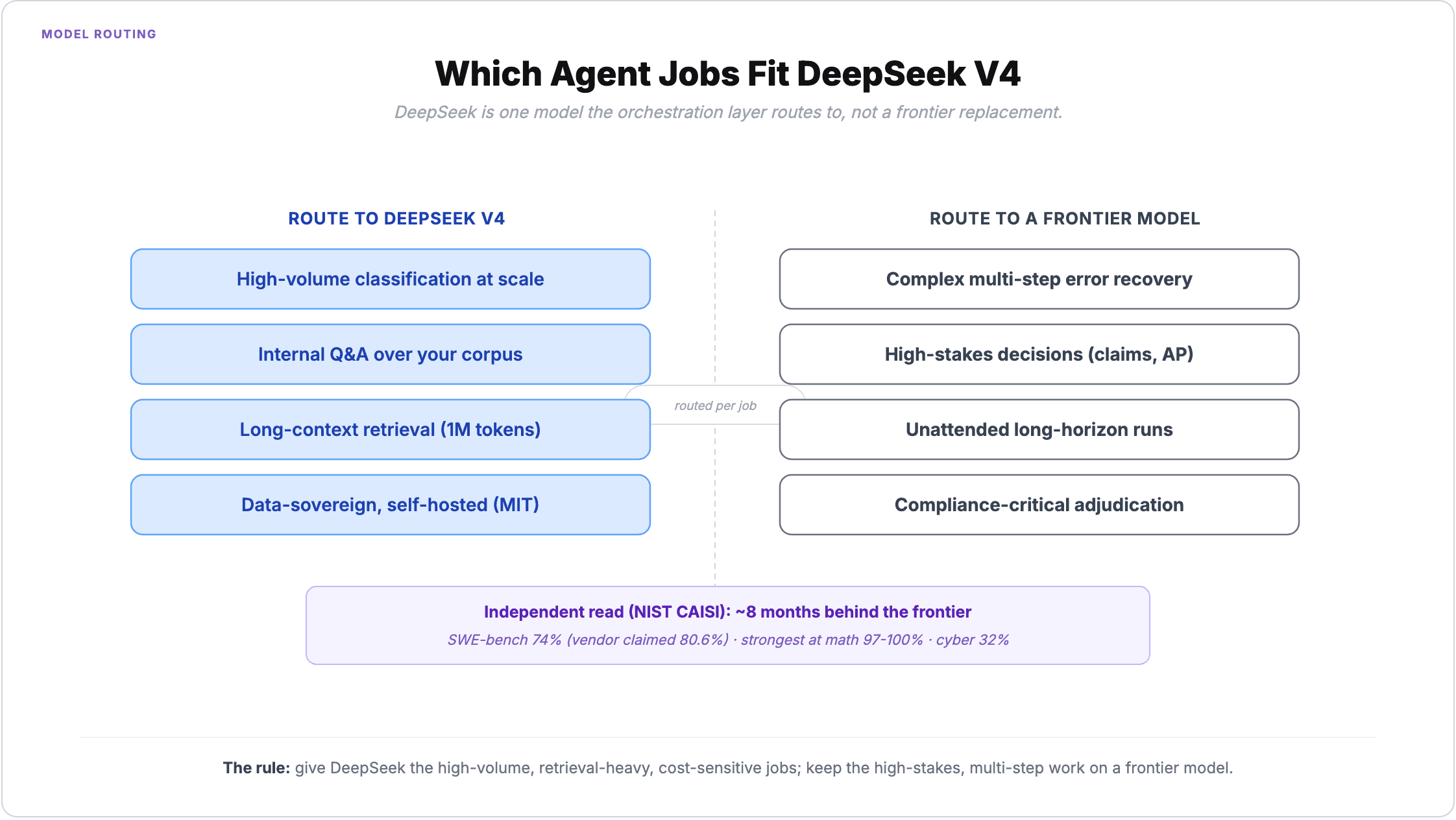
The per-benchmark picture is what tells you where it belongs. On CAISI's own runs, DeepSeek scored 74% on SWE-bench, below the 80.6% the vendor reported, alongside 90% on GPQA-Diamond and 97-100% on mathematics, its strongest domain, but only 32% on the cyber benchmark. Strong at math and knowledge, competitive on code, thinner on the harder reasoning that long agent workflows lean on.
That profile maps cleanly onto a comparison most teams are actually running:
For agent work | DeepSeek V4 (self-hosted) | Claude Fable 5 |
|---|---|---|
Monthly cost, ~1k agent runs/day* | ~$1,400 | ~$37,500 |
SWE-bench, independent (NIST CAISI) | 74% | ~95% |
Context window | 1M tokens | 1M tokens |
Weights / licence | Open, MIT, self-hostable | Closed, API only |
Multi-step recovery in unfamiliar workflows | Less reliable | Strong |
Where it fits | High-volume, retrieval, data-sovereign | High-stakes, long, unattended |
*Cost from our own model-by-model workload math: one agent, 100k input and 5k output tokens per run, ~1,000 runs a day. Same agent, roughly a 26x spread.
The agent work it's genuinely good at
DeepSeek earns the jobs where volume, cost, or data location is the binding constraint. In our production experience running agents for finance and operations teams, it routes to a specific set of workloads.
High-volume, lower-stakes automation, where the inference bill, not the occasional retry, is what you are optimizing. Document classification at scale is the clearest example.
Data-sovereign workloads, where a hosted API is off the table. Because DeepSeek is MIT-licensed, you self-host it in your own VPC and the regulated data never leaves.
Long-context retrieval, where the 1-million-token window lets an agent hold a large corpus and surface the relevant passage, which is where DeepSeek's retrieval genuinely holds up.
Give it the internal Q&A agent over your enterprise corpus, the bulk classification job, the retrieval-heavy task that would be wasteful on a frontier model. That is where the cost gap compounds in your favor and the reliability gap never surfaces.
Where it falls short
The weakness shows up the moment a workflow gets long and unfamiliar. When a tool call fails mid-task, DeepSeek's recovery is noticeably less reliable than a frontier model's, which rules it out of complex, multi-step agents that have to handle their own exceptions.
So the high-stakes paths stay on a frontier model by design: claim adjudication, AP exception handling, compliance monitoring, anything where one wrong decision costs more than the entire month's inference bill.
There is a larger point the model debate tends to skip. Roughly 88% of enterprise agent pilots never reach production, and the reasons teams cite are evaluation gaps, governance friction, and reliability. Model selection is not in that top three. The model you pick is downstream of the things that actually stop agents from shipping.
How to run it in production
If DeepSeek fits the workload, the deployment pattern is not "swap the API key." You self-host the weights for data residency, then put the parts that decide whether an agent survives on top of it. Those parts are model-independent:
An evaluation layer that measures whether the agent is actually working.
An audit trail on every action the agent takes.
Permissions scoped to the task, not broad system access.
Exception handling for when the model's recovery falls short.
Keeping that layer separate from the model is the whole point. It lets you route DeepSeek to the high-volume jobs and a frontier model to the high-stakes ones without rewriting the agent when the next model ships.
This is how we run it at Beam. For enterprise finance and operations agents, AP automation, reconciliation, claim processing, we route across models per workload, and the orchestration, integration, and audit trail are what make any of them, DeepSeek included, hold up in production.
Which model runs which job
DeepSeek V4 is not the cheapest way to replace Claude, because it does not replace Claude. It is a strong, cheap, self-hostable option for a specific band of agent work, sitting alongside a frontier model that carries the jobs it cannot.
The teams shipping production AI agents this year are not the ones that chose the single best model. They are the ones that built the routing, evaluation, and governance layer that lets them put the right model on each job. The question was never which model is best. It is which model runs which job.
Common questions about DeepSeek V4 for agents
Is DeepSeek V4 good enough for production AI agents?
For the right jobs, yes. It handles high-volume, cost-sensitive, and long-context retrieval work well, and it can be self-hosted for data residency. It is weaker at complex multi-step error recovery, so keep high-stakes, exception-heavy workflows on a frontier model.
DeepSeek V4 vs Claude Fable 5: which is better for agents?
Neither wins outright. Claude Fable 5 leads on long, high-stakes, unattended work; DeepSeek wins on cost and on data-sovereign, high-volume tasks. Most production deployments route across both per workload rather than standardizing on one.
Is DeepSeek V4 safe to use with enterprise data?
Because it is MIT-licensed and self-hostable, you can run it inside your own VPC and keep regulated data in-house, which avoids the data-residency problem of the hosted API. Governance, audit trails, and scoped permissions still have to sit on top of it.