By submitting, you consent to our use of your data. Privacy Policy.
Categoría
Agentes de IA
Compartir artículo
The short version: an AI agent is a thing, and agentic AI is a property. An AI agent is the software that carries out a task; agentic AI is the capability that lets that software plan, decide, and act on its own instead of waiting for a prompt at every step.
The terms get used interchangeably, which muddies buying decisions, because "we're doing agentic AI" can mean anything from a smarter chatbot to a system that runs a workflow unattended. Here is the real distinction, a clear comparison against the tools it gets confused with, and why the difference changes what you should buy.
What is an AI agent?
An AI agent is a piece of software that completes a task as a sequence of steps: it takes an input, decides what to do, uses tools or systems to do it, and produces a result. A single AI agent handles a defined job, verifying a document, processing an order, reconciling an account, from start to finish.
The defining trait is action. An agent does not just answer; it acts in your systems, and it handles the next step and the exception rather than handing everything back to a person.
What is agentic AI?
Agentic AI is the broader capability, the degree to which a system can operate autonomously toward a goal. It covers planning across multiple steps, adapting when something fails, and coordinating several agents to get a larger job done without a human driving each move.
Put simply, an AI agent is one worker; agentic AI is the property that makes that worker, or a team of them, able to run the process on their own. You build AI agents; agentic AI is what they exhibit when they are good enough to trust with the whole task.
The real difference, next to the tools it gets confused with
The clearest way to see it is against the things people already know.
What it does | Autonomy | Example | |
|---|---|---|---|
Chatbot | Answers a question or routes it | None | "Here's how to reset your password" |
RPA bot | Repeats a fixed, scripted task | None; breaks on change | Copies fields between two screens |
AI agent | Completes a task, handles exceptions | Acts within a defined job | Verifies a KYC document end to end |
Agentic AI | Plans, adapts, coordinates agents | Operates toward a goal | Runs onboarding across multiple agents |
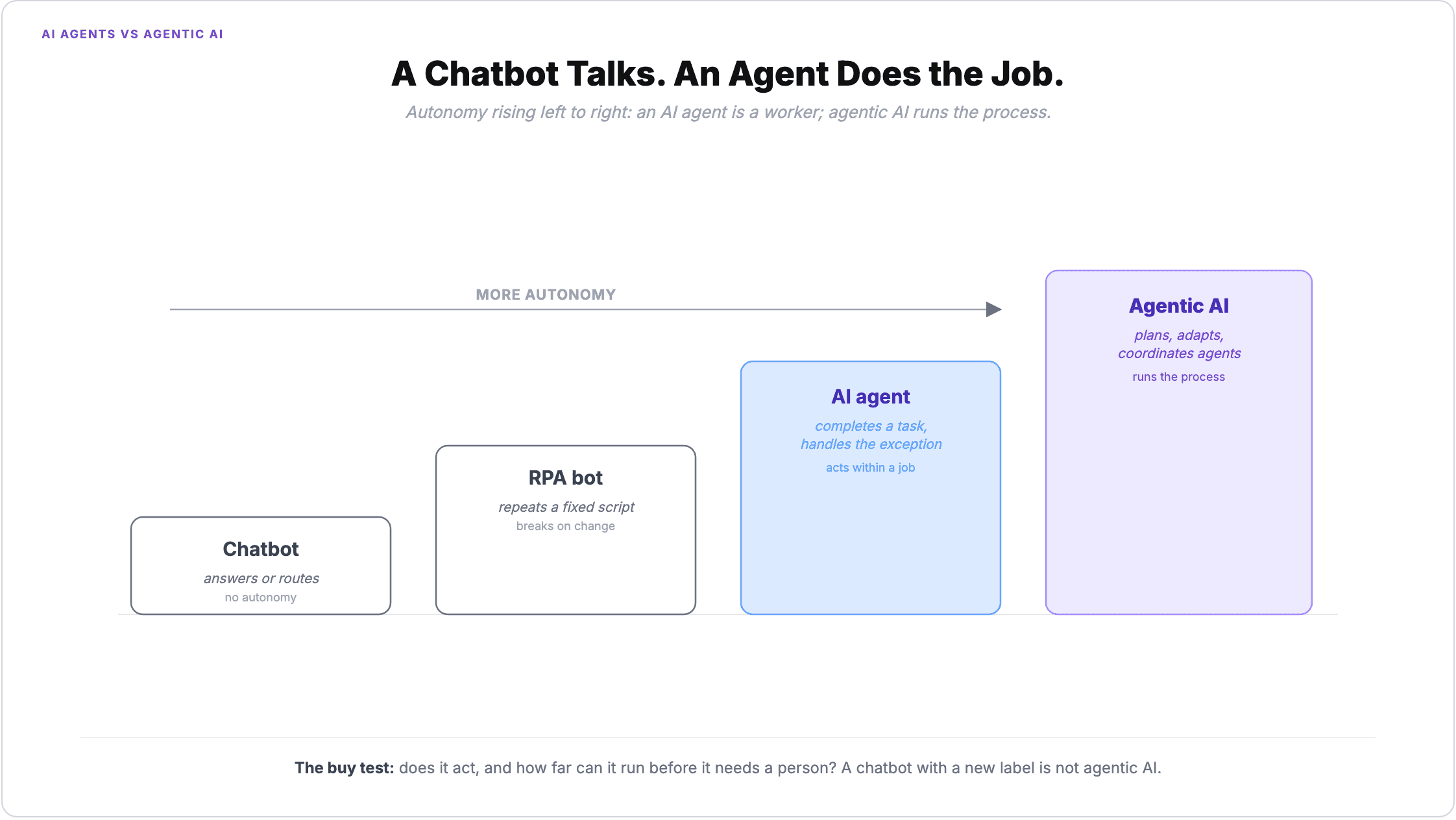
A chatbot talks. RPA repeats. An AI agent does the job. Agentic AI is when agents run the process.
Why the difference matters when you buy
The distinction is not academic; it decides what you are actually purchasing. A vendor selling "agentic AI" that turns out to be a chatbot with a new label leaves the work on your team, while a system with real agentic capability changes the headcount math.
The question to ask is simple: does it act, and how far can it run before it needs a person? A tool judged on whether it resolves the task, not whether it responds, is the one worth buying. That is also why the platform around the model matters: autonomy is safe only with orchestration, governance, and a human on the exceptions, which is what turns an AI agent from a demo into something you run in production.
Common questions about AI agents vs agentic AI
Is there a real difference between AI agents and agentic AI?
Yes. An AI agent is the software that performs a task; agentic AI is the property of acting autonomously, planning, adapting, and coordinating, toward a goal. You build agents; agentic AI is what capable agents exhibit.
Is an AI agent the same as a chatbot?
No. A chatbot answers or routes a question. An AI agent takes the action in your systems and completes the task, handling the exception rather than handing it back.
How is agentic AI different from RPA?
RPA repeats a fixed, scripted sequence and breaks when the input changes. Agentic AI plans and adapts, so it handles the messy, variable work that scripts cannot.