By submitting, you consent to our use of your data. Privacy Policy.
Categoría
Agentes de IA
Compartir artículo
AI agents in insurance are not deciding who gets paid. They automate the routine, unambiguous claims end to end, the ones with clear coverage, two parties, no fraud flags, below a threshold, and route everything else to a human.
That is where insurers are cutting claims processing time in 2026 without taking on decision risk. Here is what AI agents automate in insurance, the results, and the guardrails that make it work.
What do AI agents do in insurance?
AI agents in insurance handle the operational work around a policy or a claim as a multi-step task. They read the submission, pull the policy data, check it against rules, and take the next action, with a human reviewing anything ambiguous.
They are not underwriters or adjusters. The agent gathers and processes; the coverage decision, the fraud judgment, and the disputed call stay with a licensed professional.
That boundary is exactly what makes them safe to deploy on high-volume claims work.
How AI agents automate insurance claims
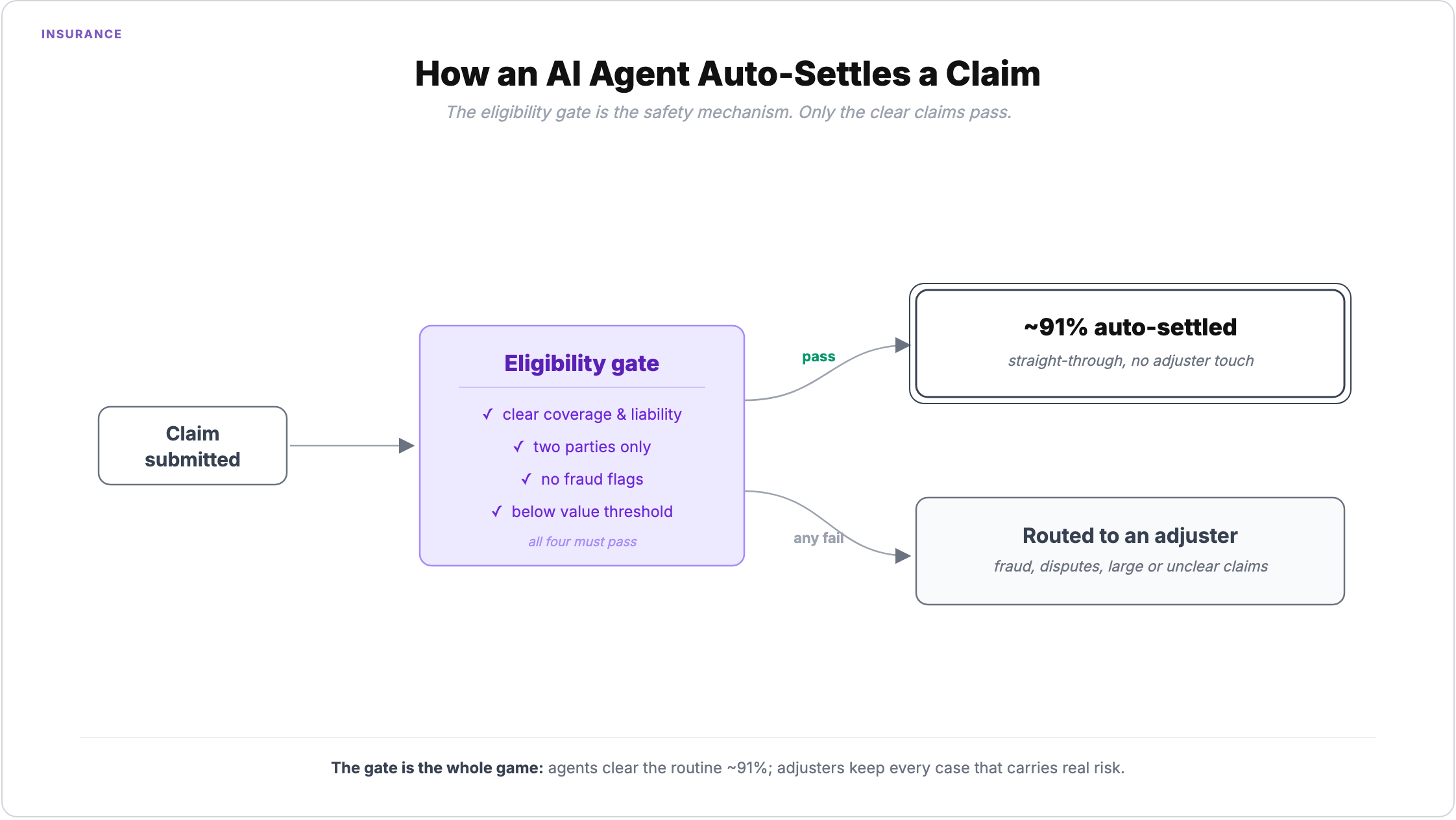
The model is straight-through processing for the clear cases, and routing for the rest. An agent reads the claim, confirms coverage and liability, checks the guardrails, and settles the routine ones itself.
At a leading Dutch insurer, Beam agents now automate 91% of eligible motor claims, thousands of routine claims a month. Average processing time per claim dropped 46%, and NPS rose 9%.
The eligibility rules are the safety mechanism. The agent only auto-settles claims with clear coverage and liability, two parties, no fraud suspicion, and a value below a set threshold. Everything outside that goes to a human, by design.
Beyond claims: AR and back-office in insurance
Claims are the headline, but the same agents clear the rest of the insurance back office. Billing, accounts-receivable, and reconciliation are just as document-heavy and just as slow when done by hand.
At a global insurer, Beam agents run accounts-receivable across 26 countries at 93% task accuracy. Invoice processing dropped from 30 to 60 minutes down to minutes, total processing time fell 47%, and 200 full-time roles were redeployed to higher-value work.
That is the pattern across insurance operations: the agent owns the high-volume, rule-heavy processing, and people move to the work that needs judgment.
Why routine-only automation is the right call in insurance
Insurance is where "automate everything" goes wrong, and where automating the routine goes very right. The value is in volume, not in edge cases.
Fraud, disputes, complex liability, and large or ambiguous claims should never be auto-settled. Those are the cases where a wrong automated decision is expensive and reputationally damaging, so they stay with an adjuster.
Getting the eligibility gate right is the whole game. A well-drawn boundary lets an agent clear the bulk of the queue while a human keeps control of every case that actually carries risk.
How to deploy AI agents in insurance safely
The requirements are the same across insurers that have done it. Agents sit on top of your existing claims and policy systems, so there is nothing to rip out.
Governance is non-negotiable. You need permissions scoped to the task, an audit trail on every action, and control over where policyholder data lives, which is why a governed agent platform matters more than any single model.
Most teams reach a live insurance agent in 4 to 6 weeks. The takeaway for 2026 is that AI agents in insurance are not replacing adjusters; they are clearing the routine claims and back-office volume so adjusters can focus on the claims that need them.