5 min leer
94% of Enterprises Get No Earnings From AI. Here's How Agentic Adopters Hit 88% ROI


By submitting, you consent to our use of your data. Privacy Policy.
Categoría
Agentes de IA
Compartir artículo
The money going into AI and the money coming out of it have almost nothing to do with each other for most companies. McKinsey's 2026 State of AI survey found that 94% of enterprises see no material earnings impact from their AI spend, and only 6% report a significant one.
The exception is specific, and it is the whole story. Among agentic AI early adopters, 88% report ROI within the first year, against 74% for gen-AI users overall. The dividing line is not how much a company spent or which model it bought. It is how the AI was deployed.
Here is what McKinsey's numbers actually say, what separates the 6% from the 94%, and how to model the return before you spend.
Why most AI spend produces no return
The gap is between what companies expect and what they can bank. Enterprises anticipate an average 171% ROI on agentic AI, yet only 39% attribute any EBIT impact to AI at all, and just 6% call that impact significant (per McKinsey, via The Register).
That is not a model problem. The models are good enough. The spend goes to copilots and pilots that assist a person or answer a question, and assistance does not show up in earnings the way completed work does. A tool that drafts a reply still leaves the task, the exception, and the sign-off with a human.
The result is a lot of activity and very little attributable margin, which is exactly the pattern 94% of enterprises are living in.
What agentic early adopters do differently
The adopters seeing returns are not running better copilots. They are running agents that complete work end to end, own the exception, and operate inside the systems where the work actually lives.
McKinsey is its own proof point. The firm now runs 25,000 AI agents alongside 40,000 people, and those agents saved 1.5 million hours of work last year, with back-office headcount down 25% while back-office output rose 10% (Yahoo Finance). That is earnings impact, not assistance.
The pattern is spreading where the work is heaviest. Among enterprises above $1 billion in revenue, 40% now say they are scaling AI agents across one or more functions, up from 27% a year ago. The companies realizing returns are the ones that moved past the pilot.
The 94% (no earnings impact) | The 6% / agentic adopters | |
|---|---|---|
What was deployed | Copilots, point tools, stalled pilots | Agents that complete work end to end |
Governance and audit | Bolted on later, if at all | Built in from the start |
How outcomes are measured | Anticipated (171% expected) | Realized (88% report ROI in year one) |
Where it runs | Beside the workflow | Inside the systems that hold the work |
Scale | Stuck in proof-of-concept | Scaling across functions |
The difference is operational, not the model
If model choice were the lever, the 94% would already be winning, because they have access to the same frontier models the 6% do. What separates them is the layer around the model: whether the agent can act in your systems, recover from an exception, prove what it did, and be measured against a business outcome.
That is the part enterprises underinvest in, and it is the part that turns AI from a line item into earnings. An agent without evaluation, an audit trail, and real integration is a demo that never becomes a deployment, which is why so much AI spend never reaches the P&L.
Model the return before you spend
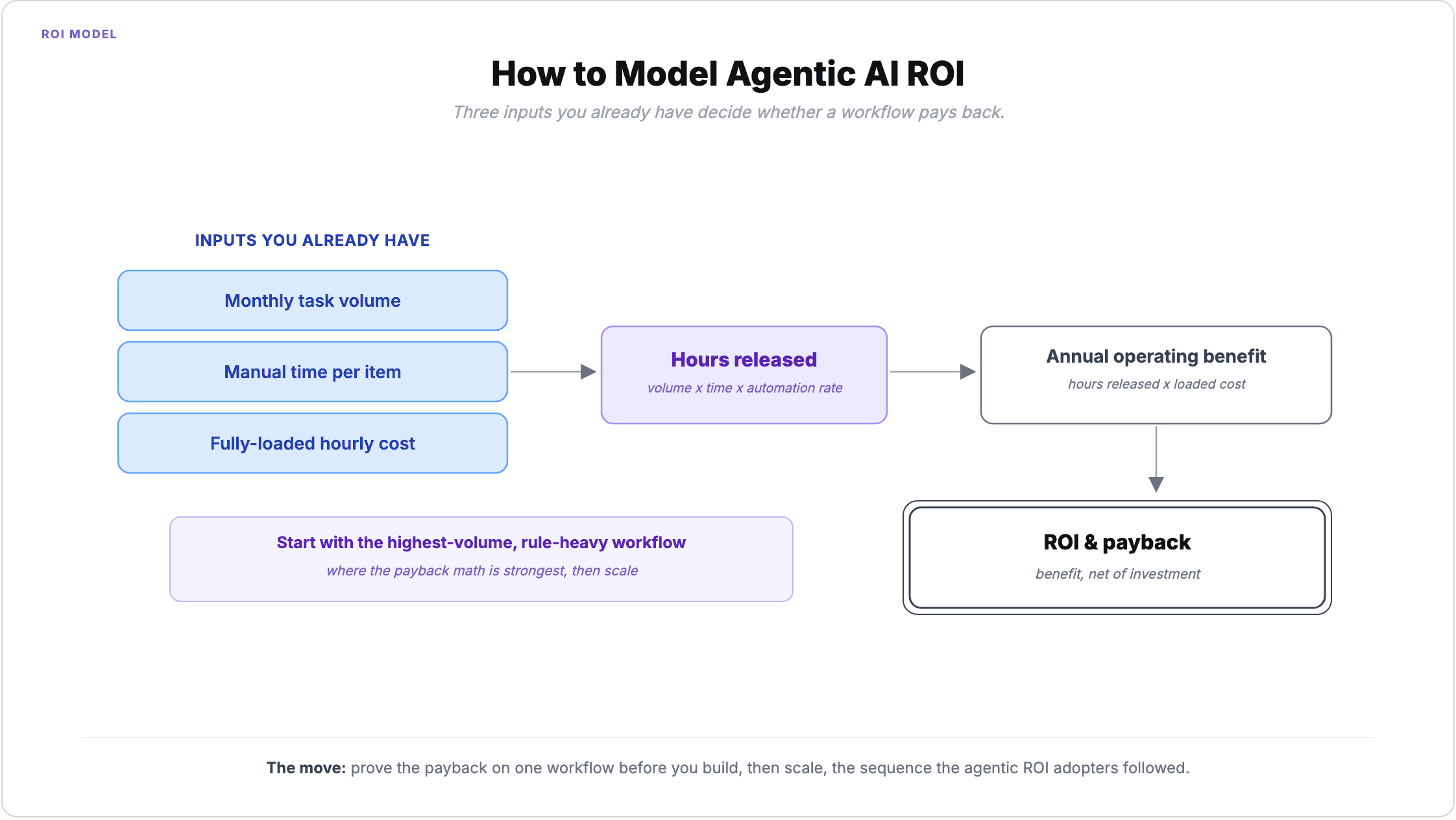
The way out of the 94% is not more budget. It is knowing, before you commit, which workflow will actually pay back and how fast. That is a calculation, and it uses three inputs you already have.
Volume of the task, per month.
Manual time it takes a person to do one, today.
Fully-loaded cost of the hour doing it.
From those, the model is straightforward: the hours an agent releases, multiplied by your loaded cost, gives the annual operating benefit, and netting that against the investment gives ROI and payback. Our AI ROI calculator runs exactly this across finance, recruiting, and BPO workflows, as a planning estimate with pricing excluded, so you can see the number on your own volumes before a single agent is built.
The point is to enter the 6% deliberately. Pick the high-volume, rule-heavy workflow where the math is strongest, prove the payback, then scale, which is the sequence the agentic adopters followed.
The ROI gap is a deployment gap
The headline number from McKinsey reads like an indictment of AI, and it is not. It is an indictment of deploying AI as an assistant and expecting it to perform like a workforce. The 6% figured that out, and their 88% first-year ROI is the receipt.
The question for 2026 is not whether AI pays back. For agentic adopters, McKinsey just showed that it does. The question is whether you deploy it as a tool beside the work or an agent that does the work, because that choice, not the model, is what decides which side of the 94% you land on.
Common questions about agentic AI ROI
Why do most enterprises get no ROI from AI?
McKinsey's 2026 survey found 94% see no material earnings impact and only 39% attribute any EBIT gain, against an anticipated 171%. The spend goes to copilots and pilots that assist rather than complete work, so it produces activity without attributable margin.
What ROI do agentic AI adopters actually see?
88% of agentic AI early adopters report ROI within the first year, compared with 74% for gen-AI users overall. Adoption is accelerating too: 40% of enterprises above $1 billion in revenue are now scaling agents, up from 27% a year ago.
How do you calculate AI agent ROI?
Multiply the task volume by the manual time per item and the automation rate to get the hours released, multiply by your fully-loaded hourly cost for the annual operating benefit, then net against the investment for ROI and payback. Beam's ROI calculator runs this per workflow.