4 دقيقة قراءة
How to Choose an Agentic AI Platform: 6 Criteria That Actually Matter


By submitting, you consent to our use of your data. Privacy Policy.
Category
وكلاء الذكاء الاصطناعي
Share the article
Most agentic AI pilots never reach production. Roughly 88% stall at the proof-of-concept stage, and the reasons teams give are not "the model wasn't good enough." They are evaluation gaps, governance friction, and reliability, which means the platform around the model decides the outcome, not the model itself.
That reframes how to choose one. The demo will always look good; the question is whether the platform closes the exact gaps that kill pilots. Here are the six criteria that actually separate an agentic AI platform you can run in production from one that stays a demo.
1. Orchestration, not just a model
An agent has to do more than answer: it has to chain steps, call tools, handle the exception, and know when to stop and ask. That coordination layer is the platform's real job.
Ask whether the platform runs multi-step, multi-agent work with a human in the loop, or whether it is a thin wrapper around a model that leaves the hard coordination to you.
2. Model choice and routing
No single model is right for every job, and the same agent can cost 26x more on a frontier model than a cheaper one. A platform that locks you to one model, or hides which model it uses, takes that lever away.
Ask whether you can route each workflow to the right model, and swap models as new ones ship, without rewriting the agent, because the same agent can cost 26x more on one model than another.
3. Governance and an audit trail
The most-cited blocker after evaluation is governance. Agents that take actions need permissions scoped to the task, an audit trail on every action, and control over where data lives, or they never clear a security review.
Ask whether every action is logged and explainable, and whether permissions are scoped, because "who approved this and why" is a question every regulated buyer will ask.
4. Integration depth
Agents create value by acting inside the systems where the work lives, the ERP, the CRM, the core platform, the legacy tool with no clean API. A platform that only works through tidy integrations will stall on the messy 80% of real workflows.
Ask how the platform reaches your actual systems, including the ones without a modern API.
5. Evaluation you can trust
The single biggest blocker, cited by 64% of teams, is not being able to measure whether the agent is working. Without evaluation, you cannot tell a good deployment from a risky one, and you cannot scale with confidence.
Ask how the platform measures agent performance against business outcomes, not just model benchmarks.
6. A human-in-the-loop design
Production agents are trusted because they escalate. The platform should make it easy to define what the agent handles, what it routes to a person, and how the handoff carries context.
Ask whether human-in-the-loop is built into the design or bolted on, because that boundary is what makes the automation safe.
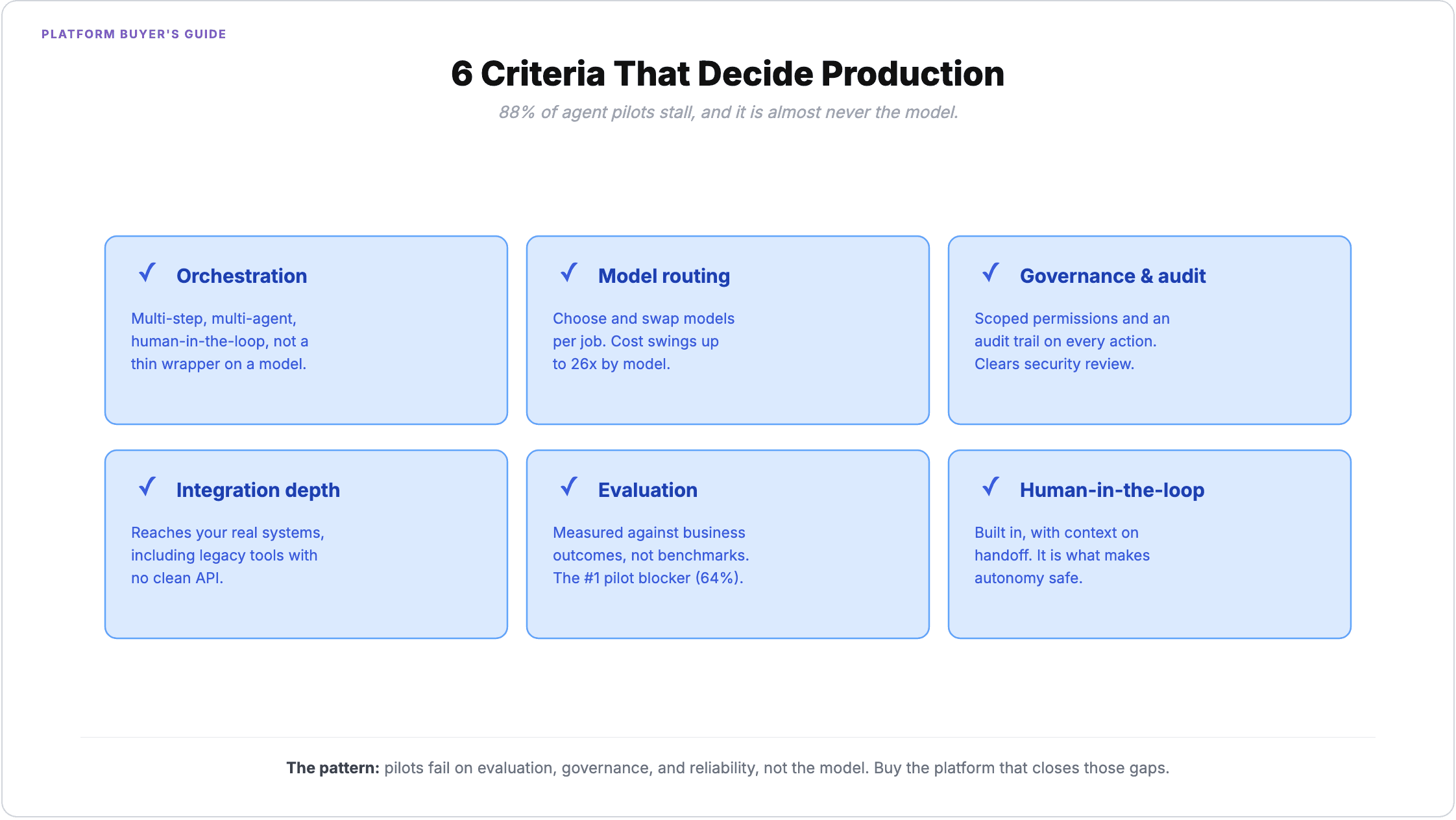
Criterion | The question to ask | Why it decides production |
|---|---|---|
Orchestration | Multi-step, multi-agent, human-in-loop? | Coordination is the real work |
Model routing | Can I choose and swap models per job? | Cost and capability lever (up to 26x) |
Governance | Scoped permissions, audit on every action? | Clears security review |
Integration | Reaches legacy systems without clean APIs? | Where the work actually lives |
Evaluation | Measured against business outcomes? | #1 pilot blocker (64%) |
Human-in-the-loop | Built in, with context on handoff? | Makes autonomy safe |
The red flags
A few signals predict a platform that will stall. Watch for a fixed single model with no routing, no audit trail, evaluation limited to model benchmarks, integration only through clean APIs, and a demo that never shows the exception path.
The pattern behind all of them is the same: a tool built to demo, not to survive production. A governed agent platform is what closes the evaluation, governance, and reliability gaps where the other 88% fail, and turns an AI agent into something you can run on the business.
Common questions about choosing an agentic AI platform
What should I look for in an agentic AI platform?
Orchestration for multi-step work, model choice and routing, governance with a full audit trail, deep integration into your real systems, evaluation against business outcomes, and a human-in-the-loop design. These are the gaps that decide whether a pilot reaches production.
Why do most agentic AI projects fail?
About 88% of agent pilots stall before production, and the top reasons are evaluation gaps (64%), governance friction (57%), and reliability (51%), not the model. Model choice is downstream of these.
Does the model matter when choosing a platform?
Less than the platform around it. The same agent can cost 26x more on one model than another, so what matters is a platform that lets you route each workflow to the right model, not one locked to a single vendor.