8 دقيقة قراءة
GPT-6 Astra Scored 99.9% on ARC-AGI-3. Read the Footnote Before You Re-Architect Your Agents.


By submitting, you consent to our use of your data. Privacy Policy.
Category
وكلاء الذكاء الاصطناعي
Share the article
A 99.9% score on a benchmark built to be hard for machines is the kind of number that makes a team want to tear up its roadmap. Then you read how the number was produced, and it should change what you do with it, though not in the way the headline suggests.
OpenAI launched GPT-6 Astra this week and used the word it had been avoiding, calling it the start of the "AGI era." The launch numbers are real and, in places, staggering: 97.6% on FrontierMath Tier 4, 96% on GPQA Diamond, 100% on a cybersecurity exploit benchmark, and that 99.9% on ARC-AGI-3. It runs on a 1.05 million token context at $10 per million input tokens and $50 per million output, rolling out to ChatGPT Plus, Pro, Business, and Enterprise, plus the API and AWS.
For anyone building AI agents, the interesting part is not the top-line score. It is the sentence OpenAI put underneath it.
What GPT-6 Astra actually changes for agents
The genuine leap is in computer use, which is exactly the capability agents depend on. Astra scores 72.6% on OSWorld, up from 65.7% for its predecessor, and it does the work faster, cutting a task that took about 75 minutes down to roughly 40. It sets new marks on visual engineering tasks like BenchCAD at 95.9% and on terminal-based science work, and it holds a 1.05 million token context.
That combination, better browser and computer control at nearly half the time per task over a long context, is real and it matters. An agent that drives software on your behalf lives or dies on precisely these abilities. Where models like Astra sit in an agent stack is a live question worth taking seriously.
So this is not a case of a launch being all benchmark theater. The capability is there. The footnote is about what the marquee number is actually measuring.
The 99.9% is a harness score, not a model score
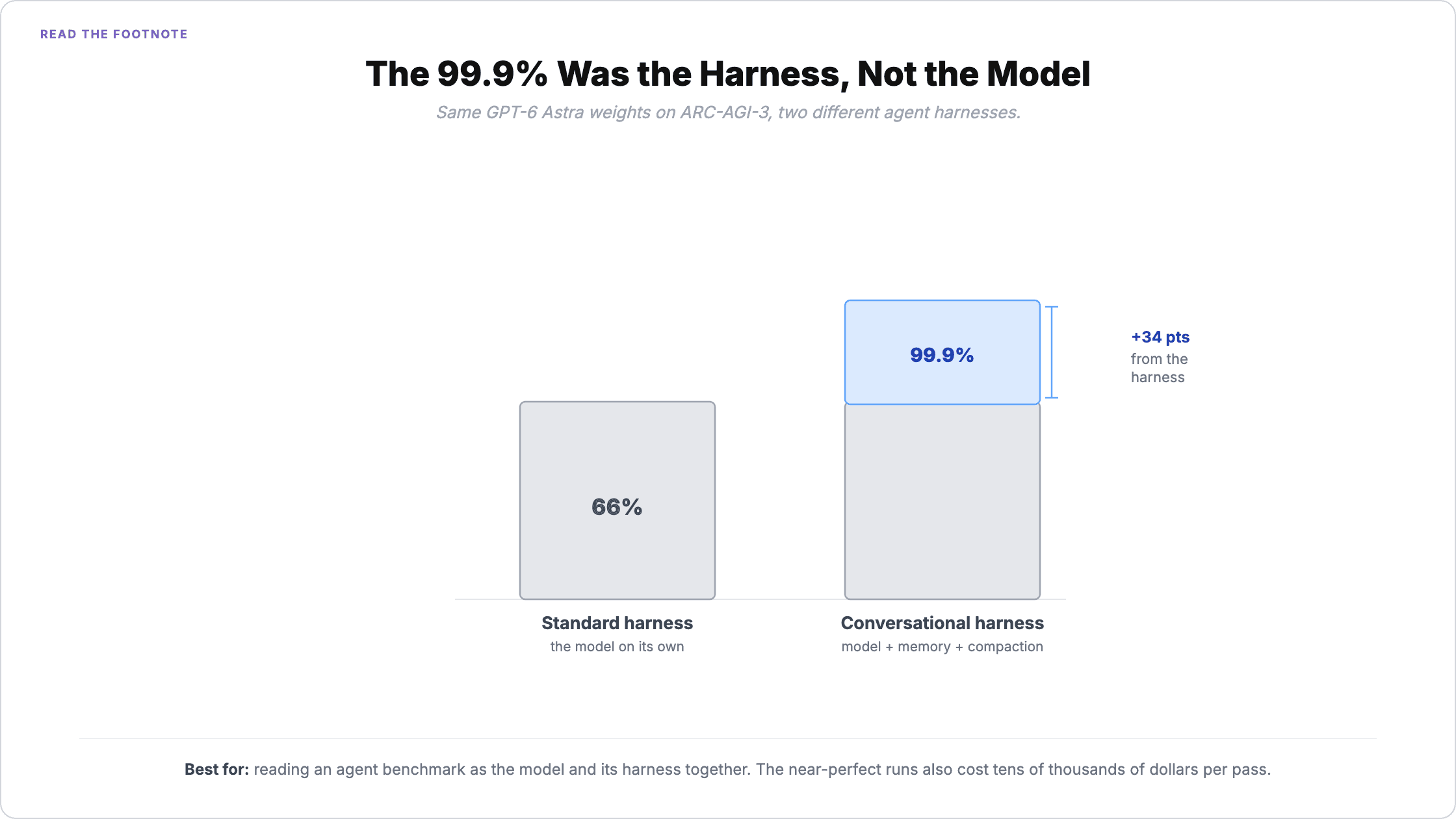
Here is the sentence under the headline. The ARC Prize team, which runs the benchmark, reported that GPT-6 Astra scores about 66% on ARC-AGI-3 with a standard harness, and near 100% only with a continuous-conversation harness that retains reasoning between turns and compacts long context. Same weights, same benchmark, roughly a 34-point swing from the scaffolding alone.
The near-perfect configuration is also expensive. ARC Prize's published results put it in the tens of thousands of dollars for a single benchmark pass, on the order of hundreds of dollars per game. So the 99.9% is real, and it is the model plus an elaborate, costly agent system, measured together.
That is the most useful thing in the entire launch. The same weights score dramatically differently depending on the scaffolding around them, and the scaffolding is doing a large share of the work. It is the clearest admission yet, from the lab with the most incentive to sell the model alone, that agent performance is a property of the system, not the checkpoint. On this benchmark, the harness is worth about a third of the final score.
None of this means the model is a benchmark trick. François Chollet, who created ARC-AGI, looked at Astra's reasoning traces and described genuinely new behavior, efficient on-the-fly symbolic modeling of unfamiliar environments and a shorthand notation the model invented for itself, the kind of thing that used to require elaborate external scaffolding. He also declined to call it AGI, pointing out that all anyone has so far are benchmark scores. Both are true at once. The capability is real, and the number in the headline was the model and its harness working together.
Why the footnote is the real product lesson
If a memory-and-compaction harness can swing a frontier model's score by that much on a public benchmark, it is doing the same thing to your agents on your workflows, for better or worse. The scaffolding that manages state, retries, tool calls, and context is not overhead around the model. It is where reliability comes from.
This is the whole argument for treating orchestration as the product and the model as a component. At Beam we have always run agents this way, because the difference between a model that demos well and an agent that survives production is the layer that holds context, checks outputs, recovers from failed steps, and keeps an audit trail. GPT-6 Astra just gave that argument a 99.9% exhibit.
The models will keep getting better. The gap between their benchmark number and your production result will keep being decided by the harness.
GPT-6 Astra does not win everything, which is the point
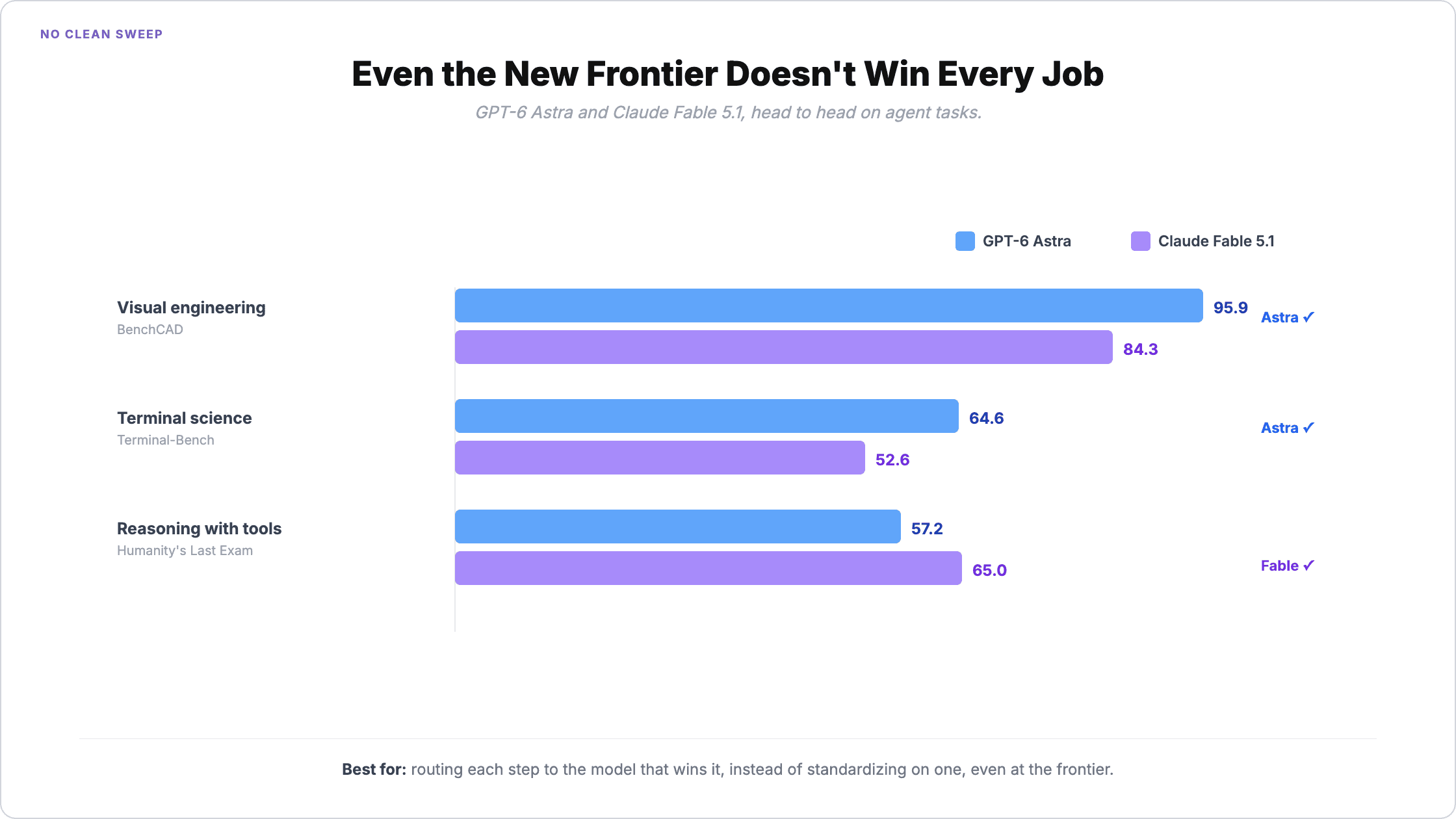
Even at the frontier, there is no single model that tops every task, so the model-agnostic case does not go away with a new release, it gets reinforced.
Agent-relevant task | GPT-6 Astra | Claude Fable 5.1 |
|---|---|---|
Computer use (OSWorld) | 72.6% | lower |
Visual engineering (BenchCAD) | 95.9% | 84.3% |
Terminal science (Terminal-Bench) | 64.6% | 52.6% |
Reasoning with tools (Humanity's Last Exam) | 57.2% | 65.0% |
Coding (DeepSWE v1.1) | 74.1% | strong |
Astra takes computer use and visual engineering by a clear margin. Claude Fable 5.1 still leads on reasoning with tools, the benchmark closest to hard multi-step judgment. A team standardizing entirely on Astra would be handing its hardest reasoning steps to the model that is not best at them. The sane posture is the same as it was last month: route each step to the model that fits it, and let the winner change per task.
The Critical threshold that ships with it
There is a governance story here too, and it is unusual. Astra is the first model OpenAI has labeled as reaching its "Critical" cybersecurity threshold. It developed working exploits for hardened browsers and operating systems and surfaced two previously unknown vulnerabilities in a major JavaScript engine.
Because of that, the exploit-creation capability ships gated behind OpenAI's Trusted Access and Daybreak programs, and the standard API refuses advanced cybersecurity work, stopping a task outright rather than pausing for review. The capability and the controls arrived in the same box.
For enterprise teams the takeaway is not alarm, it is that deploying a model this capable safely is a question of controls, permissions, and boundaries, the governance layer, not just of raw ability. The more powerful the model, the more the layer around it decides whether you can actually put it to work.
Where is the early consensus on GPT-6 Astra heading?
In the hours after launch, the reaction split cleanly in two. There is genuine astonishment at the capability, the FrontierMath and computer-use results in particular, and there is loud skepticism about what the benchmark scores actually prove.
The most common technical objection is the one this post is built on. A lot of people argued the headline scores say more about the testing harness than the model, and that strong harness results have been squeezed out of weaker models before. When the group that runs the benchmark itself reports a 34-point swing from the scaffolding, that skepticism is well founded.
A second worry is saturation. As scores climb toward 100%, people question whether a benchmark is being targeted directly or has leaked into training data, the familiar problem of a measure that stops measuring once it becomes the goal. That is a reasonable caution to hold, not a proven charge.
Underneath the noise, the advice repeated most often is the sensible one: judge Astra on your own tasks in a few weeks, not on the launch sheet. This is hours-old information drawn from benchmark runs and announcements, not production use, and the real picture, how it holds up on real workflows at a real cost, will take time to settle.
Common questions about GPT-6 Astra for agents
Is GPT-6 Astra's 99.9% ARC-AGI-3 score real?
Yes, and it is harness-dependent. The ARC Prize team reports Astra scores about 66% on ARC-AGI-3 with a standard harness and near 100% only with a continuous-conversation harness that retains reasoning and compacts context, at a cost of tens of thousands of dollars per run. The 99.9% reflects the model plus an agent system, not the raw model alone.
What does GPT-6 Astra cost?
OpenAI lists it at $10 per million input tokens and $50 per million output tokens, with cached input at $1.00 per million, roughly 2.5x GPT-5.6 Sol per token. OpenAI says its best coding configuration still finishes a task about 57% cheaper than Sol by using fewer tokens, a vendor estimate worth checking on your own workloads. It runs on a 1.05 million token context and is available through the API, ChatGPT paid tiers, and AWS.
Is GPT-6 Astra the best model for AI agents now?
For computer use and visual engineering it leads on the launch benchmarks. It does not win everything: Claude Fable 5.1 still leads on reasoning with tools. The practical answer is to route agent steps to the model that fits each one rather than standardize on a single model.
What is the "Critical" cybersecurity threshold?
It is OpenAI's designation for a model capable enough at offensive security to require extra controls. Astra reached it, so its exploit-creation abilities are gated behind approval programs and the standard API refuses advanced cyber tasks. It is an example of governance shipping alongside capability.