6 دقيقة قراءة
Claude Code and Codex Are AI Agents Too. Here's Why Enterprises Still Need a Different Kind.


By submitting, you consent to our use of your data. Privacy Policy.
Category
وكلاء الذكاء الاصطناعي
Share the article
If a tool can read your codebase, write across dozens of files, run its own tests, and open a pull request without you typing the code, calling it a "coding assistant" undersells it. Claude Code and Codex are agents. They plan, act, use tools, check their work, and recover from failure, on their own.
So the reasonable question a lot of operations and platform leaders are asking is fair: if these things are this capable, why would we need a separate AI agent platform at all? Why not point Codex or Claude Code at the business and let it run?
The answer is not that they are weak. It is that they are built for a different job, and the job matters more than the label.
What is an LLM, and what makes something an AI agent?
Start with the layer underneath, because the confusion usually begins there. A large language model is the engine. Given some text, it predicts the next tokens. On its own it answers, drafts, and reasons in a single turn, but it does not act in the world, hold state across a long task, or use your tools.
An AI agent wraps that model in the things that make it do work: a goal, a loop, memory, and access to tools it can call. The model decides what to do next, the agent runs it, feeds back the result, and repeats until the task is done. The model is the brain, the agent is the whole worker.
By that definition Claude Code and Codex are unquestionably agents. They are the model plus a developer-facing harness that reads files, runs commands, and iterates. That is exactly why the comparison is worth making carefully, rather than pretending they are just chatbots.
Same models, a completely different product surface
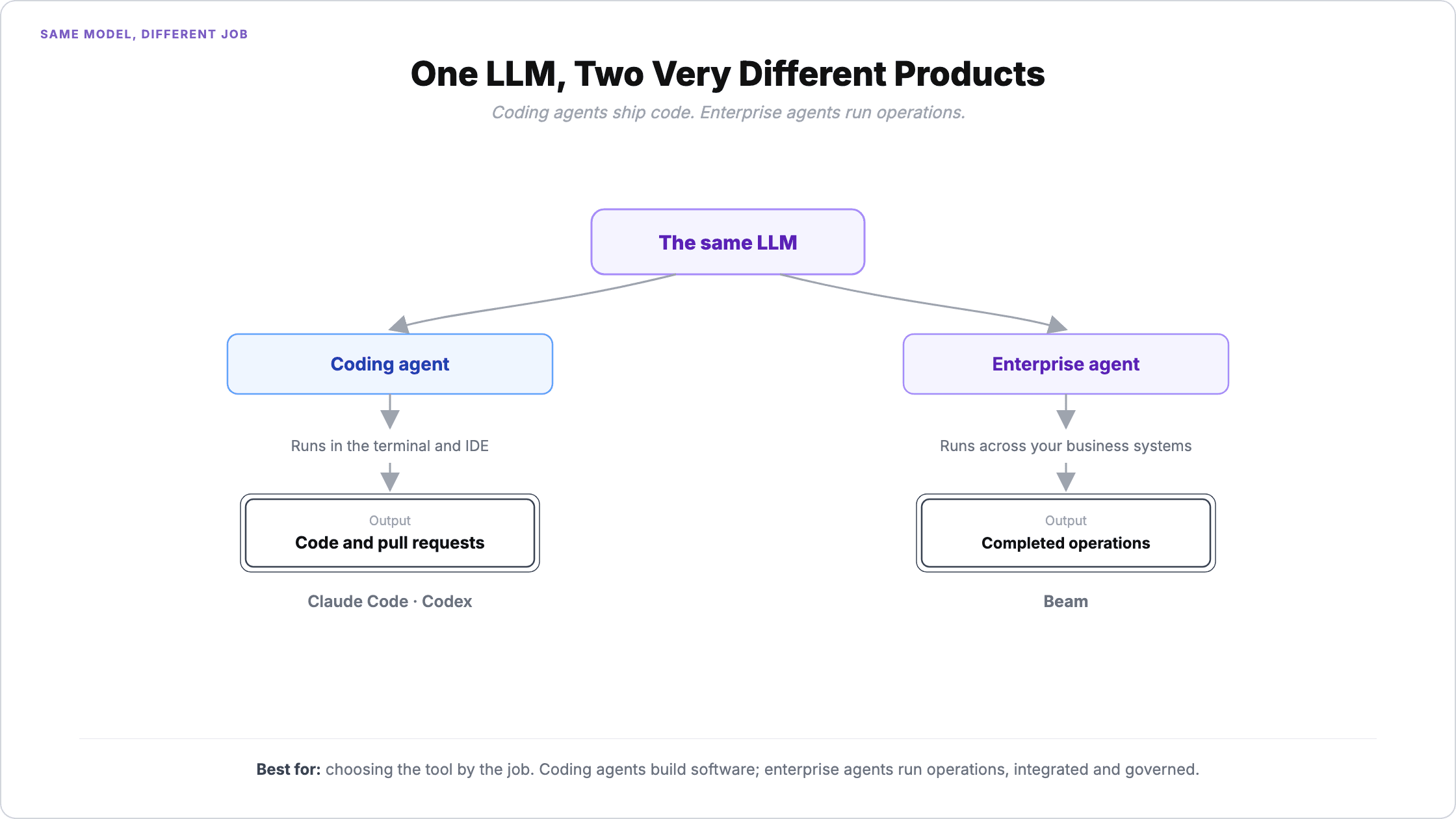
Here is the part that gets missed. Claude Code, Codex, and an enterprise agent platform can all run on the same frontier models. What separates them is the product built around the model, and that product is shaped by who uses it and what it produces.
Claude Code and Codex are built for developers. They live in the terminal, the IDE, and a cloud sandbox, and their unit of work is code: a feature, a fix, a pull request a human engineer reviews and merges. Even their unattended modes, headless scripts, CI runs, and cloud tasks, are automating software development. The output is code.
An enterprise agent has a different unit of work. Its user is a business team, not an engineer, and its output is completed operations: a claim adjudicated, an invoice matched, a KYC check cleared, an order pushed through. It runs across the business systems where that work lives, and it runs unattended because the point is to remove the manual step, not to help someone write software faster.
Coding agents and enterprise agents, side by side
Coding agents (Claude Code, Codex) | Enterprise agents (Beam) | |
|---|---|---|
Who it is for | Developers and engineering teams | Business and operations teams |
Unit of work | Code: features, fixes, pull requests | Completed operations: claims, invoices, KYC, orders |
Where it runs | Terminal, IDE, code sandbox, CI | Across enterprise systems (ERP, CRM, ticketing, email) |
The loop | A coding session a human reviews and merges | A multi-step business process, run unattended |
Built-in knowledge | Your repository and dev tooling | Your SOPs, processes, and business data |
Governance | Repo permissions, sandbox, code review | Process audit trail, approvals, human-in-the-loop on decisions |
None of this is a knock on the coding tools. Codex was named a Leader in Gartner's 2026 Magic Quadrant for enterprise AI coding agents, and it earned that for coding. The table is not ranking quality. It is showing two different jobs.
Why you still need enterprise agents when the coding tools are this good
A coding agent can build you an automation. It cannot be the automation for a non-engineering team, and that is the gap.
If you want an accounts-payable process to run itself, someone still has to connect it to your ERP and inbox, encode the exception handling, decide where a human signs off, keep an audit trail a controller can defend, and keep it running when the model or the vendor changes. That is not a coding task you hand to Codex once. It is an operating system for the process, owned by the business team that lives in it.
That is what Beam is: a platform where a business user turns a written process into a working agent, wired into the systems where the work happens, orchestrated across multiple steps and multiple agents, and governed so every decision is auditable. The AI agents do operations work, not engineering work, and they are designed to survive the handoff from a demo to a department.
Put simply, Claude Code and Codex help your engineers ship software. An enterprise agent platform helps your business run its operations. Both are agents. They are not substitutes.
When to use a coding agent and when to use an enterprise agent
The honest guidance is to match the tool to the work rather than pick a winner.
Reach for Claude Code or Codex when the job is software: building an internal tool, fixing bugs, refactoring, prototyping, or automating parts of your development pipeline. They are excellent at it and getting better fast.
Reach for an enterprise agent platform when the job is a business process that needs to run across your systems, unattended, with governance, and owned by the people who do the work rather than the people who write the code. If you are weighing the model vendors behind these tools for that second job, we lay out the details in our Beam vs Anthropic and Beam vs ChatGPT comparisons.
Common questions about coding agents versus enterprise AI agents
Are Claude Code and Codex real AI agents?
Yes. Both plan an approach, edit files, run commands and tests, iterate, and prepare or open pull requests, which is agent behavior, not chatbot behavior. They are agentic coding tools. The distinction from an enterprise agent platform is the job they are built for, not whether they qualify as agents.
What is the difference between an LLM and an AI agent?
An LLM is the model that predicts text and reasons within a single turn. An AI agent wraps that model in a goal, a loop, memory, and tools so it can take actions, check results, and keep going until a task is complete. The model is the brain, the agent is the worker built around it.
Can Claude Code or Codex automate a business process?
They can build software that helps automate one, and they can run unattended for development tasks. What they are not designed to be is the running business-process agent itself, integrated across your operational systems, owned by a business team, and governed with a process audit trail. That is a different product category.
Why use an enterprise AI agent platform instead of a coding assistant?
Because operations work is not a coding task. An enterprise platform lets business users turn their own processes into agents, connects to the systems where the work happens, orchestrates multi-step workflows unattended, and keeps every decision auditable. A coding assistant is the wrong shape for that job even when it shares the same underlying model.