7 دقيقة قراءة
Claude Fable 5.1 for AI Agents: The Frontier Got Cheaper, and Finally Deployable


By submitting, you consent to our use of your data. Privacy Policy.
Category
وكلاء الذكاء الاصطناعي
Share the article
The headline on Claude Fable 5.1 is a benchmark, but the story is a business decision. Anthropic took its most capable model, made it 25 to 45% cheaper to run, and wrapped it in data controls that let a Fortune 500 run it on their own infrastructure. The frontier didn't just get smarter this month. It became deployable.
That matters more than another point on a leaderboard, because for most enterprises the barrier to autonomous agents was never raw capability. It was custody: who holds the data, who can prove what the agent did, whether it clears a security review. Fable 5.1, released on 1 September 2026, is Anthropic answering that. Here is what actually shipped, what the numbers mean for agents, the real-world evidence that has accumulated since launch, and where it belongs in a production stack.
What Anthropic actually shipped
Fable 5.1 and Mythos 5.1 are the same underlying model with different access. Fable 5.1 is the generally available version on paid Claude plans and the API, with production safeguards in place. Mythos 5.1 is the same model through restricted-access programs for vetted cybersecurity and life-sciences organizations, currently US-only.
The release is a point update tuned for one thing above all: autonomous, tool-using, long-running work. The general reasoning improved a few points, but the agentic scores roughly doubled in places, which tells you where Anthropic spent its effort. This is a model built to run agents, not just answer questions.
The benchmark leap, and what it means for agents
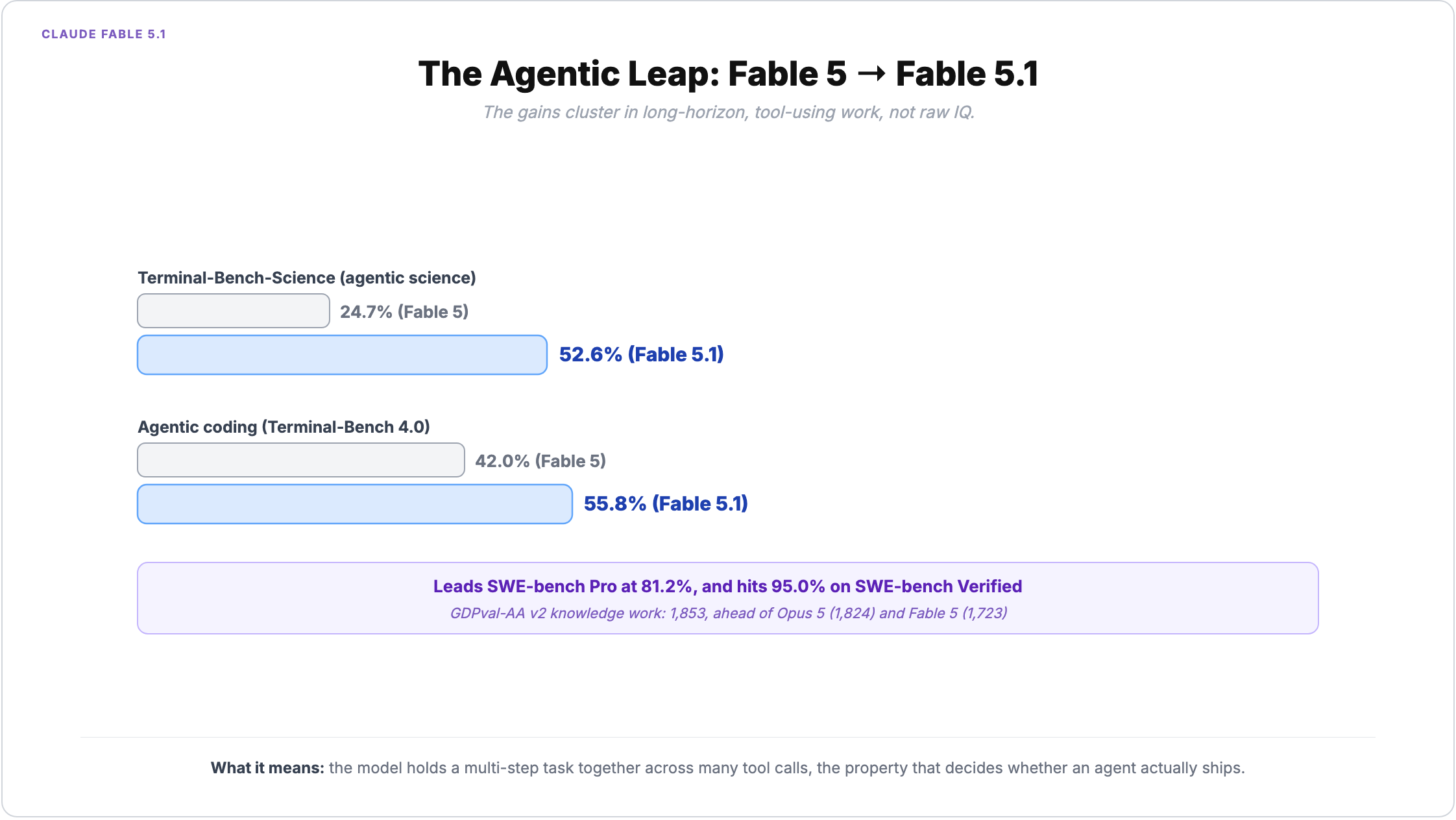
The numbers cluster exactly where autonomous work lives. Fable 5.1 now leads the SWE-bench Pro leaderboard at 81.2% and reaches 95.0% on SWE-bench Verified, the strongest published real-world software-engineering results of any model.
The agentic jumps are the tell. Terminal-Bench-Science more than doubled from 24.7% to 52.6%, agentic coding on Terminal-Bench 4.0 went from 42.0% to 55.8%, and on GDPval-AA v2, a measure of real enterprise knowledge work, it scores 1,853, ahead of Opus 5 at 1,824 and Fable 5 at 1,723. Reasoning with tools reached 65.0% on Humanity's Last Exam and computer use hit 41.7% on OSWorld 2.0.
The pattern is not "higher IQ." It is longer, more reliable autonomy: the model holds a multi-step task together across many tool calls without a human catching it every few steps. That is the exact property that decides whether an agent ships.
The real-world evidence, now that it has been out a few weeks
Because Fable 5.1 has been live longer than this month's other launches, there is production evidence, not just benchmarks. The examples that matter are the long, unsupervised ones.
Anthropic's Millennium case study describes the model disassembling an external vendor library, matching it against a core dump, and tracing a crash to a bug in code that had stumped engineers for years. One user documented a 38-hour autonomous run on a machine-learning problem in which the model diagnosed a prior result as a label artifact, corrected it, and kicked off six parallel experiments on its own. Developers report it handling multi-file refactoring loops with a reliability that previously required constant human oversight.
That last line is the whole point. Frontier autonomy is not about a flashier demo; it is about the agent staying correct over hours of work you did not watch.
The price cut nobody expected on a frontier model
Frontier models usually get more expensive as they get better. Fable 5.1 went the other way. Sticker pricing holds at $10 per million input tokens and $50 per million output, but the effective cost drops 25% on typical workloads and up to 45% on heavily agentic ones.
The mechanism is caching and batching, which is where agent costs actually accumulate. Cache reads fell 75%, from $1 to $0.25 per million tokens, and batch processing halves the rates to $5 and $25 for asynchronous work. For an agent that re-reads a large context on every step, that cache cut is the real saving.
Model | Role | Peak coding | Price (in / out per 1M) | Best for |
|---|---|---|---|---|
Claude Fable 5.1 | Frontier flagship | SWE-bench Pro 81.2% (leads) | $10 / $50 (cache $0.25) | Hardest, highest-stakes, long-horizon agents |
Gemini 3.8 Flash | Fast workhorse | mid-difficulty | $0.75 / $3.75 | High-volume, latency-sensitive work |
Muse Spark 1.3 | Cost-efficient tier | leads its tier | ~$1.25 / $4.25 | Tool-heavy, cost-sensitive agents |
It is still the premium option. Gemini 3.8 Flash and Muse Spark 1.3 cost a fraction as much. The case for Fable 5.1 is not price; it is that when peak quality on the hardest work matters more than the inference bill, nothing else leads SWE-bench Pro.
The bigger unlock: custody, not capability
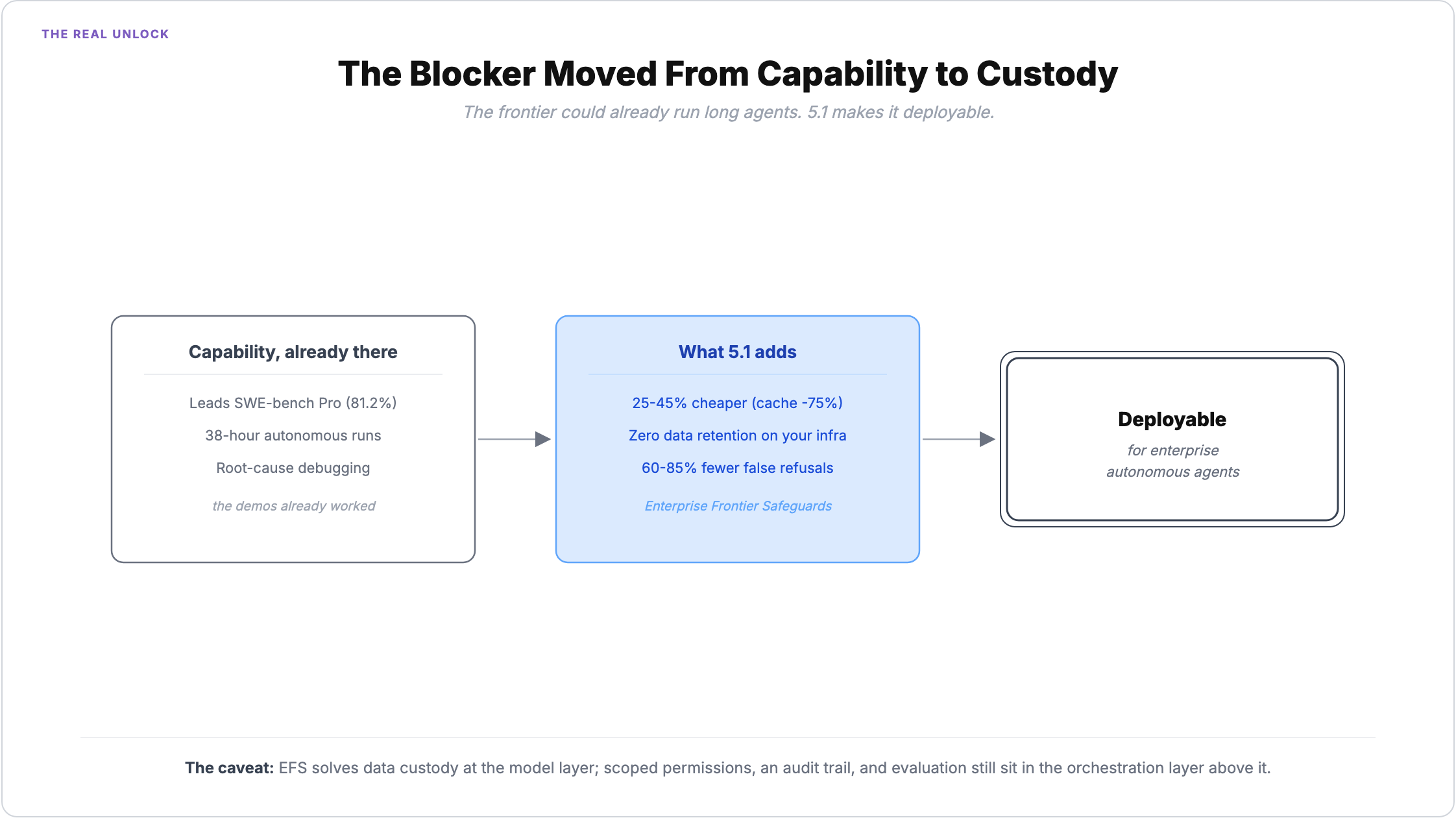
The most important change in 5.1 is not on any benchmark. Enterprise Frontier Safeguards let an organization run the model with zero data retention on customer-controlled infrastructure, while Anthropic's safety monitoring stays intact. It rolls out in phases starting later in fall 2026.
This is the barrier that actually kept autonomous agents out of regulated enterprises. The capability to run a coding agent overnight has existed for a while; what did not exist was a way to do it without sending sensitive code and data to a vendor's cloud. The enterprise blocker moved from capability to custody, and EFS is built to answer custody.
The safety side improved in the same practical direction: 60% fewer false positives on cybersecurity tasks and 85% fewer on benign biology and medical queries, so the model stops refusing legitimate work, plus best-in-class results on prompt-injection benchmarks, which is the attack that matters most for tool-using agents.
Where Fable 5.1 fits in an agent stack
No single model is right for every job, and Fable 5.1 does not change that. It changes what you route to the top of the stack. At Beam we run production agents on whichever model fits the work, and 5.1 is where the hardest paths go.
The highest-stakes decisions where a wrong call costs more than any inference bill, claim adjudication, complex exception handling, compliance-critical work.
The longest-horizon autonomous runs, the multi-hour, multi-step jobs where reliability across the whole task is the requirement.
The hardest software engineering, where it leads SWE-bench Pro and handles root-cause debugging that trips up cheaper models.
The high-volume, latency-sensitive, cost-sensitive work still belongs on a model-agnostic stack's cheaper tiers, like Gemini 3.8 Flash or Muse Spark 1.3. Fable 5.1 is the frontier you reserve for the exceptions those models hand back.
One nuance worth holding onto: EFS solves data custody at the model layer, but it is not the whole governance story. You still need permissions scoped to each task, an audit trail on every action, and evaluation against business outcomes, the orchestration layer that sits above any model and does not change when you swap one in.
A note on Mythos 5.1
Mythos 5.1, the restricted-access twin, is where the frontier's scientific edge shows. It designed high-affinity protein binders with roughly 10x better binding than competition entries and near 50% hit rates against a typical 10 to 15%, produced a Venus elevation map at 2-3km detail, and optimized GPU kernels for 1.4x to 2.5x speedups. It is not a general-agent tool, but it signals how far autonomous frontier capability now reaches, which is exactly why the custody controls around it matter.
What it means for 2026
Fable 5.1 closes a gap that had nothing to do with intelligence. The frontier could already run long autonomous agents; now it can do so 25 to 45% cheaper and inside your own data boundary. That combination is what turns "impressive demo" into "approved for production."
The question it leaves is the one that has been true all year. When the best model for the hardest work keeps changing, and getting cheaper, the advantage is not owning the model. It is having the orchestration and governance to route the right one to each job and prove what it did. Fable 5.1 just made the top of that stack a lot easier to justify.
Common questions about Claude Fable 5.1
What's new in Claude Fable 5.1 vs Fable 5?
Mainly autonomous, long-running agent performance: SWE-bench Verified rises to 95.0%, agentic coding and science benchmarks roughly double, and it leads SWE-bench Pro at 81.2%. It also runs 25 to 45% cheaper on agentic workloads (cache reads down 75%) and adds Enterprise Frontier Safeguards for zero-data-retention deployment.
Is Fable 5.1 worth the premium over cheaper models?
For the hardest, highest-stakes, longest-horizon work, yes. It leads real-world software engineering and holds long autonomous runs together reliably. For high-volume or cost-sensitive work, cheaper models like Gemini 3.8 Flash or Muse Spark 1.3 are the better route, which is why most stacks use both.
What is Claude Mythos 5.1?
It is the same model as Fable 5.1, offered through restricted-access programs for vetted cybersecurity and life-sciences organizations (currently US-only), with reduced safeguards for approved defensive and scientific work.