By submitting, you consent to our use of your data. Privacy Policy.
Category
وكلاء الذكاء الاصطناعي
Share the article
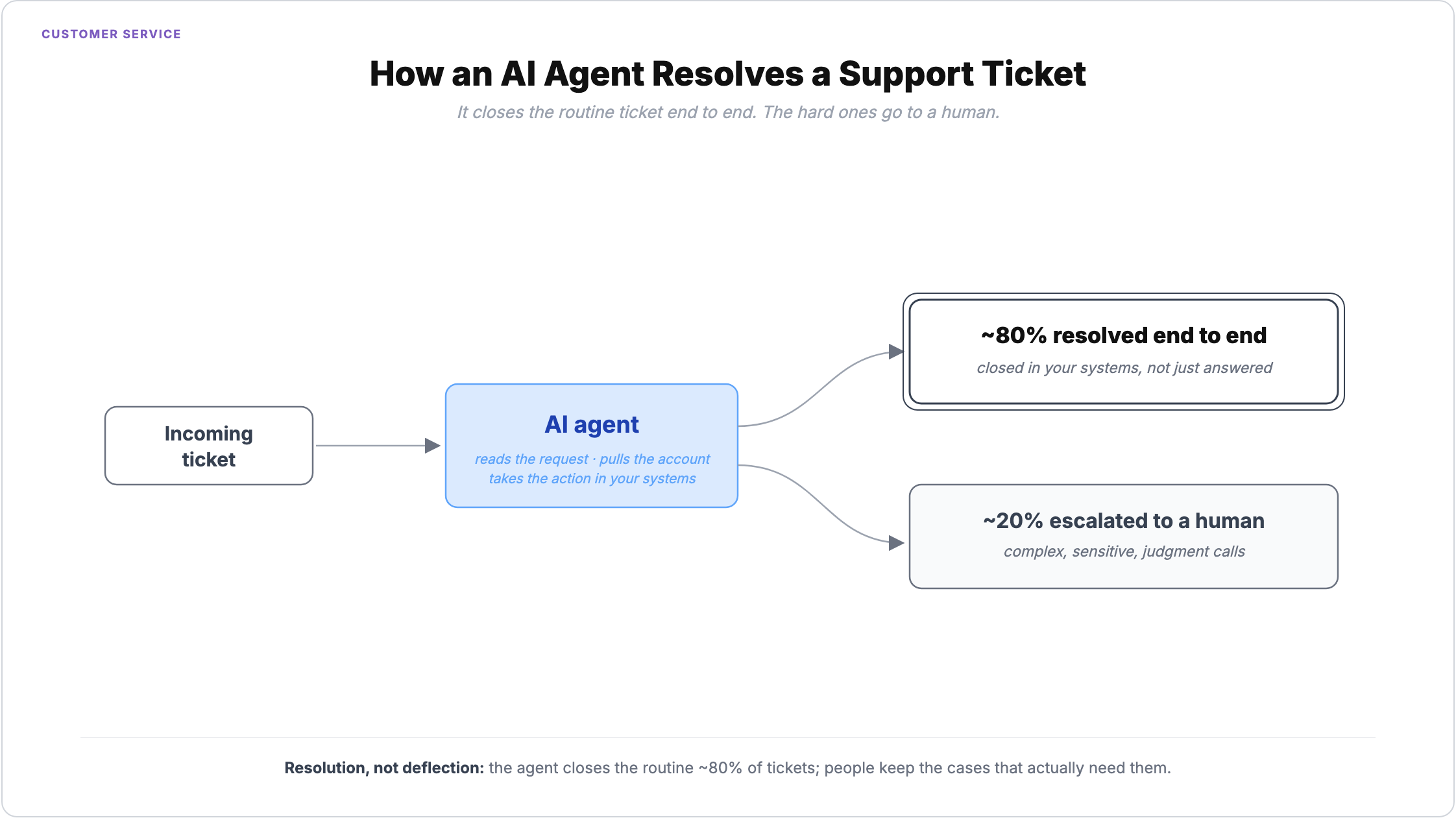
An AI customer service agent does more than deflect a ticket to an FAQ. It resolves the routine request end to end: it reads what the customer wants, pulls the account, takes the action, and replies, while a human handles the judgment calls.
That is the difference between a chatbot and an agent, and it is why customer service is one of the clearest places AI agents pay off in 2026. Here is what AI agents in customer service actually automate, the results, and where humans still belong.
What is an AI customer service agent?
An AI customer service agent is software that handles a support request as a multi-step task, not a single reply. It understands the intent, looks up the relevant data, decides the next action, and completes it, with a person reviewing the exceptions.
The distinction from a chatbot matters. A chatbot answers a question or routes the ticket; an agent actually does the thing the customer asked for, like updating an address, processing a return, or reissuing an invoice.
That is why agents move the numbers a chatbot never could. They close tickets instead of forwarding them.
What AI agents actually automate in customer service
The wins are the high-volume, rule-heavy requests that fill a support queue.
Order and account status — looking it up and answering with the real data.
Account changes — address updates, plan changes, resets, done directly in the system.
Returns, refunds, and reissues — the routine transactions, end to end.
Triage and routing — reading the ticket and sending the rest to the right human.
Multilingual support — the same agent handling requests across languages.
The pattern is always the same: the agent owns the routine volume, and the hard cases go to a person.
The results AI customer service agents deliver
These are production numbers, not projections. A hospitality operator handles 5,750 guest interactions a month across 6 agents, the kind of volume that used to require a much larger team.
In a regulated setting, the effect is just as sharp. At Avi Medical, a healthcare provider, Beam agents automate 81% of patient inquiries, around 3,000 a week.
The knock-on metrics are the point. There, median response time dropped 87%, cost per inquiry fell 93%, and NPS rose 9%. Across support deployments, agents commonly resolve around 80% of routine tickets while holding 95%-plus accuracy on the edge cases that do get through.
Chatbot vs AI agent: why the difference matters
Most "AI customer service" that disappointed teams was a chatbot in a new coat. It answered, deflected, or escalated, and the actual work still landed on a person.
An agent is judged on resolution, not deflection. It reads the request, takes the action in your systems, and closes the loop, so the ticket is done, not just acknowledged.
That is the line to watch when you evaluate a tool. Ask whether it resolves the request or just responds to it.
Where humans still belong in customer service
Being clear about the limits is what makes the automation trustworthy. Agents should own the routine, not the sensitive.
The angry customer, the complex complaint, the judgment call on a goodwill refund, the moment that needs empathy: those stay with people. An agent that tries to handle them erodes the trust the fast, accurate routine work built.
The right design keeps humans on exactly those cases and frees them to do it well, because they are no longer buried in password resets.
How to deploy AI agents in customer service
The pattern that works is consistent across teams. Agents sit on top of the helpdesk and CRM you already run, so there is nothing to replace.
They follow your existing macros and policies, and a human stays on the exceptions. You need permissions scoped to the task and an audit trail on every action, which is why a governed agent platform matters more than the model underneath.
Most teams reach a live customer service agent in 4 to 6 weeks. The takeaway for 2026 is that AI agents in customer service are past the chatbot era: the ones worth deploying resolve the routine work end to end, and hand your team the cases that actually need a human.