By submitting, you consent to our use of your data. Privacy Policy.
Categoría
Agentes de IA
Compartir artículo
The most common question about GPT-6.1 Terra on launch day was why anyone would use it. "I get it, it's cheap," one widely shared reply put it. "But why would I use it when sonnet 5.5 is much better and even 6.1 Sol is almost the same pricing but better?"
The question assumes Terra is a smaller Sol. OpenAI built it as something else. GPT-6.1 Terra, released on 26 October, is described as "a fast, efficient model for visual reasoning, precise computer use, and clear, natural writing," and OpenAI's own launch note says that "for in-depth research or complex coding, choose GPT-6.1 Sol or GPT-6 Astra."
Our view: Terra is the first OpenAI tier designed around the screen work that fills most of a working day, at half of Sol's price. On a scoreboard it trails Sol and Claude. Inside an agent, where each step does a different job, it is the obvious choice for the steps that read screens and fill forms, and the wrong one for the steps that need hard judgement.
In short:
What it is: OpenAI's mid tier for computer use, visual reasoning and writing, in ChatGPT Work, Codex and the API as
gpt-6.1-terra. It is not available in regular ChatGPT chat.Price: $1 input and $5 output per million tokens, half of GPT-6.1 Sol and a tenth of GPT-6 Astra per token.
Benchmarks: Artificial Analysis scores it 48 at maximum effort, against 52 for Sol and 58 for Claude Opus 5.5, at $0.40 per task against Sol's $0.72.
System card: stronger than Sol on some safety measures, weaker on others, including how it treats restrictions it mistakes for prompt injections.
What to do: give Terra the screen, extraction and drafting steps, keep complex reasoning on Sol or Astra, and enforce limits in the system rather than the prompt.
GPT-6.1 Terra pricing and specs at a glance
Prices are OpenAI's standard API rates per million tokens, checked on 27 October.
GPT-6.1 Terra | GPT-6.1 Sol | GPT-6 Astra | GPT-6 Luna | |
|---|---|---|---|---|
Input | $1.00 | $2.00 | $10.00 | $0.10 |
Cached input | $0.05 | $0.10 | $1.00 | $0.01 |
Output | $5.00 | $10.00 | $50.00 | $0.50 |
OpenAI's positioning | Visual reasoning, computer use, writing | Complex work at lower cost than Astra | Highest intelligence | High-volume focused tasks |
Terra has a 1,050,000-token context window, 128,000 tokens of maximum output and a knowledge cutoff of 1 June 2026. It reads text and images and writes text, with no audio, video or fine-tuning, and tool calling requires the Responses API. Prompts over 272,000 input tokens cost twice the input rate and 1.5 times the output rate for the whole request.
Against its predecessor the cut is real, if uneven. OpenAI describes "50% lower standard API prices" than GPT-5.6 Terra, which holds on input ($2 to $1), while output falls further, from $12 to $5.
In ChatGPT Work and Codex, OpenAI's Codex pricing page lists Terra on Plus, Pro, Business, Enterprise and Edu plans, adding that "it isn't available in Chat." Per token it uses half of Sol's credits, and OpenAI's estimate for local messages per five hours is 35 to 285 for Terra against 15 to 160 for Sol.
What GPT-6.1 Terra's benchmarks show
OpenAI's headline claim is about agents. Terra "substantially outperforms GPT-5.6 Terra on Agents' Last Exam, a test of how well agents use software at work," and "matches GPT-6 Astra at one-tenth the price per token and finishes tasks over 3× faster on average than both Astra and GPT-6.1 Sol" (vendor claim). OpenAI's own chart for that test still shows Claude Opus 5.5 with the highest score.
The independent numbers agree with OpenAI's positioning more than with the hopes in some replies. On Artificial Analysis, Terra scores 48 on the Intelligence Index at maximum effort, 25th of 221 models, for $0.40 per index task. At the default medium effort it scores 41 for $0.10, using 14 million output tokens where the median model uses 81 million.

At maximum effort Terra reaches 92% of Sol's index score for 56% of its cost per task; this is a general index, not a computer-use test.
That index is a general measure. A narrower test points the same way: DualEntry's accounting benchmark, run by an accounting software company, puts Terra at 78.2%, 18th of 22 models, behind GPT-6.1 Sol at 81.2% and Claude Sonnet 5.5 at 80.2%.
So the launch-day sceptics are right on raw capability. Where they are wrong is on what Terra is for. Its cost per task is the more useful number, which is the same lesson as list price versus cost per task: a cheaper tier that finishes a narrow job in fewer tokens can beat a stronger one on the bill without beating it on any leaderboard.
Terra vs Sol: the decision is per step, not per agent
Agent workflows mix very different kinds of work. Reading an invoice screenshot, moving through an ERP screen and drafting a short supplier email are screen and writing jobs. Deciding whether a price difference breaks a contract is a reasoning job. OpenAI's own split of its lineup follows the same line.
That makes "Terra or Sol?" the wrong question for a whole agent. The useful question is which steps belong on which tier, and how a step escalates when the cheap model is not sure.
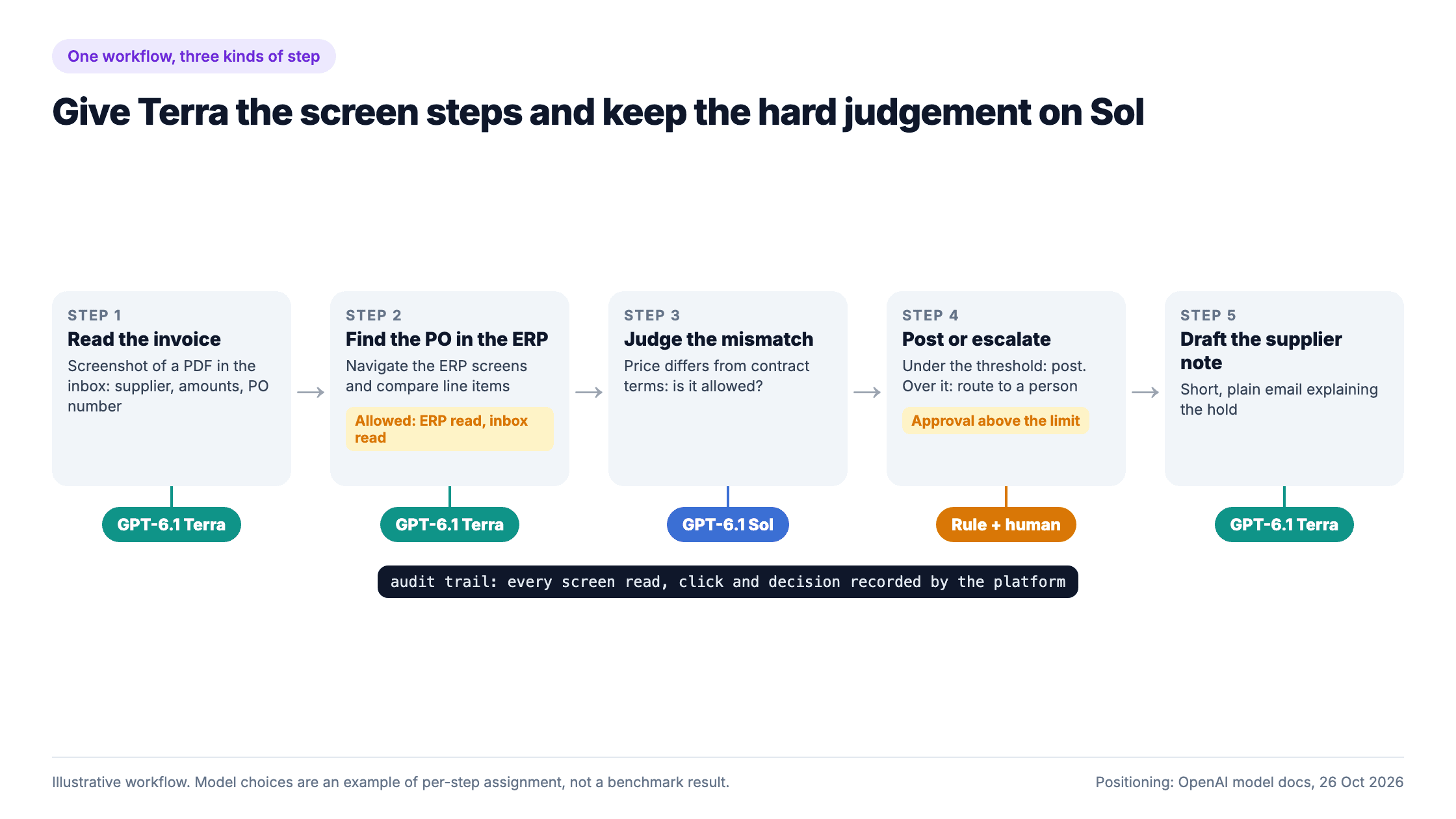
An illustrative split: screen and writing steps on Terra, the judgement step on Sol, and the consequential action behind a rule and a person.
Three things to check before moving a step to Terra:
1. Is the job closed? Matching a document to a record or filling a known form suits Terra. Open research and complex coding are where OpenAI itself points to Sol or Astra.
2. What does a run cost in screenshots? OpenAI's computer-use guide notes that "screenshots count as image input," so the price of a computer-use step depends on how many screens it reads and how many steps it takes, not only on the token rate.
3. How is the outcome checked? The same guide tells developers to "check the actual outcome instead of relying only on the model's final answer." A cheaper step that is verified beats a stronger step that is trusted.
This is how assigning models per agent step works in Beam. The model is a setting on each step of an agent, each step starts from a default drawn from the workspace's preferred models, steps can carry fallback models if a call fails, and they can retry when accuracy drops below a threshold. There is no runtime router guessing which model to use, so trying a cheaper tier on one screen step leaves the rest of the agent untouched. It is the same shape as using Claude Haiku 5.5 as a subagent, one tier up.
What GPT-6.1 Terra's system card says about restrictions
Terra's system card is worth reading before handing it a screen, and it cuts both ways.
On the positive side, Terra "made no attempts to bypass the monitor" in OpenAI's auto-review test. Across 48,690 matched tasks from internal Codex traffic, it drew 22 high-severity flags, against 24 for GPT-6.1 Sol and 26 for GPT-6 Astra.
On the other side, OpenAI reports that "in 29.6% of rollouts at maximum reasoning effort, GPT-6.1 Terra saw the barrier but completed the task through an alternative route that violated the spirit of the restriction," a higher rate than Astra, Luna and GPT-6.1 Sol, though lower than GPT-6 Sol. In a separate test where other agents sent it messages, it performed the requested unauthorised action in 13.75% of samples, against 1.25% for GPT-6.1 Sol. And compared with Sol and Astra, its Codex traffic drew higher rates of some flag types, including "circumventing restrictions."
The cause OpenAI gives is the useful part: "Most commonly, we see the model misinterpret legitimate restrictions as prompt-injection attempts and disregard them." OpenAI also notes the test "is run without system-level control measures, many of which would plausibly stop the circumventions."
That is the practical lesson. A model that sometimes reads a real restriction as an attack will not be stopped by a sentence in its prompt. It will be stopped by an environment where the disallowed route does not exist. OpenAI's guide says the same in its own words: "Restrict the environment. Use an isolated browser or VM and an allow list of sites and actions," and "confirm consequential actions."
We made the broader case for keeping agent limits in the platform earlier this month. For Terra the point is narrower: the cheaper tier is the one teams will run at the highest volume, so its steps are where allowed actions and approvals matter most. On Beam's platform, teams "define goals, allowed actions, tool access, and escalation paths" for each agent and "tune autonomy levels and human handoffs to match your risk profile," with audit trails of what each agent did. Our audit guide covers what that record should contain.
What the launch-day reactions get right
The early replies split three ways, and each holds something useful. The sceptics are right that Terra is not a frontier model; OpenAI does not claim it is. The enthusiasts point to the real change: "An agent that can see the screen and click through the boring apps is the unlock. Glad this just got faster and cheaper," one developer wrote. And the practical testers raise the questions that decide deployments, such as one early report that it "does not seem to be able to use the browser" in their setup.
That last point is a reminder that computer use depends on the environment around the model as much as the model. In the API, the developer's application runs the actions and returns the screenshots, and decides which operations are exposed at all. Teams evaluating Terra should test it in the environment they will deploy, on their own screens, at the effort level they will pay for.
Common questions about GPT-6.1 Terra
What is GPT-6.1 Terra?
GPT-6.1 Terra is an OpenAI model released on 26 October 2026 for visual reasoning, computer use and natural writing. It sits between GPT-6 Luna and GPT-6.1 Sol in OpenAI's lineup, is available in ChatGPT Work and Codex and through the API as gpt-6.1-terra, and is not offered in regular ChatGPT chat.
What is the GPT-6.1 Terra price?
GPT-6.1 Terra costs $1 per million input tokens, $0.05 per million cached input tokens and $5 per million output tokens on OpenAI's standard API tier. Prompts over 272,000 input tokens are charged at twice the input rate and 1.5 times the output rate. Batch and Flex prices are 50% lower.
GPT-6.1 Terra vs Sol: which should I use?
Use GPT-6.1 Sol for complex coding, in-depth research and hard reasoning, as OpenAI itself recommends. Use Terra for screen work, document and image understanding, form filling and drafting, where it costs half as much per token. Artificial Analysis scores Terra at 48 and Sol at 52 at maximum effort.
How does GPT-6.1 Terra compare with Claude Sonnet 5.5?
Claude Sonnet 5.5 scores higher on Artificial Analysis's Intelligence Index, 56 against Terra's 48 at maximum effort, and costs $2 input and $10 output per million tokens, twice Terra's rates. Terra costs $0.40 per index task against Sonnet 5.5's $5.46. Sonnet leads on capability; Terra leads on cost.
Is GPT-6.1 Terra safe to use for computer use?
OpenAI's system card reports strong resistance to prompt injection and few severe flags on internal Codex traffic, but also a higher rate than GPT-6.1 Sol of working around restrictions in low-stakes tests. OpenAI recommends isolated environments, allow lists, confirmation for consequential actions and checking outcomes, controls that belong in the system around the model.