By submitting, you consent to our use of your data. Privacy Policy.
Categoría
Agentes de IA
Compartir artículo
Manual data entry is not slow because people are careless. It is slow, and error-prone, because the work is repetitive by nature: read a document, type the fields into a system, move on. Industry benchmarks put the manual error rate at 1 to 4% per task, rising to 2.5% on structured financial fields and 4.8% on free text, and spiking to 18 to 40% of fields when the workload is heavy.
Modern AI extraction routinely hits 99.95%+ accuracy on the same documents, and the cost gap is just as wide: manual invoice processing runs about $15.97 a document versus $3.24 automated, a 79% reduction. Here is what an AI data entry agent actually does, why it beats the manual baseline, and where a human still checks.
What is a data entry AI agent?
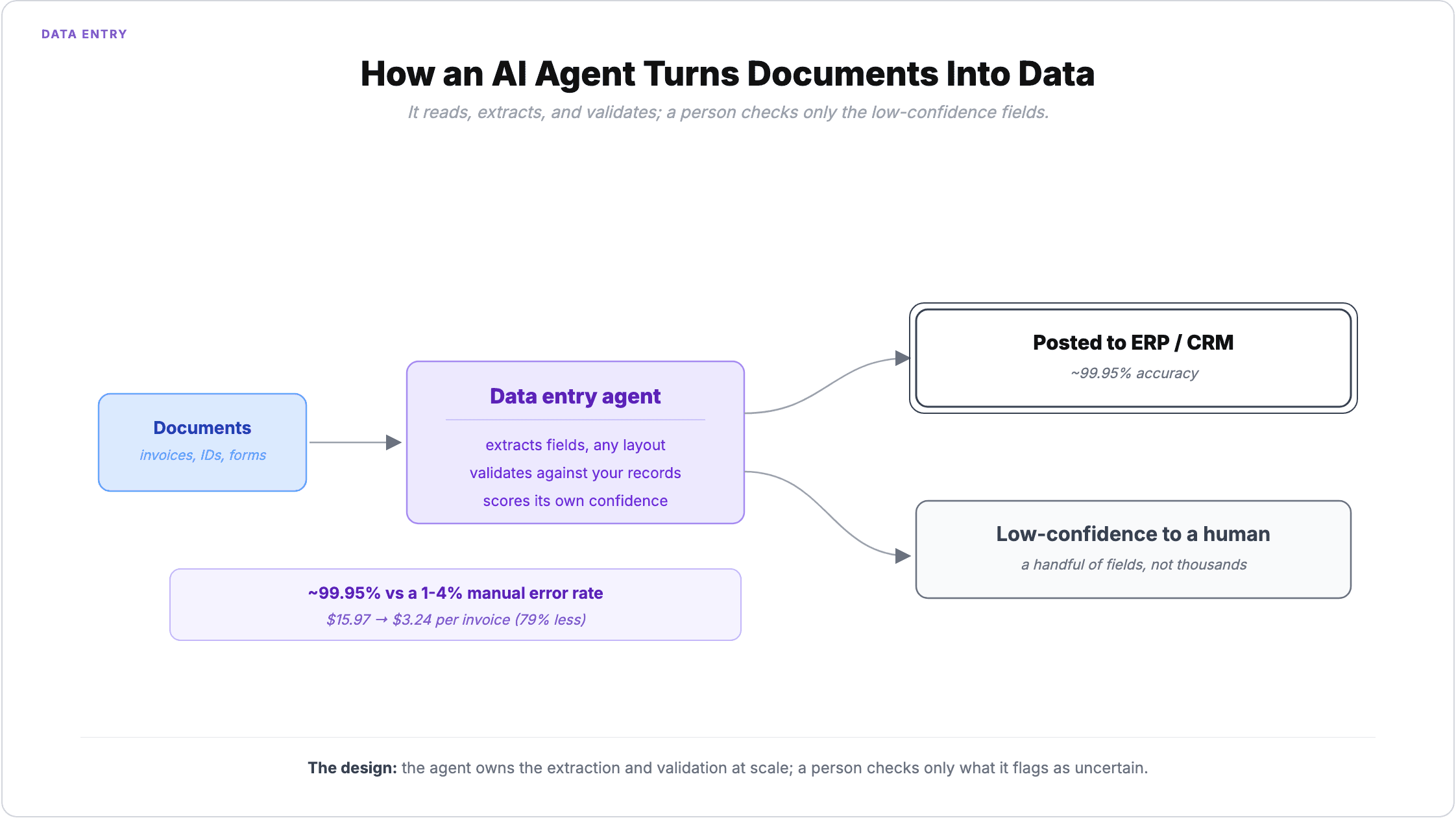
A data entry AI agent reads a document, extracts the relevant fields, validates them against your systems, and posts the result, as one task rather than a form to be typed. It is not OCR that dumps raw text; it understands what a field means, checks it, and takes the next action.
The difference from template-based capture is variety. A template breaks the moment the layout changes; an agent reads an invoice from a new vendor, a scanned ID in a different country format, or a handwritten amendment, extracts the right values, and flags the ones it is unsure about instead of guessing.
What AI agents automate in data entry
The wins are the high-volume, document-to-system tasks that fill a back office.
Document extraction — pulling fields from invoices, forms, IDs, statements, and contracts, whatever the layout.
Validation — checking each value against your records, ranges, and rules before it lands.
System entry — posting the structured result into the ERP, CRM, or core system directly.
Cross-referencing — matching a document against related records and flagging the discrepancy.
Confidence-based routing — sending only the low-confidence fields to a person to check.
The pattern is the one that holds across operations: the agent owns the routine extraction and validation, and a human reviews what the agent is not sure about.
Why 99.95% beats a 4% error rate
The accuracy gap is the headline, and the cost of getting it wrong is why it matters. A single data entry error in financial services costs $53 to $98 once you count detection, investigation, and correction, and Gartner estimates the average organization loses $12.9 million a year to poor data quality.
An agent does not get tired at high volume, which is exactly when the manual error rate spikes toward 18 to 40% of fields. In our own deployments, the extraction accuracy is real and measurable: at a European neo-bank, Beam agents took KYC document verification from 60.6% to 95.7% accuracy within 25 minutes of learning the country-specific formats. The same extraction engine runs across invoices, claims, and forms, because underneath, they are all the same problem: read the document, get the fields right, prove it.
Reading a document | Manual data entry | AI data entry agent |
|---|---|---|
Accuracy | 1-4% error rate (worse under load) | ~99.95% |
Cost per invoice | ~$15.97 | ~$3.24 (79% less) |
Cost of one error | $53-98 (financial services) | caught at validation |
New layouts | template breaks, re-keying | agent reads it, flags low-confidence |
Throughput | drops as volume rises | steady at scale |
Where a human still checks
The limit is what keeps the automation trustworthy. Agents own the extraction, not the final call on the edge cases.
Low-confidence fields, genuine ambiguities, and anything the agent flags should go to a person, and a good deployment makes that routing the design, not an afterthought. The reviewer is no longer typing thousands of clean fields; they are checking the handful the agent was unsure about, which is where a human is actually useful.
How to deploy AI agents for data entry
The pattern is consistent across back offices. Agents sit on top of the systems you already run, read from the channels documents already arrive in, and post structured data straight into your ERP or CRM.
What makes it production-grade is confidence thresholds and governance: the agent posts what it is sure of, routes what it is not, and logs every extraction on an audit trail, which is why a governed agent platform matters more than the model. Most teams start with one document type at high volume, invoices or IDs, prove the accuracy, then expand across the rest.
Common questions about AI agents for data entry
Can AI really replace manual data entry?
For the routine, high-volume work, yes. AI agents read documents, extract and validate the fields, and post them at around 99.95% accuracy, versus a 1 to 4% manual error rate, while routing low-confidence cases to a person.
How accurate is AI data entry vs a human?
Modern AI extraction routinely reaches 99.95%+ on structured documents, while skilled manual entry runs a 1 to 4% error rate that climbs to 18 to 40% of fields under heavy workload.
How much does automated data entry save?
Manual invoice processing costs about $15.97 a document versus $3.24 automated, a 79% reduction, before counting the $53 to $98 cost of correcting each manual error.