4 دقيقة قراءة
AI Agents for HR and Recruiting in Saudi Arabia: Hiring for Saudization


By submitting, you consent to our use of your data. Privacy Policy.
Category
وكلاء الذكاء الاصطناعي
Share the article
In Saudi Arabia, recruiting is no longer just about filling roles. It is about filling them with the right mix to stay compliant, because the 2026 to 2028 Nitaqat cycle raised Saudization quotas across sectors and tied them to a moving target of documentation. Miss the band and the penalty is direct: a Red-status employer faces restrictions on visas, contract renewals, and government tenders.
That turns HR and recruiting into a high-volume, compliance-heavy operation, which is exactly where AI agents earn their place. Here is what agents automate for Saudi employers hiring under Saudization, and where HR still needs a person.
What Saudization now demands of HR
The rules got sharper in 2026. The new Nitaqat phase, effective 26 April 2026, aims to localise more than 340,000 additional private-sector jobs by 2028, with sector quotas rising: engineering firms at 30% (with a SAR 8,000 minimum salary to count), accounting climbing toward 70% by 2030, marketing and sales at 60%, procurement at 70%, and 69 administrative roles fully reserved for Saudi nationals.
The compliance mechanics changed too. From 15 April 2026, a Saudi employee only counts toward the quota if their contract is electronically documented and authenticated on the Qiwa platform, and the minimum wage to count rose from SAR 3,000 to SAR 4,000. Registration alone is no longer enough, which means HR now carries a continuous documentation and monitoring load on top of the hiring itself.
What AI agents automate for Saudi HR and recruiting
The work splits into three high-volume streams, all of them a fit for agents.
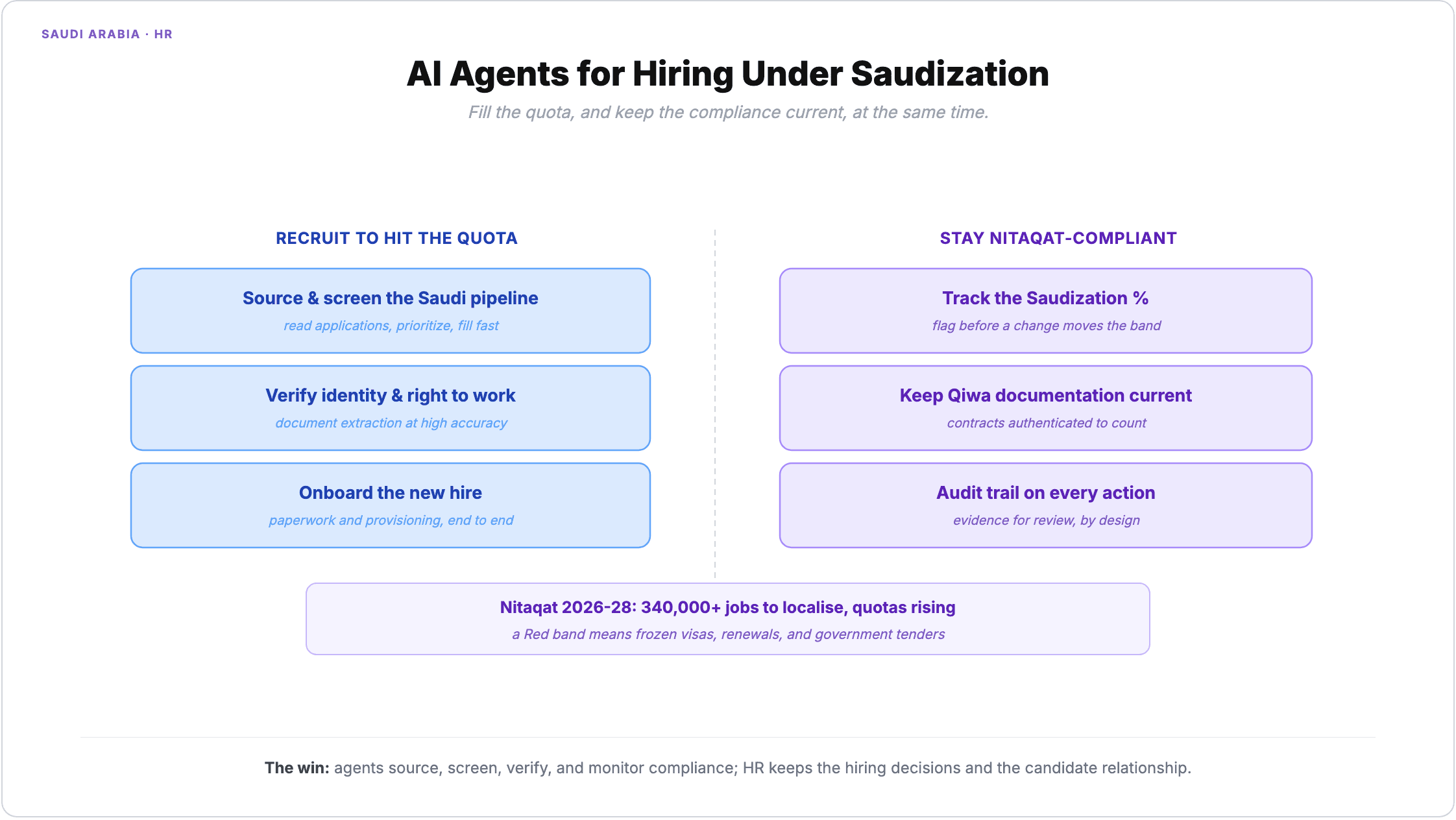
Sourcing and screening to hit quota — reading applications, screening candidates, and prioritizing the Saudi-national pipeline so roles fill fast enough to hold the band.
Identity and right-to-work verification — reading and verifying documents, the same extraction that takes KYC-style verification from error-prone manual work to high accuracy.
Saudization tracking and Qiwa documentation — monitoring the live Saudization percentage, flagging when a hire moves the band, and keeping contract documentation current on Qiwa.
The pattern is the one that holds across operations: the agent owns the high-volume processing and the compliance monitoring, and HR keeps the human decisions.
Saudization workload | Manual HR | With an AI agent |
|---|---|---|
Sourcing to quota | slow, band at risk | screened, prioritized Saudi pipeline |
Identity / right-to-work | error-prone re-keying | verified at high accuracy |
Saudization % tracking | periodic and reactive | monitored live, flagged early |
Qiwa documentation | manual, easy to lapse | kept current and authenticated |
Audit trail | rebuilt from files | logged on every action |
Why the compliance angle is the real win
Recruiting speed matters, but the sharper edge in Saudi Arabia is staying compliant while you hire. A quota that depends on live Qiwa documentation and a minimum-wage threshold is easy to fall out of by accident, and the cost of a Red band is measured in frozen visas and lost tenders.
An agent that tracks the Saudization percentage in real time, keeps documentation authenticated, and flags a risk before it drops the band turns a reactive scramble into a monitored process. Every action is logged, which is exactly the audit trail a regulator or an internal review will ask for. This is where recruiting automation and governance overlap, and where a governed platform matters more than any single model.
Where HR still needs a person
The limit keeps the automation trustworthy. Agents own the processing and the monitoring, not the judgment.
Final hiring decisions, the candidate relationship, sensitive cases, and the strategic calls on workforce planning stay with HR. The agent clears the sourcing, screening, verification, and compliance tracking so the team spends its time on the people, not the paperwork.
How to deploy AI agents for HR in Saudi Arabia
The pattern is the same one that works across regulated operations. Agents sit on top of the ATS, HRIS, and the Qiwa and GOSI systems you already use, follow your existing policies, and keep a human on the exceptions.
Governance is non-negotiable here: permissions scoped to the task, an audit trail on every verification and documentation action, and control over where personal data lives. Beam already works with Saudi institutions, including a partnership with Saudi Arabia's RDI to drive AI transformation across enterprises, and the same governed platform runs the HR and recruiting work. Most teams start with sourcing-and-screening or Saudization tracking, prove it, then expand.
Common questions about AI agents for HR in Saudi Arabia
How do AI agents help with Saudization compliance?
They monitor the live Saudization percentage, keep contract documentation authenticated on Qiwa, and flag when a hire or departure risks moving the Nitaqat band, with every action logged for audit, so compliance becomes a monitored process rather than a periodic scramble.
Can AI agents speed up hiring Saudi nationals?
Yes. Agents read applications, screen candidates, and prioritize the Saudi-national pipeline, so roles fill fast enough to hold the quota band, while final hiring decisions stay with HR.
Is AI recruiting compliant with Saudi data rules?
It can be, on a governed platform. Permissions are scoped to the task, every verification is logged, and personal data stays under your control, which is what a regulated Saudi deployment requires.