By submitting, you consent to our use of your data. Privacy Policy.
Category
وكلاء الذكاء الاصطناعي
Share the article
Accounts payable is one of the most expensive back-office functions to run by hand, and invoice processing is the reason. The average company spends about $15.97 to process a single invoice manually and around 12 minutes doing it, with roughly 22% of invoices hitting an exception that needs a human to chase.
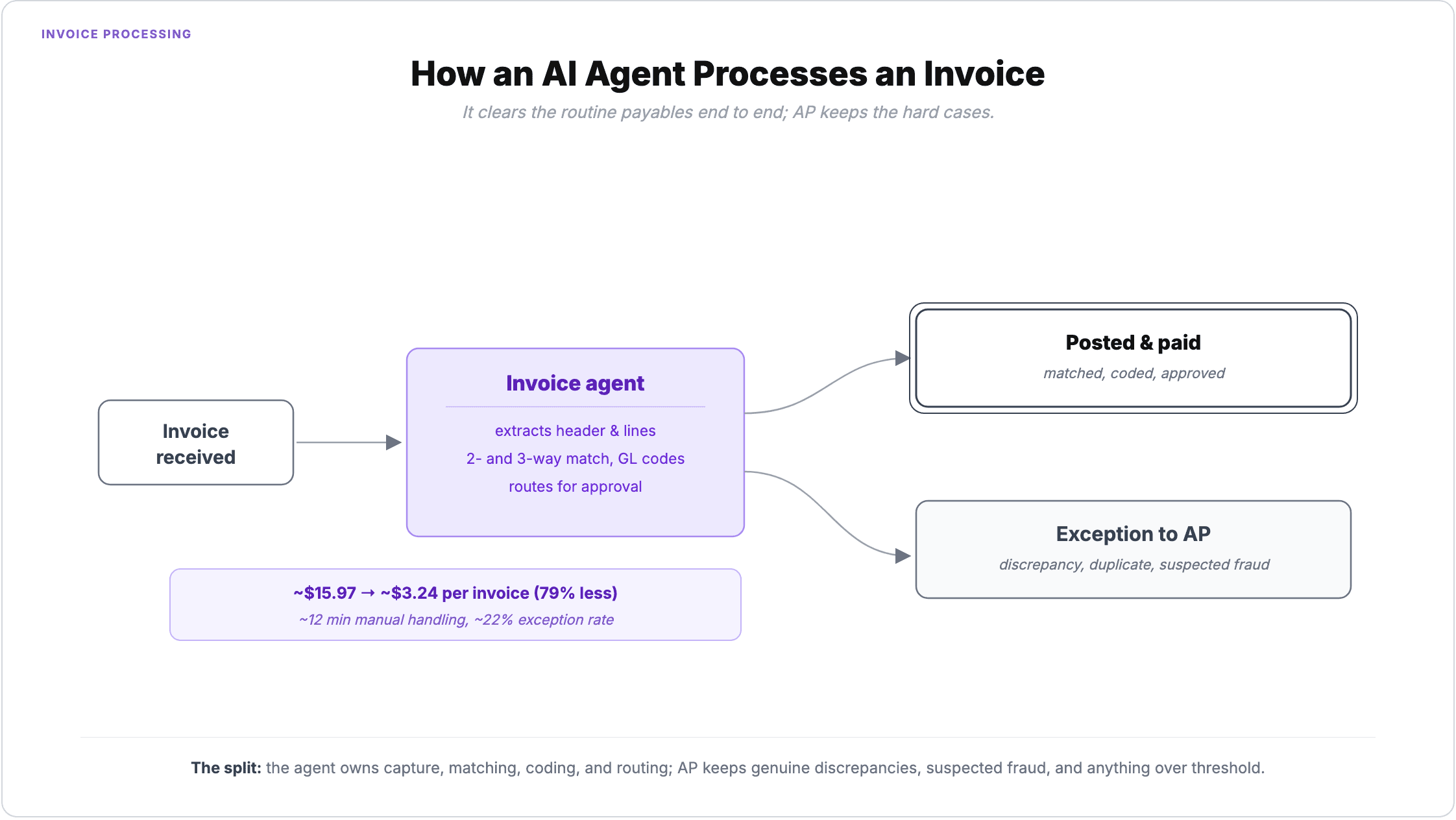
An AI agent takes that cost to about $3.24 a document, a 79% reduction, by handling the capture, matching, coding, and routing end to end. Here is what an invoice processing agent actually does, the numbers, and where AP still needs a person.
What is an invoice processing AI agent?
An invoice processing AI agent handles a payable as a multi-step task: it reads the invoice, extracts the line items, matches it to the PO and the goods receipt, codes it to the right account, and routes it for approval, with a person handling the exceptions.
The difference from OCR-plus-rules is the messy middle. A rules engine handles the clean, templated invoice; an agent reads a new vendor's format, resolves a line that does not match the PO quantity, and flags the discrepancy with an explanation instead of dropping the whole invoice into an exception queue.
What AI agents automate in invoice processing
The wins are the high-volume steps that fill an AP queue.
Capture and extraction — reading header and line-item data from any invoice format or channel.
Two- and three-way matching — reconciling the invoice against the PO and goods receipt.
GL coding — coding the invoice to the right account and cost center.
Approval routing — sending each invoice to the right approver with the context attached.
Exception handling — explaining the mismatch and resolving what it can before escalating.
The pattern holds: the agent owns the routine processing and the explainable exceptions, and AP keeps the judgment calls.
What it actually saves
The cost gap is the headline. Manual invoice processing runs about $15.97 a document versus $3.24 automated, and the manual baseline carries a 22% exception rate and roughly 12 minutes of handling per invoice.
The effect compounds at enterprise scale. At a global insurer, Beam agents took invoice processing from 30 to 60 minutes down to minutes, cut total processing time 47%, and let 200 full-time roles move to higher-value work, running order-to-cash across 26 countries at 93% task accuracy. The model is not the differentiator there; the orchestration and the audit trail are.
Per invoice | Manual AP | AI agent |
|---|---|---|
Cost | ~$15.97 | ~$3.24 (79% less) |
Handling time | ~12 minutes | minutes, unattended |
Exception rate | ~22% to a human | agent resolves the explainable ones |
Matching | line-by-line by hand | 2- and 3-way, automated |
Audit trail | rebuilt from notes | captured on every action |
Where AP still needs a person
The limit is what keeps it safe to run. Agents own the processing, not the final call on the hard cases.
Genuine discrepancies, suspected duplicate or fraudulent invoices, new-vendor risk, and anything above a set threshold should go to an AP specialist. A good deployment routes exactly those to a person and clears everything else, so the team stops keying invoices and starts managing the exceptions that matter.
How to deploy AI agents for invoice processing
The pattern is the same across finance operations. Agents sit on top of the ERP and AP systems you already run, follow your existing coding rules and approval matrix, and keep a human on the exceptions.
Governance is what makes it auditable: permissions scoped to the task, an audit trail on every match and payment action, and control over thresholds, which is why a governed agent platform matters more than the model. Most teams start with PO-backed invoices, prove the match rate, then expand to non-PO and exceptions.
Common questions about AI agents for invoice processing
What does an invoice processing AI agent do?
It captures and extracts invoice data, runs two- and three-way matching against the PO and goods receipt, codes the invoice, routes it for approval, and resolves or escalates exceptions, handling the routine volume end to end.
How much does AI invoice processing save?
Manual invoice processing costs about $15.97 a document versus $3.24 automated, a 79% reduction, before counting the time saved on a ~22% manual exception rate and ~12 minutes of handling per invoice.
Does an AI agent replace the AP team?
No. It automates capture, matching, coding, and routing, while AP specialists handle genuine discrepancies, suspected fraud, and anything above the approval threshold.